
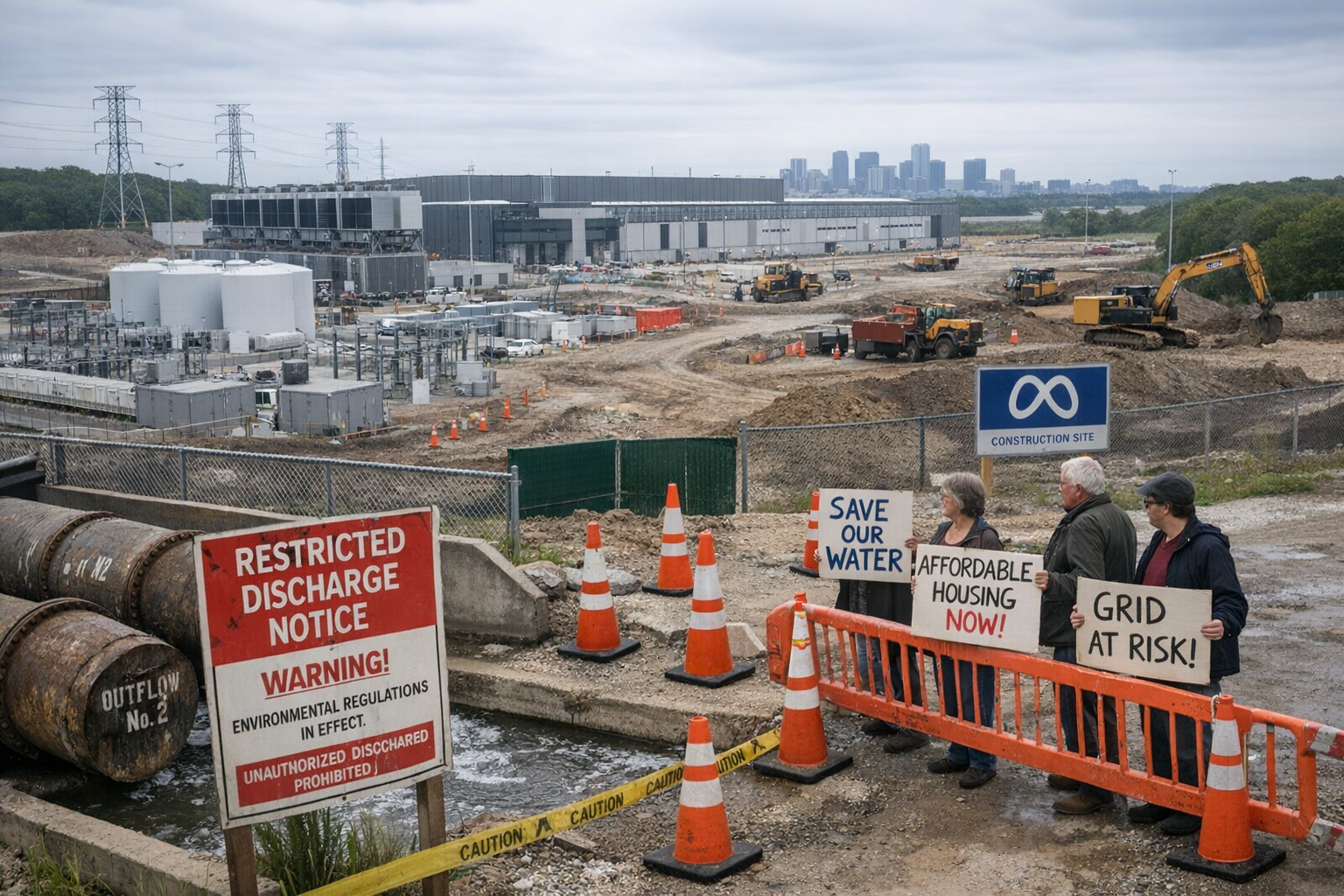
A wastewater scare in Wyoming has sharpened a widening backlash against AI data centers
The political fight over the infrastructure behind artificial intelligence is entering a new phase, as a wastewater contamination incident in Wyoming and fresh planning battles in Britain underscore how local resistance to data centers is broadening from abstract unease to concrete fights over water, housing and electricity.
In Cheyenne, city utility officials said a rare bacterium, *Cupriavidus gilardii*, was traced to an industrial user connected to construction of Meta’s new data center, prompting authorities to permanently revoke that user’s discharge privileges and tighten rules for how wastewater from such projects is handled. Officials said drinking water was not affected, and Meta said it had shifted wastewater hauling offsite and was working with local authorities to be “a good neighbor.”
Still, the episode has become something more consequential than an isolated construction problem. It has given local governments a real-world example of the kinds of utility and environmental risks that can accompany the rapid buildout of AI facilities, whose immense computing demands require sprawling campuses, heavy construction, vast electricity supplies and, in many cases, large volumes of water.
Cheyenne’s Board of Public Utilities resumed reuse-water irrigation only after remediation, according to local officials, and the city has since suspended or tightened acceptance of certain wastewater discharges tied to data-center activity. That matters because it turns a theoretical policy debate into an operational one: permitting conditions, utility access and construction practices are now being reconsidered in response to an actual contamination event.
From niche opposition to mainstream local politics
The Wyoming dispute arrives as data-center projects are running into tougher resistance elsewhere, particularly in Britain, where opponents are increasingly framing the issue not only as one of energy demand and carbon emissions, but of land use and community priorities.
In east London, campaigners are fighting a proposed data center at the Truman Brewery site near Brick Lane, arguing that one of the city’s most pressured neighborhoods needs affordable housing more urgently than digital infrastructure serving finance and AI industries. The project remains in a government-called-in planning process after local rejection, making it an early test of whether national growth ambitions will override municipal objections.
For critics, the symbolism is potent: in an area known for immigrant history, small businesses and a long-running housing squeeze, a large data center has come to represent a model of development that consumes land while creating relatively few local jobs and offering little relief to residents struggling with rents and displacement.
That same tension is now evident in Scotland, where the Scottish National Party’s national council has backed a moratorium on new hyperscale data centers pending an impact review. The motion is not yet government policy, but it has raised the stakes for Britain’s broader AI strategy by suggesting that one part of the United Kingdom may seek to pause the buildout altogether until the infrastructure costs are better understood.
Supporters of the freeze have pointed to claims that proposed hyperscale projects could collectively require at least 6,000 megawatts of power, more than double Scotland’s peak electricity usage, according to the parliamentary motion behind the push. Whether or not that figure becomes the basis for policy, it captures the scale of the concern: these are not ordinary commercial developments, but facilities that can reshape grid planning, land allocation and local environmental burdens.
The strain on climate promises
The latest disputes also land at a difficult moment for the technology industry’s climate commitments. As companies race to secure computing capacity for generative AI, the energy requirements of new data centers are colliding with their public pledges to cut emissions and rely on clean power.
That tension has become particularly visible in Britain after scrutiny of a flagship Lanarkshire “AI growth zone,” where reporting found that the project could not meet its advertised renewable-energy promise as originally presented. The controversy has fed skepticism over whether governments and developers are overselling how easily AI expansion can be squared with climate goals.
Across the industry, the problem is becoming harder to paper over. Data centers require continuous, reliable power, and in many markets clean energy supplies are already constrained. Even where companies buy renewable-energy credits or sign long-term power contracts, local opponents increasingly argue that what matters is the immediate effect on grids, backup generation, water systems and nearby communities.
A global buildout meets local limits
Resistance to data-center expansion is no longer sporadic. Around the world, projects have been challenged over noise, transmission lines, historical preservation, water use, tax incentives and electricity demand. In the United States alone, at least 75 projects worth roughly $130 billion were blocked or delayed in the first quarter of 2026, according to recent reporting — about as many as in all of 2025.
That surge suggests a shift in the politics of AI infrastructure. For years, data centers were often treated as obscure back-end facilities, welcomed by officials eager for investment and tax revenue. But the rise of AI has made them larger, more power-hungry and more visible. In many places, residents now see them less as neutral engines of innovation than as industrial developments being imposed on communities with insufficient scrutiny.
The Wyoming case may prove especially important because it is not just about aesthetics, emissions projections or fears of future strain. It involves a specific public-utility response to contamination tied to an AI-related construction project. If other municipalities begin revisiting sewer, water or discharge rules for data-center sites, the implications could extend well beyond one Meta campus.
What comes next
Much remains uncertain. It is not yet clear whether Cheyenne’s tougher wastewater posture will be copied elsewhere or remain a local exception. In Britain, the key questions are political: whether Scottish ministers act on the moratorium push, and whether national officials eventually approve the Brick Lane project despite local opposition.
But taken together, the disputes point to a deeper challenge for governments and technology companies alike. The race to build AI capacity is colliding with the practical limits of place: finite grids, finite water systems, contested urban land and increasingly skeptical voters.
For the industry, the promise of AI still rests on the assumption that the underlying infrastructure can be built fast enough to support it. In Wyoming, London and Scotland, that assumption is looking more fragile.
Sources
Further reading and reporting used to add context:
- https://www.techradar.com/pro/a-very-very-unpleasant-surprise-meta-forced-to-halt-data-center-water-discharges-after-polluting-citys-water-reclamation-system-with-resistant-bacterium-shutdown-and-cleaning-of-two-water-reclamation-plants-expected-to-last-months
- https://www.theguardian.com/uk-news/2026/jul/07/scotland-could-freeze-datacentre-projects-in-challenge-to-uks-ai-strategy
- https://www.tomshardware.com/tech-industry/data-centers/cheyenne-suspends-data-center-fill-and-flush-and-closed-loop-discharges-after-meta-contractor-contaminated-its-reuse-water-system
- Ministers call in £500m Brick Lane data centre plan | LocalGov
- https://www.parliament.scot/chamber-and-committees/votes-and-motions/S7M-00419
- https://wyomingdatacenterfacts.com/2026/07/02/meta-linked-company-goat-systems-loses-cheyenne-sewer-access-after-contamination/
- https://www.datacenterdynamics.com/en/news/snp-backs-national-data-center-moratorium-in-scotland/
- https://www.theguardian.com/us-news/2026/jul/08/meta-datacenter-ai-wyoming-water
- https://www.techspot.com/news/113041-cheyenne-suspends-datacenter-wastewater-after-rare-bacterium-traced.html
- https://www.eastlondonlines.co.uk/2026/05/opposition-mounts-to-brick-lane-data-centre-plans-as-reed-decision-awaited/
- https://cowboystatedaily.com/2026/07/02/cheyenne-wont-take-data-center-wastewater-after-meta-company-contaminated-system/
- https://towerhamletsslice.co.uk/whitechapel/protesters-demand-homes-not-brick-lane-data-centre-truman-brewery/
- https://www.nelondoner.co.uk/news/17022026-brick-lane-redevelopment-decision-still-pending-as-campaigners-await-government-ruling
- https://www.reddit.com/r/uknews/comments/1uqnxyh/curry_bagels_and_ai_londoners_fight_plan_for_huge/
- https://www.reddit.com/r/techbeat/comments/1upfnz0/cheyenne_bans_data_center_wastewater_discharges/
- https://www.towerhamlets.gov.uk/lgnl/planning_and_building_control/planning_applications/search_and_comment_planning_applications.aspx
- https://www.gov.scot/policies/renewable-and-low-carbon-energy/renewables-obligation/
- https://www.gov.scot/binaries/content/documents/govscot/publications/foi-eir-release/2026/02/foi-202500492202/documents/foi-202500492202—information-released—annex/foi-202500492202—information-released—annex/govscot%253Adocument/FOI%252B202500492202%252B-%252BInformation%252Breleased%252B-%252BAnnex.pdf
- https://www.gov.scot/publications/british-industrial-competitiveness-scheme-bics-changes-renewables-obligation-scotland-order-2009/pages/6/
- https://democracy.towerhamlets.gov.uk/documents/s42926/6.4g%20Additional%20App2.%20Inspectors%20Report%20on%20LBTH%20Examination%20into%20the%20Managing%20Development%20Local%20Pla.pdf
- https://www.gov.scot/binaries/content/documents/govscot/publications/foi-eir-release/2025/04/foi-202500453159/documents/foi-202500453159—information-released—documents/foi-202500453159—information-released—documents/govscot%3Adocument/FOI%2B202500453159%2B-%2BInformation%2Breleased%2B-%2BDocuments.pdf
- https://digitalconnectivity.campaign.gov.scot/green-data-centres
- https://www.gov.scot/binaries/content/documents/govscot/publications/foi-eir-release/2025/07/foi-202500458424/documents/eir-202500458424—information-released—annex-a/eir-202500458424—information-released—annex-a/govscot%3Adocument/EIR%2B202500458424%2B-%2BInformation%2Breleased%2B-%2BAnnex%2BA.pdf
- https://www.gov.scot/news/muirbuirn-licence-scheme/
- https://www.gov.scot/policies/nuclear-energy/nuclear-stations/
- https://www.gov.scot/publications/foi-202500480120/
- https://www.gov.scot/policies/renewable-and-low-carbon-energy/heat-networks/
- https://www.gov.scot/binaries/content/documents/govscot/publications/foi-eir-release/2026/02/foi-202500491029/documents/eir-202500491029—information-released—annex-a—c/eir-202500491029—information-released—annex-a—c/govscot%3Adocument/EIR%2B202500491029%2B-%2BInformation%2Breleased%2B-%2BAnnex%2BA%2B-%2BC.pdf
- https://www.towerhamlets.gov.uk/Documents/Planning-and-building-control/Strategic-Planning/Neighbourhood-Planning/Spitalfields%20Neighbourhood%20Planning%20Forum%20%26%20Area%20Application%20supporting%20information%20Part_1_NEW.pdf
- https://www.gov.scot/publications/local-government-finance-circular-1-2026-settlement-for-2026-to-2027/
- https://www.gov.scot/publications/energy-consents-how-to-apply/
- https://www.gov.scot/policies/oil-and-gas/unconventional-oil-and-gas/
- https://www.gov.scot/publications/business-regulatory-impact-assessment-unconventional-oil-gas-policy/
- https://www.theguardian.com/us-news/2026/jul/03/datacenter-recall-elections
- https://www.theguardian.com/technology/2026/jul/06/britain-ai-growth-zones-explainer
- https://www.theguardian.com/uk/scotland/2026/jul/06/all
- https://www.theguardian.com/us-news/2026/jul/05/ratepayer-protection-act-datacenters
- https://www.theguardian.com/technology/2026/jul/07/stymied-datacentre-projects-threaten-global-ai-revolution
- https://www.theguardian.com/technology/2026/mar/09/revealed-uks-multibillion-ai-drive-is-built-on-phantom-investments
- https://www.theguardian.com/uk/london/2026/jul/07/all
- https://www.theguardian.com/technology/technology%2Btheguardian/mainsection
- https://www.theguardian.com/world/2026/mar/11/wednesday-briefing-from-missing-billions-to-nonexistent-datacentres-inside-britains-ai-drive
- https://www.theguardian.com/us-news/2026/jun/06/new-york-datacenter-temporary-ban
- https://www.theguardian.com/politics/2026/mar/09/key-takeaways-on-ai-phantom-investments-uk
- https://usadvertising.theguardian.com/assets/files/client-facing-2024-editorial-calendar_-updated-03_14_24.pdf
- https://usadvertising.theguardian.com/assets/files/the-guardian-us-brand-safety-white-paper-%281%29-%281%29-%281%29.pdf
- https://advertising.theguardian.com/assets/files/media-kit-2026-1772022840.pdf
- https://advertising.theguardian.com/assets/files/rate-card-2026-%281%29.pdf
- https://www.industrywirewyoming.com/executive-report
- https://www.breitbart.com/tech/2026/07/07/metas-massive-wyoming-ai-data-center-contaminates-cheyennes-wastewater-treatment-system-with-rare-bacteria/amp/
- https://lakelandgazette.info/news/2026/07/05/meta-data-center-water-discharges-suspended-after-contaminating-the-citys-reclamation-water-supply-with-bacterium-system-offline-for-months-for-cleaning-closed-loop-cooling-system-purge-s/
- https://vuink.com/post/gbzfuneqjner-d-dpbz/tech-industry/data-centers/cheyenne-suspends-data-center-fill-and-flush-and-closed-loop-discharges-after-meta-contractor-contaminated-its-reuse-water-system
- Notice Regarding Discharge to the Sanitary Sewer System – City of Cheyenne BOPU
- https://www.wyomingenvironmentaltimes.com/executive-report
- https://cowboystatedaily.com/2026/07/07/cheyenne-board-of-public-utilities-stays-silent-on-data-center-sewer-contamination-2/
- https://www.inc.com/georgia-fearn/meta-cheyenne-ai-data-center-isnt-open-already-triggered-wastewater-crackdown/91370878
- https://www.readers.id/en/cheyenne-suspends-data-center-wastewater
- https://www.watereducation.org/aquafornia-news/cheyenne-wont-take-data-center-wastewater-after-meta-contractor-contaminated-system
- https://www.reddit.com/r/techbeat/comments/1unid9v/cheyenne_blocks_data_center_wastewater_after_meta/
- https://wyoleg.gov/InterimCommittee/2026/SWC-2026050615-02CityofCheyenneContractwithGoatSystemsLLC.pdf
- https://cheyenneleads.org/wp-content/uploads/2026/04/Data-Center-Facts-April-14-2026.pdf
- https://www.reddit.com/r/technology/comments/1uqssi1/cheyenne_suspends_datacenter_wastewater_after/
- US residents angry at datacenters ‘being shoved down our throats’ are recalling officials | Datacenters | The Guardian











Leave a Reply