

A Labor Reckoning Arrives With A.I.
The workplace disruptions long forecast in the age of artificial intelligence are beginning to take a more concrete form: not simply as abstract warnings about the future of work, but as altered daily tasks, announced layoffs and a fresh appetite for collective action in industries that once viewed unions with suspicion.
In software engineering, workers say the craft of the job is already changing. In newsrooms, executives are now invoking A.I. directly to justify cuts. And in the technology sector, where high salaries and lavish perks long helped keep organized labor at bay, employees are increasingly turning to petitions and union campaigns as they try to shape how A.I. is deployed — and who pays the price for it.
Taken together, the developments suggest that A.I.’s labor effects are no longer theoretical. They are arriving unevenly, but across a widening front.
Engineers Fear the Loss of the Work That Trained Them
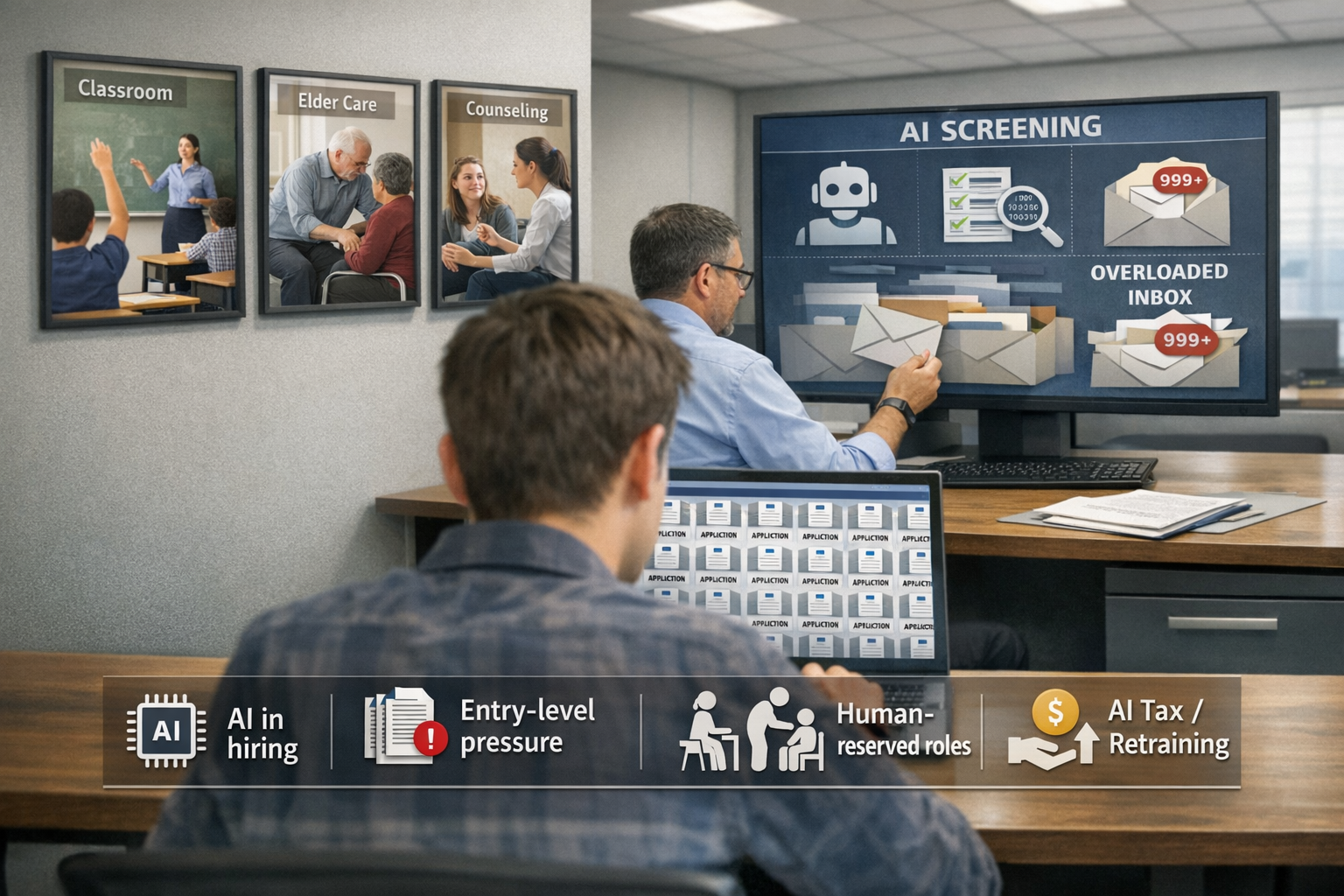
For many software engineers, the anxiety is not only that jobs may disappear. It is that the work itself is being hollowed out.
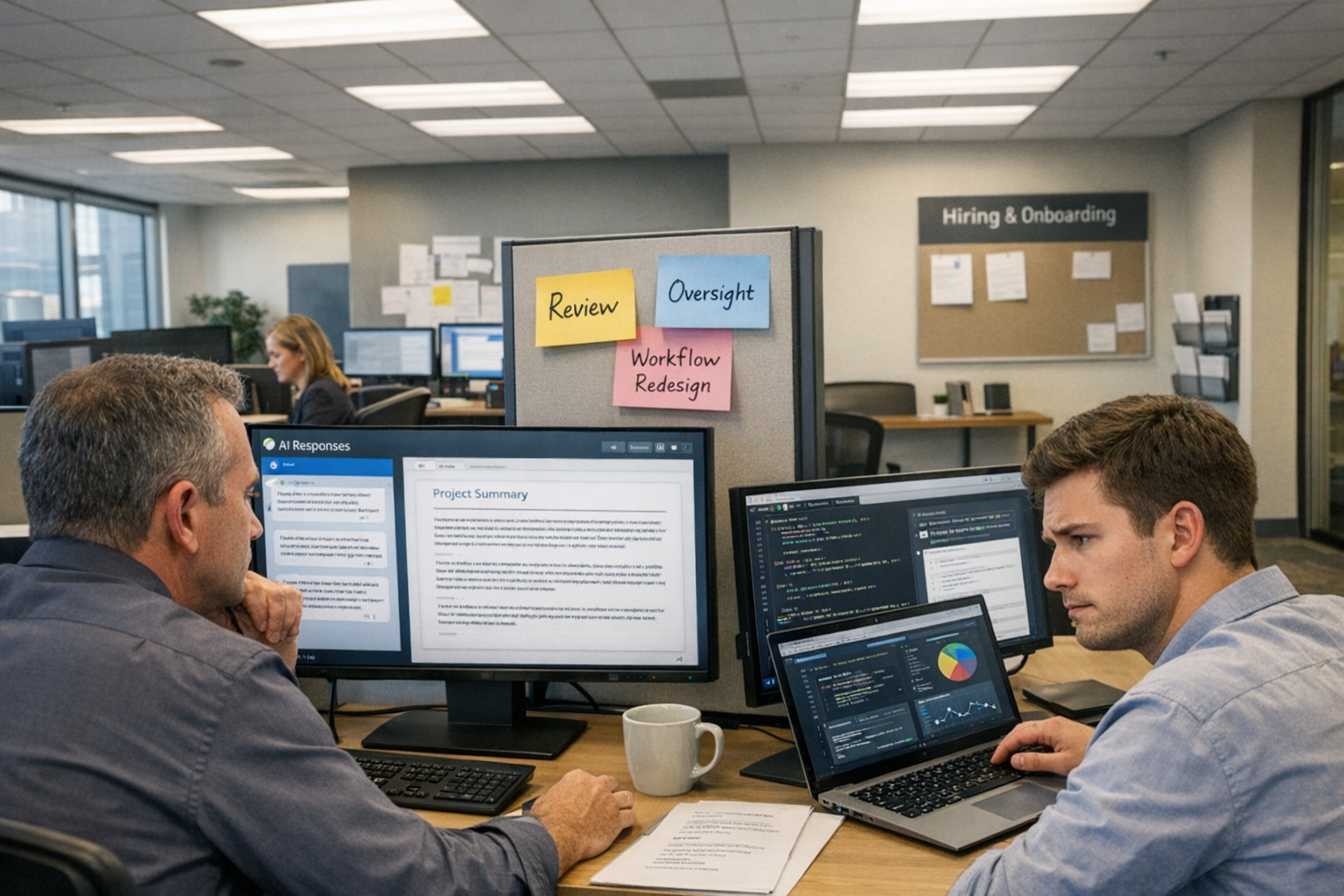
Some engineers say their roles have shifted from writing code and designing systems to reviewing machine-generated output, a change they fear could erode the very skills that made them valuable. One engineer described deliberately coding a personal project by hand, resisting A.I. assistance in order to “keep my axe sharp.” The concern is less nostalgia than professional survival: if software tools increasingly perform the entry-level and midlevel tasks through which engineers learn, what happens to the pipeline that turns junior programmers into experienced ones?
That question is beginning to draw attention beyond worker anecdote. A July 2026 preprint argued that generative A.I. may be absorbing many of the lower-level tasks that historically served as training grounds for younger engineers. If that dynamic persists, the technology could do more than speed up coding. It could alter how expertise is formed.
For employers, this may look like efficiency. For workers, it can feel like deskilling — a redefinition of high-skill labor into oversight of systems they did not fully build and may not fully trust.
The uncertainty is whether this marks a permanent degradation of engineering work or a transition to a different hierarchy of skills, with more value placed on systems design, judgment and supervision of A.I. tools. But the sense of professional dislocation is already real.
Newsrooms Face a More Immediate Shock
The strain is perhaps most visible in media, where A.I. is colliding with a business model that was already fragile.
Nine Entertainment, Australia’s largest media company, said this month that it would cut about 30 newsroom positions at The Sydney Morning Herald and The Age, blaming what it called an “extreme state of disruption” caused by artificial intelligence. Management presented the move as an adaptation to structural change, not merely another round of cost cutting.
That distinction may matter less to journalists facing redundancy than to investors and executives trying to explain it. The economic pressures on publishers predate the chatbot boom: weak advertising markets, declining referral traffic and years of digital restructuring have all battered the industry. But A.I. is adding a new and increasingly explicit pressure point.
Publishers now face the possibility that readers will get summaries, headlines or conversational answers from chatbots rather than visiting news sites directly. Research from the Reuters Institute found that weekly use of A.I. chatbots for news reached 10 percent globally in 2026, and 16 percent among people under 35. For media companies dependent on audience traffic for subscription growth and advertising revenue, those numbers are ominous.
In that sense, the newsroom layoffs are about more than internal automation. They also reflect a fear that A.I. is reshaping how information is distributed, weakening the economic foundations of journalism at the same time that it introduces new tools into editorial work.
From Individual Adaptation to Collective Demands
If the first phase of the A.I. labor story centered on workers trying to adapt — learn new tools, protect their résumés, stay employable — a second phase is now emerging, one defined by collective demands.
At Google, more than 4,500 workers recently delivered a petition seeking stronger layoff protections. In Britain, employees at Google DeepMind have moved toward unionization, driven by concerns that extend beyond job security to include the uses of the technology itself, including military applications and workplace surveillance. The Alphabet Workers Union and allied organizers say anxiety around A.I.-driven restructuring has helped mobilize campaigns for severance guarantees, buyouts and greater worker input.
This is a notable shift in an industry that long styled itself as post-union: meritocratic, flexible and too well compensated to need organized labor. But those assumptions have weakened as layoffs have spread and workers have felt themselves losing influence over the products they build and the terms under which those products are deployed.
A.I. has sharpened that tension. Employees are being asked not only to create systems that may reduce head count, but in some cases to accept heavier workloads while those same systems are used to measure productivity or justify reorganization.
Whether this wave of organizing leads to formal bargaining power remains uncertain. Petitions and union drives can generate visibility without securing recognition or enforceable protections. And companies may move faster with A.I.-led restructuring than labor campaigns can respond.
Still, the significance lies in the change of posture. In parts of tech, workers are no longer relying solely on personal reinvention to weather A.I. They are testing whether collective power can slow, redirect or at least soften the consequences.
Anxiety Spreads Faster Than Answers
The result is a broader climate of job anxiety that now cuts across classically “safe” knowledge professions. Engineers, editors and technical managers — workers once thought relatively insulated from automation — are confronting a version of vulnerability more often associated with other sectors.
Yet even now, the scale of A.I.’s direct impact remains hard to isolate. Some layoffs attributed to A.I. may also reflect older corporate habits: trimming costs, consolidating teams, responding to weak markets or pursuing strategic restructuring under a more fashionable label. The technology is clearly becoming part of management’s vocabulary for change, but that does not mean it is always the sole cause.
What is clearer is that A.I. has moved from speculative promise to workplace force. It is changing what skilled workers do all day. It is being cited in decisions about who stays and who goes. And it is pushing some employees — especially in tech — toward forms of solidarity that would have seemed improbable not long ago.
For years, the debate over artificial intelligence and jobs turned on dramatic predictions. Now the story is becoming more ordinary, and more consequential: an engineer practicing by hand on the train ride home, a reporter facing a redundancy notice, a tech worker signing a petition for protections that did not once seem necessary.
That may be how labor transformations really arrive — not all at once, but through altered routines, shrinking head counts and a growing realization that the future of work is no longer ahead. It is already in the office.
Sources
Further reading and reporting used to add context:
- https://www.pcgamer.com/hardware/over-4-500-google-workers-have-signed-a-petition-calling-for-layoff-protections-these-layoffs-and-cuts-are-not-difficult-decisions-but-simply-profit-being-put-over-the-people-that-make-this-company-run/
- Nine to axe 30 jobs at the Age and SMH due to ‘extreme’ AI disruption | Nine Entertainment | The Guardian
- https://www.wired.com/story/google-deepmind-workers-vote-to-unionize-over-military-ai-deals/
- https://www.investing.com/news/stock-market-news/us-judge-wont-block-meta-from-laying-off-workers-who-filed-ai-discrimination-lawsuit-4798876
- https://www.theguardian.com/technology/ng-interactive/2026/feb/19/ai-work-future
- https://www.theguardian.com/technology/series/reworked
- https://www.theguardian.com/technology/technology%2Bartificialintelligenceai
- https://au.finance.yahoo.com/news/axe-fall-jobs-nine-010729872.html
- https://mediagazer.com/260721/p5
- https://www.alphabetworkersunion.org/press/alphabet-workers-union-statement-on-meta-layoffs
- https://themeridiem.com/ai/2026/5/5/ai-ethics-shift-from-protest-to-power-as-deepmind-workers-unionize
- https://www.reddit.com/r/aiwars/comments/1uuz7x0/how_software_engineers_are_having_to_adapt_to_ai/
- https://www.cbsnews.com/news/26-meta-workers-sue-ai-aided-layoffs-medical-family-leave/?ftag=CNM-00-10aab4i&intcid=CNI-00-10aaa3a
- https://arxiv.org/abs/2607.17067
- https://www.80.74.31.215.sslip.io/global-development/workers–rights
- https://get.chainguard.dev/hubfs/Assets/2026%20Engineering%20Reality%20Report.pdf
- https://arxiv.org/abs/2606.05608
- https://arxiv.org/abs/2605.23135
- https://arxiv.org/abs/2601.21305
- https://www.reddit.com/r/GenAI4all/comments/1uyrwpv/26_meta_employees_are_suing_the_company_claiming/
- https://www.reddit.com/r/Futurology/comments/1uzqdz6/thousands_of_google_workers_demand_layoff/
- Chasing new skills, going back to basics and pushing for collective action: how software engineers are adapting to AI | AI (artificial intelligence) | The Guardian
- https://www.theguardian.com/technology/software
- https://www.theguardian.com/technology/2026/jul/12/all
- https://www.theguardian.com/technology/artificialintelligenceai/2026/jul/12/all
- https://www.theguardian.com/technology/series/reworked/2026/jul/12/all
- https://www.theguardian.com/technology/technology%2Bcontent/interactive
- https://www.theguardian.com/technology/technology%2Btechnology?page=4
- https://www.theguardian.com/technology/computing
- https://www.theguardian.com/technology/technology%2Bartificialintelligenceai?page=2
- https://www.theguardian.com/technology/artificialintelligenceai
- https://www.theguardian.com/us/technology
- https://recruiters.theguardian.com/assets/files/inclusive_recruitment/The-Guardian-Jobs-guide-to-inclusive-recruitment.pdf
- https://advertising.theguardian.com/assets/files/media-kit-2026-1772022840.pdf
- https://recruiters.theguardian.com/assets/files/hr_tech/HRTechGuide_GuardianJobs.pdf
- https://usadvertising.theguardian.com/assets/files/the-guardian-us–corporate-sustainability_-consumer-sentiments-research-x-script.pdf
- https://ausadvertising.theguardian.com/assets/files/guardianadvertising_shift_happens_au_2025.pdf
- https://advertising.theguardian.com/assets/files/rate-card-2026-%281%29.pdf
- https://reutersinstitute.politics.ox.ac.uk/digital-news-report/2026/emerging-uses-ai-chatbots-news-and-what-it-means-journalism
- https://reutersinstitute.politics.ox.ac.uk/digital-news-report/2026/dnr-executive-summary
- https://reutersinstitute.politics.ox.ac.uk/digital-news-report/2026
- https://reutersinstitute.politics.ox.ac.uk/news/our-podcast-digital-news-report-2026-episode-4-how-people-are-using-ai-chatbots-news
- https://www.edelman.com/reuters-institute-digital-news-report-2026
- https://reutersagency.com/digital-news-report-2026-launch-events
- https://reutersinstitute.politics.ox.ac.uk/digital-news-report/2025/dnr-executive-summary
- https://www.epra.org/news_items/key-findings-from-the-digital-news-report-2026
- https://reutersinstitute.politics.ox.ac.uk/es/digital-news-report/2026/usos-de-chatbots-ia-en-noticias-y-periodismo
- https://reutersinstitute.politics.ox.ac.uk/es/digital-news-report/2026/dnr-resumen-ejecutivo
- https://pondero.ai/news/2026-06-20-reuters-institute-digital-news-report-2026/
- https://reutersinstitute.politics.ox.ac.uk/es/digital-news-report/2026
- https://cdn1.tenchat.ru/static/vbc-gostinder/2026-06-23/0d999abb-2574-48a4-b7d9-cec8c17a0f12.pdf
- https://frittord.no/attachments/12d8a0bd999be94177f92b959c091a9f75435e06/551-20260616020953475697.pdf
- https://arxiv.org/abs/2605.22785
- https://arxiv.org/abs/2606.15708
- https://www.reddit.com/r/aussie/comments/1uzpp6n/is_this_really_that_surprising/
- https://arxiv.org/abs/2601.11072
- https://en.wikipedia.org/wiki/Generative_AI
- https://en.wikipedia.org/wiki/Automated_journalism
- https://www.reddit.com/r/Journalism/comments/1u982yv/news_creators_and_journalisms_trust_problem/
- https://www.reddit.com/r/aiwars/comments/1ozv1r1/countries_that_are_most_and_least_comfortable/
- https://www.reddit.com/r/learnmachinelearning/comments/1o3dee1
- https://www.reddit.com/r/u_enoumen/comments/1o3dfxx
- https://www.theguardian.com/technology/2026/jul/16/google-workers-layoff-protections-ai
- https://www.theguardian.com/technology/2026/jun/18/ai-threatens-gig-work-rise
- https://www.theguardian.com/us-news/2026/may/04/google-deepmind-uk-workers-union
- https://www.theguardian.com/technology/2026/may/20/google-deepmind-talks-uk-unions-ai-use-israel-us-defence
- https://www.theguardian.com/technology/all
- https://www.theguardian.com/us-news/us-unions
- https://www.theguardian.com/technology/2026/jun/05/labour-will-make-ai-work-for-workers-liz-kendall
- https://www.theguardian.com/business/technology
- Google DeepMind workers in UK vote to unionize amid deal with US military | US news | The Guardian





Leave a Reply