
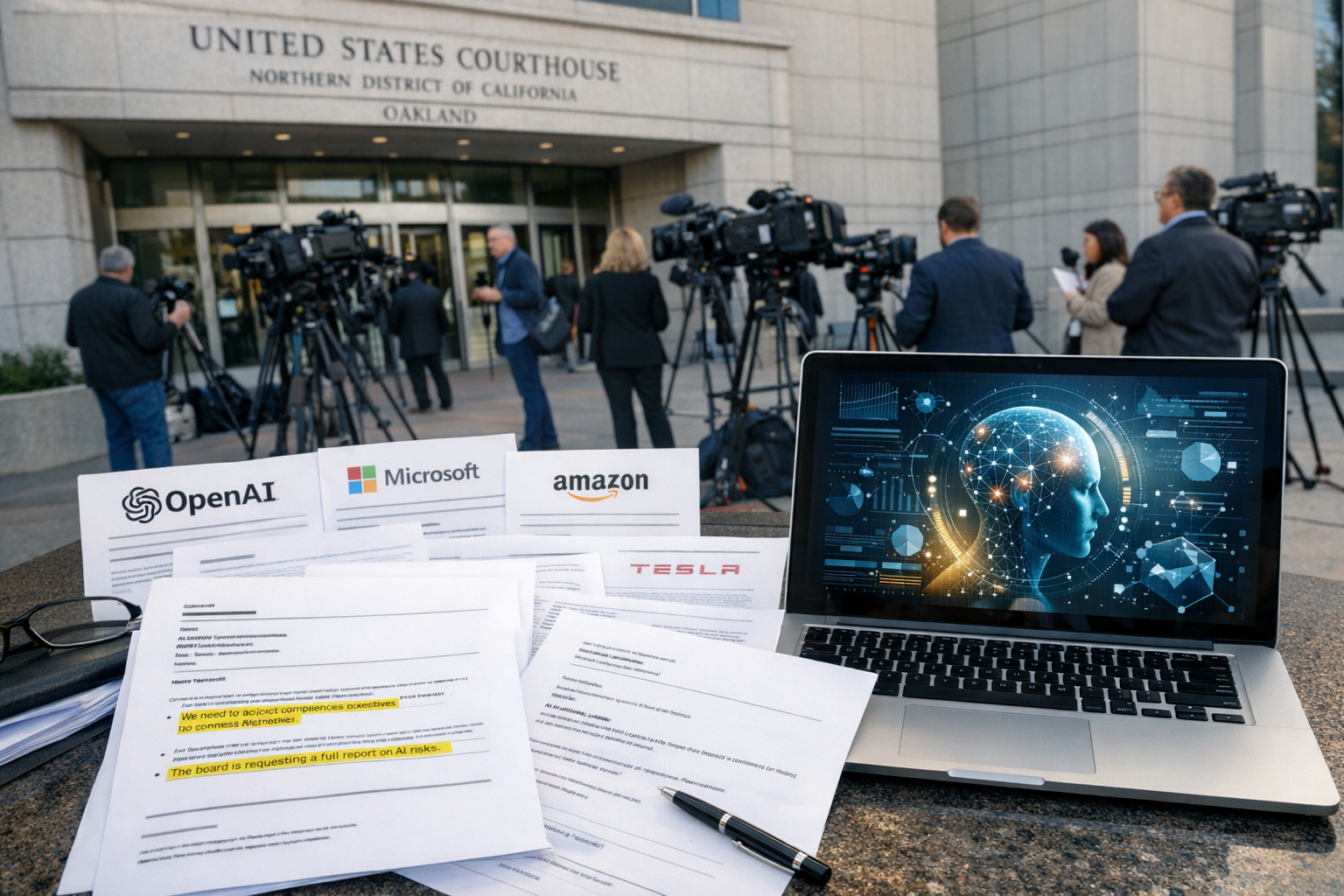
New evidence sharpens the central fight in Musk’s case against OpenAI
The second week of Elon Musk’s trial against OpenAI has shifted the case from a familiar argument about the company’s founding ideals into a more pointed examination of power, motive and strategic maneuvering inside the artificial intelligence industry.
In federal court in Oakland, Calif., lawyers for OpenAI introduced testimony and internal documents meant to undercut Mr. Musk’s portrayal of himself as a betrayed co-founder who gave millions to a nonprofit venture that later abandoned its mission. Instead, the company’s legal team has sought to show that Mr. Musk had ambitions of his own: to influence OpenAI’s direction, potentially draw it closer to Tesla and, at one point, even try to recruit Sam Altman into his orbit.
At the same time, newly aired internal Microsoft emails have complicated the narrative around OpenAI’s rise. The messages suggest that Microsoft executives were not simply captivated by OpenAI’s promise when the relationship began to deepen. They were skeptical of the company and of Mr. Altman, according to evidence shown in court, but also worried that failing to engage could leave OpenAI aligned more closely with Amazon.
Taken together, the disclosures have opened a new phase in the case, one that goes beyond the origin story of OpenAI and asks what each of the principal players truly wanted as artificial intelligence became one of Silicon Valley’s most consequential battlegrounds.
OpenAI presses its case on Musk’s motives
Mr. Musk sued OpenAI, Mr. Altman, Greg Brockman and Microsoft in 2024, accusing them of steering OpenAI away from its founding charitable mission and toward private profit. He has testified that he contributed roughly $38 million in OpenAI’s early years and believed the organization was meant to prioritize broad human benefit over commercial gain.
But testimony this week sought to recast that history.
Shivon Zilis, a former OpenAI board member with longstanding ties to Mr. Musk, testified that he had explored folding OpenAI into Tesla, according to accounts from the courtroom. She also described discussions in which Mr. Musk considered offering Mr. Altman a seat on Tesla’s board, evidence OpenAI is using to argue that his present claims are entangled with earlier efforts to exert influence over the company and its leadership.
That line of argument goes to the heart of the case. If OpenAI can persuade the court that Mr. Musk was not merely a disillusioned founder but also a rival pursuing strategic advantage, his claims of moral betrayal may become harder to separate from competitive grievance.
Other testimony has underscored the instability inside OpenAI itself. Former Chief Technology Officer Mira Murati described episodes of internal distrust and turmoil surrounding Mr. Altman’s leadership, adding another layer to the proceedings. Her account does not resolve the legal question at the center of the case, but it reinforces how much of OpenAI’s trajectory was shaped by personal conflict as well as institutional design.
Microsoft’s private doubts come into view
The newly disclosed Microsoft communications may prove just as significant.
According to emails from 2018 shown in court, Microsoft executives expressed private skepticism about OpenAI’s direction and about Mr. Altman, even as they weighed whether and how closely to engage with the organization. Yet the same exchanges reflected concern that excessive caution could push OpenAI toward Amazon, Microsoft’s chief cloud rival.
That evidence matters because Microsoft’s role in the case has often been presented in simple terms: a giant technology company embracing OpenAI and accelerating its transformation into a commercial force. The internal messages suggest a more ambivalent calculation. Microsoft appears to have seen risk in partnering with OpenAI, but greater risk in letting a potentially important AI lab drift into a competitor’s sphere.
The distinction could be important for the court’s understanding of intent. Rather than depicting OpenAI’s commercialization as the inevitable result of investor enthusiasm, the emails point to a landscape in which strategic defensiveness and cloud competition were already shaping decisions. In that telling, Microsoft was not acting out of pure confidence so much as out of fear of losing position in a rapidly emerging market.
The company’s internal doubts may also complicate arguments about the degree of control or influence it later came to wield over OpenAI. If Microsoft was wary at the outset, the court may be asked to consider not only how close the relationship became, but why it formed in the first place.
A case about governance — and about the AI industry itself
The trial has become a proxy battle over one of the defining questions of the AI era: whether organizations founded in the language of public benefit can remain faithful to that mission once the costs, stakes and competitive pressures of building frontier AI systems begin to soar.
OpenAI was created as a nonprofit research lab with a stated aim of ensuring that artificial general intelligence would benefit humanity broadly. Over time, it adopted a more complex structure, including a for-profit arm capable of raising the immense capital needed to build and deploy advanced systems. That evolution has been central to Mr. Musk’s lawsuit, which argues that the shift amounted to a betrayal of OpenAI’s original purpose.
OpenAI, by contrast, has argued that commercialization and partnership were necessary responses to the economics of AI development, where training leading systems requires enormous computing power, elite talent and cloud infrastructure. The Microsoft emails introduced this week lend support to the idea that these choices unfolded within a hardening commercial struggle among the world’s largest technology firms, not in a vacuum of idealistic research.
That broader context helps explain why the case matters beyond the parties involved. The outcome could influence how courts, regulators and investors think about hybrid governance structures in AI — especially arrangements that begin with nonprofit or public-interest aspirations and later seek private capital at massive scale.
What comes next
The current proceedings are part of the liability phase of the trial. A pretrial order indicates that a remedies phase is expected to follow, likely beginning on May 18, with Microsoft allotted separate presentation time.
That next stage may prove especially consequential. Even if the court finds fault in aspects of OpenAI’s evolution, it remains unclear whether any eventual remedy would meaningfully alter the company’s governance or relationships, or whether the case will chiefly inflict reputational damage on some of the most prominent figures in artificial intelligence.
For now, the second week of testimony has made one thing clearer: this is no longer just a dispute over whether OpenAI drifted from its founding promises. It is also a contest over how to interpret the ambitions of the people who built it, challenged it and helped finance its rise.
And with more senior witnesses still expected, including Microsoft leaders, the trial’s most revealing testimony may yet be ahead.
Sources
Further reading and reporting used to add context:
- https://www.axios.com/2026/05/11/musk-altman-greg-brockman-diary-law
- https://www.pcgamer.com/software/ai/microsoft-might-be-all-in-on-openai-now-but-back-in-2018-thought-it-was-just-motivated-by-a-need-to-show-how-al-can-crush-humans/
- https://apnews.com/article/4f8810743d6ef9a72f91f8721a3f4027
- https://www.wired.com/story/microsoft-executives-discuss-openai-sam-altman-2018/
- https://www.investing.com/news/stock-market-news/in-openai-trial-former-technology-chief-says-altman-sowed-chaos-distrust-among-top-executives-4664964
- https://www.techbuzz.ai/articles/musk-v-altman-evidence-shows-what-microsoft-executives-thought-of-openai
- https://arstechnica.com/tech-policy/2026/05/musks-world-war-iii-threat-in-twitter-lawsuit-haunts-him-at-openai-trial/
- https://madechango.com/study-guide/view/1659
- https://www.resultsense.com/news/2026-05-07-murati-altman-openai-trial-testimony/
- https://www.vanityfair.com/news/story/shivon-zilis-musk-altman-trial
- https://fortune.com/2026/05/08/shivon-zilis-openai-trial-elon-musk-xai-sam-altman/
- https://www.techradar.com/ai-platforms-assistants/this-is-a-real-risk-we-all-could-die-as-a-result-of-artificial-intelligence-the-openai-trial-took-a-dramatic-turn-as-elon-musk-and-sam-altman-faced-off-over-ais-real-world-danger
- https://www.technobezz.com/news/mother-of-elon-musks-children-testifies-he-offered-sam-altman-a-tesla-board-seat
- https://www.forbes.com/sites/aliciapark/2026/05/04/musk-suggested-settling-with-openai-just-before-trial-then-went-on-attack-new-court-filing-shows/
- https://www.wired.com/story/elon-musk-recruit-sam-altman-tesla-ai-lab-trial/
- https://www.the-independent.com/bulletin/news/elon-musk-shivon-zilis-openai-hearing-testifying-b2972272.html
- https://www.reddit.com/r/ItaliaBox/comments/1t8r30u/musk_v_altman_week_2_openai_fires_back_and_shivon/
- https://cases.justia.com/federal/district-courts/california/candce/4%3A2024cv04722/433688/477/0.pdf
- https://www.reddit.com/r/TradeVerseNetwork/comments/1t7i8nz/musk_vs_altman_trial_enters_week_2/
- https://whtc.com/2026/05/06/in-openai-trial-former-technology-chief-says-altman-sowed-chaos-distrust-among-top-executives/
- https://www.investing.com/news/stock-market-news/musk-sought-settlement-with-openai-before-oakland-trial-filing-shows-4655614
- https://www.reutersconnect.com/item/shivon-zilis-and-greg-brockman-arrive-to-court-for-openai-trial/dGFnOnJldXRlcnMuY29tLDIwMjY6bmV3c21sX1ZBODM2OTA2MDUyMDI2UlAx
- https://docs.justia.com/cases/federal/district-courts/california/candce/4%3A2024cv04722/433688/477
- https://letsdatascience.com/news/zilis-testifies-musk-offered-altman-tesla-board-seat-8a451b5f
- https://news.bloomberglaw.com/financial-accounting/musk-weighed-offering-altman-tesla-board-seat-jury-told-1
- https://www.washingtonpost.com/technology/2026/05/08/shivon-zilis-elon-musk-trial//
- https://www.theinformation.com/briefings/musk-ally-testifies-offered-sam-altman-tesla-board-seat/
- https://www.techzine.eu/news/analytics/141123/musk-wanted-tesla-to-acquire-openai/
- https://www.lemonde.fr/en/economy/article/2026/04/27/elon-musk-vs-sam-altman-silicon-valley-s-ai-mavericks-face-off-in-court_6752881_19.html
- https://www.lemonde.fr/en/economy/article/2026/04/30/musk-s-irritation-at-questions-about-openai-s-origin-on-display-at-trial_6753006_19.html
- https://apnews.com/article/a4a8930b17b534d49a13e53d581d9e4c
- https://en.wikipedia.org/wiki/Musk_v._Altman
- https://apnews.com/article/b3c647391fbaa0f081611027b4e98479
- https://apnews.com/article/eb854fa682675f70267abd8a7b9a6a43
- Musk v. Altman Evidence Shows What Microsoft Executives Thought of OpenAI | WIRED
- Elon Musk tells his side of OpenAI's beginnings in trial pitting him against CEO Sam Altman
- Musk sought settlement with OpenAI before Oakland trial, filing shows By Reuters



Leave a Reply