
Anthropic Broadens Its Business Push
Anthropic is widening its commercial campaign on several fronts at once, seeking to move beyond its reputation as a favorite among developers and technically sophisticated companies and into a broader swath of the business market.
In recent days, the company has introduced a small-business package built around ready-made software integrations and training, emerged in spending data as briefly surpassing OpenAI in business adoption, and changed the economics of how paying Claude subscribers use the system for automated, programmatic tasks. Taken together, the moves amount to a more expansive business strategy: make Claude easier to adopt across everyday office software, while charging more predictably for heavier production use.
The strategy comes at a consequential moment for the generative A.I. industry. The consumer chatbot race remains prominent, but the larger and more durable prize is increasingly corporate spending — not only from big enterprises, but also from smaller businesses trying to fold A.I. into finance, sales, customer support and internal operations.
A Push Into Small Business
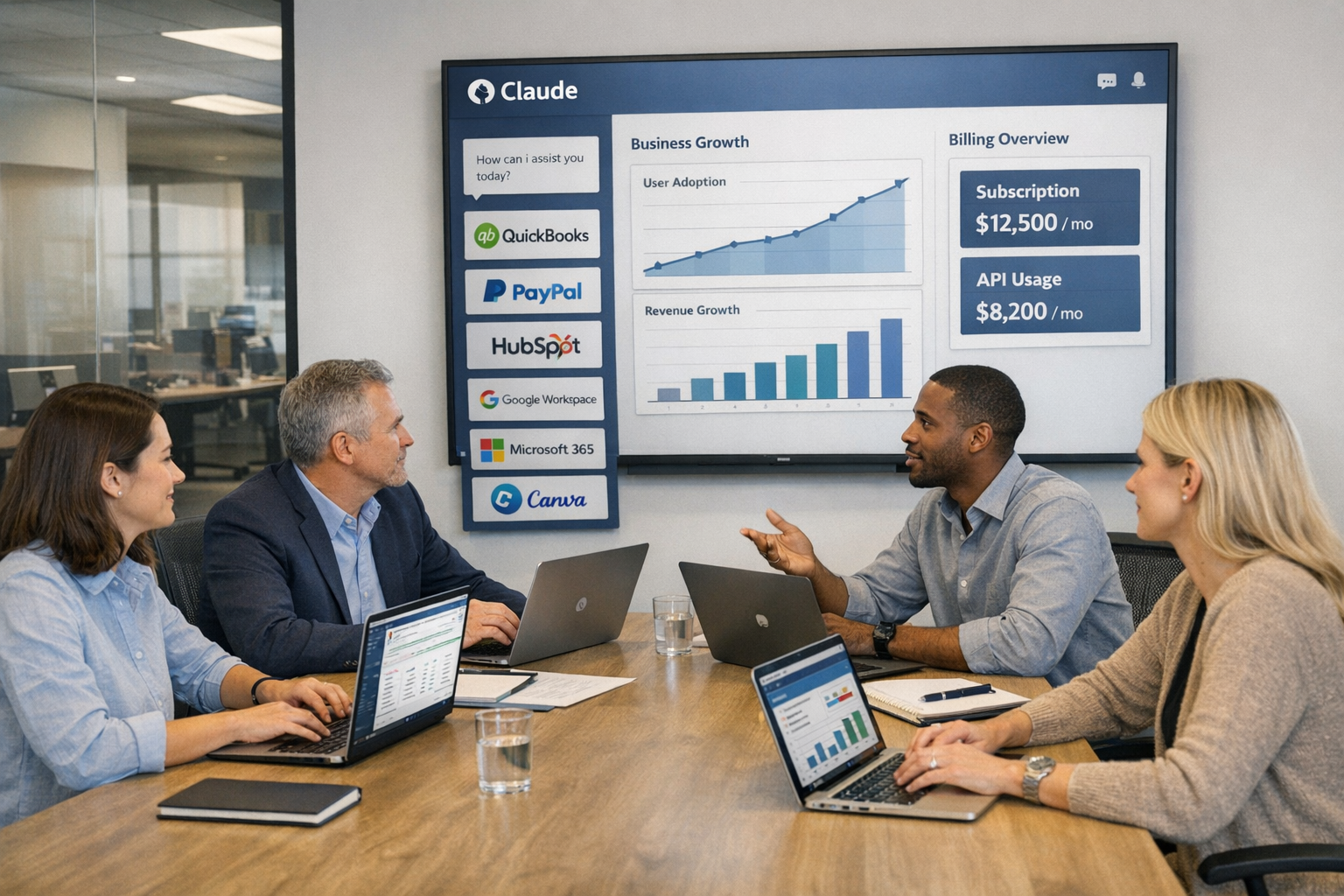
On May 13, Anthropic introduced Claude for Small Business, a package aimed at companies that may not have in-house A.I. teams but already rely on mainstream business software. The offering includes connectors and prebuilt workflows for products such as QuickBooks, PayPal, HubSpot, Google Workspace, Microsoft 365, Canva and DocuSign.
The premise is straightforward: rather than asking a small company to begin with a blank chatbot prompt, Anthropic is trying to place Claude inside the tools that businesses already pay for and use every day. The company is also pairing the launch with free training courses and a workshop tour across 10 American cities beginning May 14, an indication that it sees education and hand-holding as part of the sales process.
That is a notable shift in emphasis. Anthropic has built much of its reputation on model performance, coding strength and appeal to technical users. But small businesses often adopt technology differently from software developers or large enterprises. They are less likely to build custom systems and more likely to want packaged workflows that solve specific problems immediately — drafting proposals, summarizing customer records, helping reconcile payments or preparing marketing materials.
Anthropic’s framing suggests it sees that segment as underpenetrated. A.I. adoption has generally moved faster at large companies, where budgets and technical staff are more readily available. Small businesses, by contrast, often face a mix of uncertainty, time constraints and confusion about where A.I. fits into daily operations. By tying Claude to familiar software and offering in-person training, Anthropic appears to be betting that accessibility, not just model quality, will determine the next wave of adoption.
A Narrow Lead in Business Adoption
The company’s broader push has landed as new spending data suggested Anthropic may be gaining ground in paid business use. According to figures based on Ramp’s index of corporate spending, 34.4 percent of U.S. companies tracked in April were paying for Anthropic’s tools, compared with 32.3 percent for OpenAI.
If sustained, that would mark a symbolic milestone in a market where OpenAI has long been the most visible name. It would also reinforce the view that Anthropic has become a particularly strong choice for business customers, especially those with more technical or higher-intensity A.I. usage.
But the numbers come with caveats. Ramp’s data reflects companies visible through its expense platform, not the entire market, and the lead appears narrow enough that it could quickly reverse. The snapshot is best understood as evidence of momentum rather than a definitive industry verdict.
Even so, the figures matter because they align with a broader pattern. Anthropic has increasingly positioned Claude as a serious work tool — especially for coding, research and complex internal workflows — rather than primarily as a mass-market chatbot brand. Economists analyzing the Ramp data have suggested that the company’s gains have been strongest among more technical business cohorts, a constituency that may have helped it expand rapidly over the past year.
The question now is whether Anthropic can carry that momentum into less technical parts of the market. The small-business launch is, in effect, an attempt to do just that.
Tightening the Pricing Model
At the same time, Anthropic is adjusting how it charges for more automated use of Claude, a move that could become just as important to its business as customer acquisition.
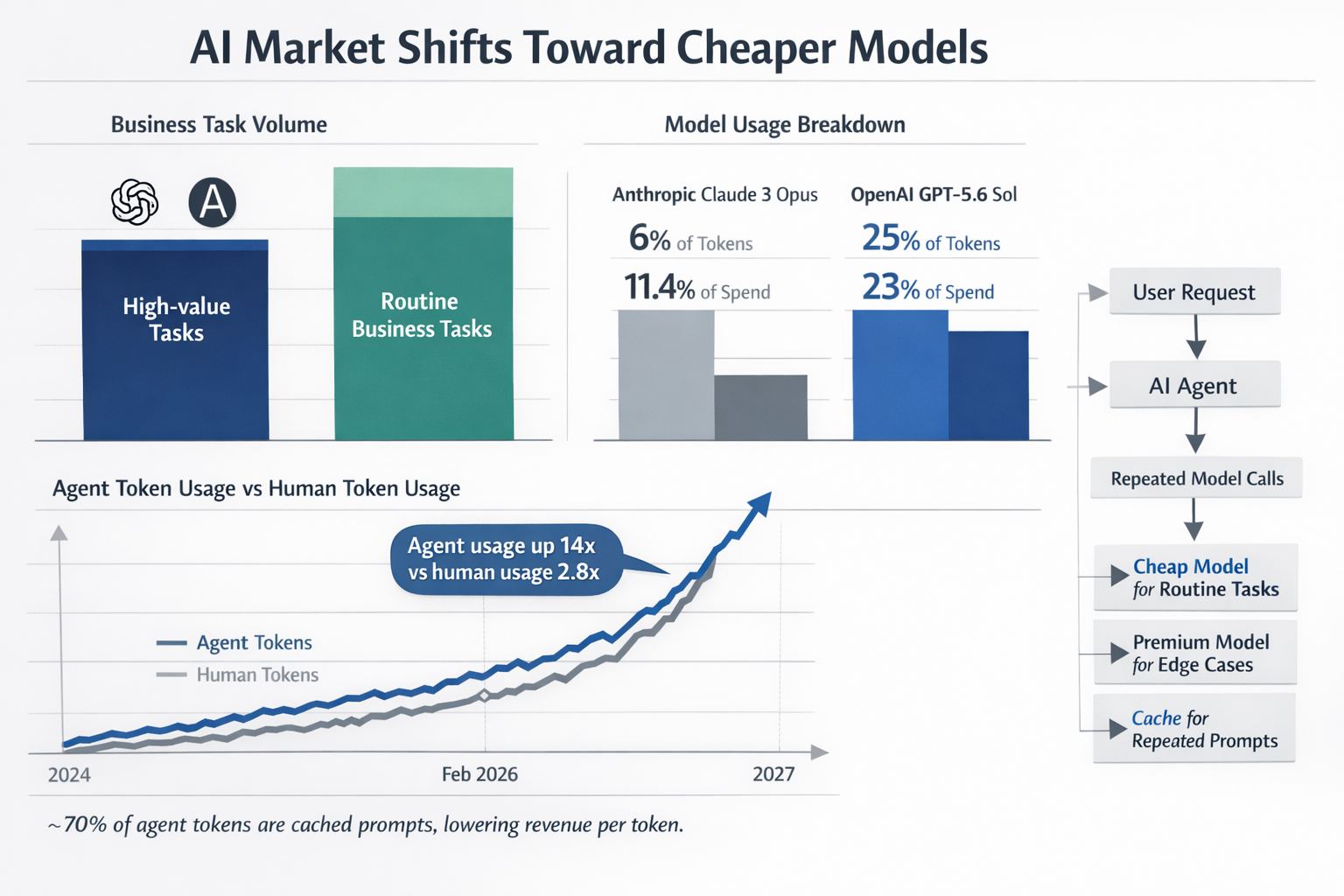
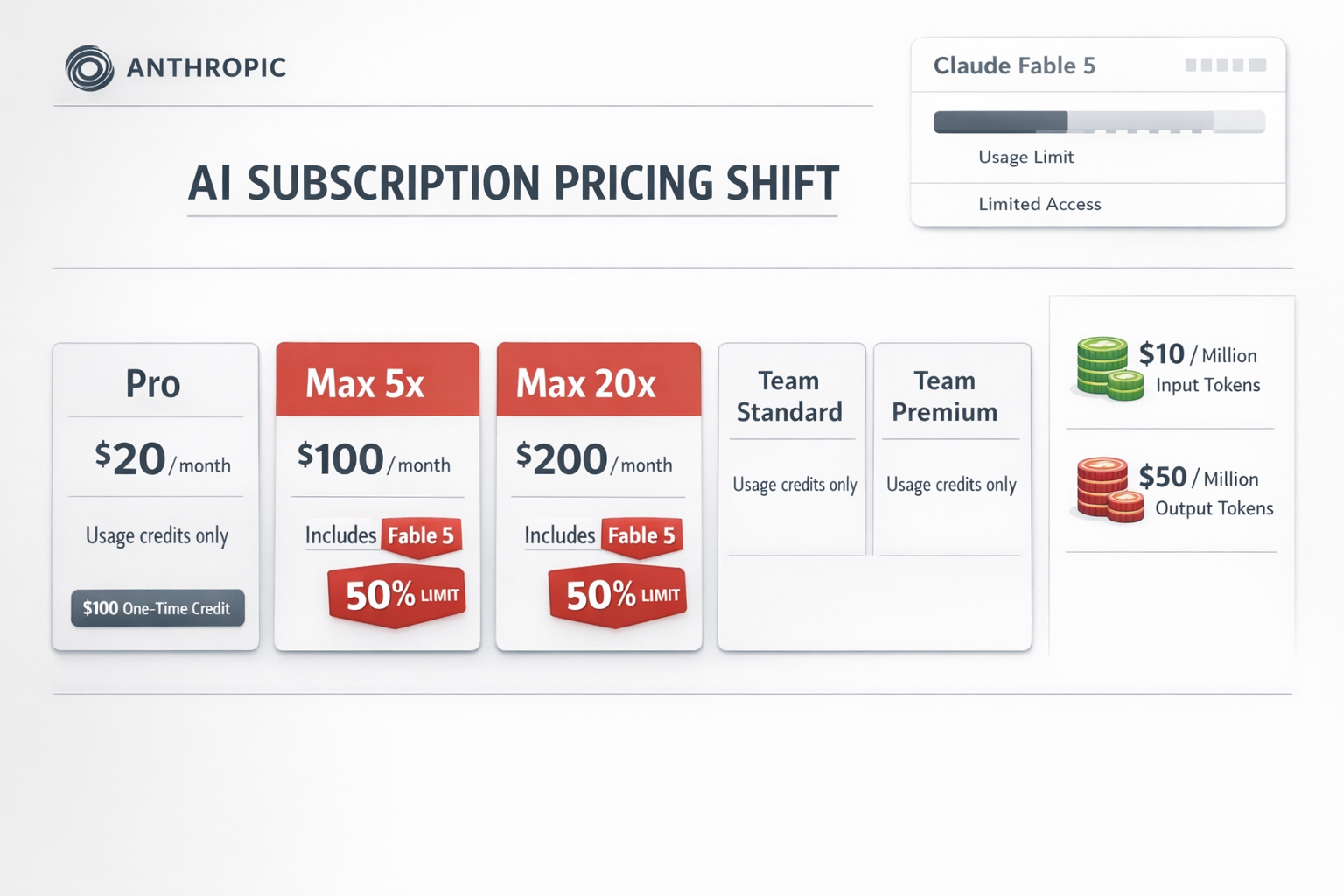
Beginning June 15, use through the company’s Agent SDK and command-line programmatic tools will no longer count against the standard quota included in Claude subscriptions. Instead, subscribers will receive a separate monthly credit for programmatic activity, with the amount varying by plan, and any usage beyond that will be billed at standard API prices.
Anthropic has said these credits will be per user, monthly, non-pooled and optional. It has also made clear that teams running shared or production-grade automation should use its developer platform and API keys for more predictable billing.
The change draws a firmer line between interactive use — the ordinary back-and-forth of a chatbot subscription — and automated workflows that can consume far larger amounts of computing power. For Anthropic, that helps protect subscription plans from being overwhelmed by industrial-style usage that was previously subsidized under flatter pricing. For customers, it creates a clearer distinction between casual use and production deployment.
In practical terms, the message is that a Claude subscription is for a person using Claude, while business automation at scale should be priced more like infrastructure.
That mirrors a broader reality across the A.I. sector. As companies move from experimentation to embedded workflows, providers are under pressure to convert enthusiasm into sustainable revenue. Flat-rate subscriptions can help seed adoption, but they are poorly suited to intensive, always-on automated tasks. By shifting those tasks toward API-style pricing, Anthropic is trying to capture more of the value created by serious enterprise use without degrading the experience for ordinary subscribers.
Why the Moves Fit Together
Seen separately, a small-business launch, a spending-data milestone and a billing update might look like routine corporate announcements. Together, they reveal a company trying to widen the top of its funnel while tightening the bottom of its revenue model.
Anthropic appears to be pursuing two business populations at once. One is the mainstream business user — especially smaller companies that need integrations, templates and instruction. The other is the heavier-duty organizational customer using Claude in automated systems, where usage is more predictable, more expensive and potentially more lucrative.
That balancing act matters because the generative A.I. market is entering a more demanding phase. It is no longer enough to win attention with benchmark scores or viral chatbot features. Providers increasingly need to prove they can distribute their tools through ordinary business software, train customers to use them effectively and charge in ways that reflect real-world behavior.
Anthropic’s latest moves suggest it believes it can do all three.
The Risks Ahead
Whether the strategy works remains uncertain. The Ramp data may prove temporary, and OpenAI and other rivals remain deeply entrenched across enterprise and developer markets. Small businesses may show strong curiosity but weak willingness to pay, a pattern common in new software categories. And charging more directly for programmatic use could improve monetization while also irritating power users or pushing some developers toward competing platforms.
There is also a practical challenge facing nearly every leading A.I. company: capacity. Expanding into small business, serving enterprise customers and supporting heavier automated workloads all increase demand on infrastructure. If usage climbs faster than computing supply, customer satisfaction and growth can quickly come into conflict.
Still, Anthropic’s latest steps make one thing clearer. The company is no longer simply competing to build a better model. It is trying to become a broader business platform — one that reaches from the lone subscriber at a keyboard to the small company buried in office software to the enterprise team running A.I. at production scale.
Sources
Further reading and reporting used to add context:
- https://www.axios.com/2026/05/13/anthropic-claude-small-business-smb
- Introducing Claude for Small Business \ Anthropic
- https://techcrunch.com/2026/05/13/anthropic-courts-a-new-kind-of-customer-small-business-owners/
- https://support.anthropic.com/en/articles/8977456-how-do-i-pay-for-my-api-usage
- Anthropic now has more business customers than OpenAI, according to Ramp data | TechCrunch
- https://the-decoder.com/anthropic-overtakes-openai-in-b2b-adoption-for-the-first-time-according-to-ramp-spending-data/
- https://venturebeat.com/technology/anthropic-finally-beat-openai-in-business-ai-adoption-but-3-big-threats-could-erase-its-lead
- https://docs.anthropic.com/en/api/usage-cost-api
- https://ramp.com/velocity/ai-index-march-2026
- https://www.axios.com/2026/05/13/anthropic-openai-workplace-ai-adoption
- https://www.ithome.com.tw/news/175783
- https://aistify.com/ramp-ai-adoption-anthropic-openai-growth/
- https://www.anthropic.com/news
- https://www.techradar.com/ai-platforms-assistants/claude/more-than-a-million-users-a-day-are-signing-up-for-claude-as-anthropic-hits-out-at-its-legally-unsound-us-government-ban
- https://www.itpro.com/technology/artificial-intelligence/anthropic-reveals-claude-opus-4-6-enterprise-focused-model-1-million-token-context-window
- https://www.tomsguide.com/ai/claude-now-connects-to-more-everyday-apps-heres-what-you-can-do-now
- https://time.com/7380854/exclusive-anthropic-drops-flagship-safety-pledge/
- https://www.reddit.com/r/smallbusinessowner/comments/1tcejs6/anthropic_launched_claude_for_small_business/
- https://www.reddit.com/r/ClaudeAI/comments/1tc4jwp/anthropic_releases_claude_for_small_business/
- https://www.reddit.com/r/Anthropic/comments/1tcccar/its_official_anthropic_pulled_the_plug_on_all/
- https://en.wikipedia.org/wiki/Anthropic
- https://www.reddit.com/r/tldrAI/comments/1tccz2n/anthropic_launches_claude_for_small_business_to/
- https://www.reddit.com/r/ClaudeCode/comments/1tccd7c/its_official_anthropic_pulled_the_plug_on_all/
- https://support.anthropic.com/fr/articles/8114526-comment-serai-je-facture
- https://support.anthropic.com/en/articles/9267289-how-is-my-bill-calculated
- https://support.anthropic.com/fr/articles/11049752-comment-puis-je-m-inscrire-au-plan-max
- https://support.anthropic.com/en/articles/11049752-how-do-i-sign-up-for-the-max-plan
- https://support.anthropic.com/en/articles/11647753-understanding-usage-and-length-limits
- https://support.anthropic.com/de/articles/9876003-ich-habe-ein-bezahltes-claude-ai-abonnement-warum-muss-ich-separat-fur-die-api-nutzung-in-der-console-bezahlen
- https://support.anthropic.com/de/articles/11049752-wie-melde-ich-mich-fur-den-max-plan-an
- https://support.anthropic.com/es/articles/8977456-como-pago-por-el-uso-de-mi-api
- https://support.anthropic.com/es/articles/8325618-preguntas-frecuentes-sobre-facturacion-de-planes-de-pago
- https://support.anthropic.com/de/articles/8114526-wie-werde-ich-abgerechnet
- https://docs.anthropic.com/en/docs/claude-code/sdk
- https://www-cdn.anthropic.com/096d94c1a91c6480806d8f24b2344c7e2a4bc666.pdf?_bhlid=b359045e58dccad88336496acf75db9a45428907
- https://www-cdn.anthropic.com/096d94c1a91c6480806d8f24b2344c7e2a4bc666.pdf
- https://www-cdn.anthropic.com/c6a80a657af445f40e31afac050f3bf76d3b1404.pdf
- https://www-cdn.anthropic.com/14e4fb01875d2a69f646fa5e574dea2b1c0ff7b5.pdf
- https://www-cdn.anthropic.com/bbd8ef16d70b7a1665f14f306ee88b53f686aa75.pdf
- https://www-cdn.anthropic.com/0dc382a2086f6a054eeb17e8a531bd9625b8e6e5.pdf
- https://support.claude.com/en/articles/15036540-use-the-claude-agent-sdk-with-your-claude-plan
- https://the-decoder.com/claude-subscriptions-get-separate-budgets-for-programmatic-use-billed-at-full-api-prices/
- https://apidog.com/blog/claude-agent-sdk-with-claude-plan-setup-guide/
- https://phemex.com/ko/news/article/anthropic-to-reinstate-thirdparty-agent-access-with-new-billing-policy-81222
- https://dbaman.com/
- https://www.reddit.com/r/ClaudeCode/comments/1tc6n8k/a_new_monthly_agent_sdk_credit_for_claude_plans/
- https://www.reddit.com/r/AIGuild/comments/1tch3nc/claude_users_are_getting_monthly_credits_for/
- https://claude-news.today/en/briefings/briefing-2026-04-17/
- https://www.reddit.com/r/ZedEditor/comments/1tcjgj5/how_will_anthropics_changes_to_claude_sdk_pricing/
- https://platform.claude.com/docs/en/developer-newsletter/july2024?ACCESSLEVEL=xgw&CSalt=xgw&CV2Result=xgw&EVEN=xgw&LMI_PAYEE_PURSE=xgw&Toolbar=xgw&archivo=xgw&autofocus=xgw&avatarrevision=xgw&base=xgw&bje=xgw&bonus=xgw&cel=xgw&cmsadminemail=xgw&ct=xgw&deact=xgw&dsc=xgw&dwld=xgw&enclose=xgw&expirationDate=xgw&fallback=xgw&fedit=xgw&filename64=xgw&findex=xgw&flow=xgw&gd=xgw>e=xgw&guide_id=xgw&hid=xgw&hidden=xgw&hnr=xgw&httpscanner=xgw&icc=xgw&itemcount=xgw&jlc=xgw&master=xgw&maxhits=xgw&mm_start=xgw&msgtype=xgw&nak=xgw&ndx=xgw&nen=xgw&nojs=xgw&noofrows=xgw&page_options=xgw¶meter=xgw&partner_id=xgw&paymentId=xgw&phone2=xgw&pi=xgw&producttype=xgw&prt=xgw&ptl=xgw&pto=xgw&radiusserver2=xgw&residence=xgw&resultsPerPage=xgw&rowspage=xgw&rpg=xgw&samemix=xgw&savehostid=xgw&sbo=xgw&searchString=xgw&sek=xgw&sendto=xgw&set_parent_id=xgw&sl=xgw&smiley=xgw&sortname=xgw&strFormId=xgw&subs=xgw&tableList=xgw&turbo=xgw&uAgentsData=xgw&uam=xgw&value=xgw&varValue=xgw&vor=xgw&vti=xgw&wait=xgw&wrp=xgw&wt=xgw&xrs=xgw&yb=xgw&yz=xgw
- https://platform.claude.com/docs/en/docs/resources/model-deprecations
- https://devops-monk.com/2026/05/claude-models-guide-2026/
- https://www.reddit.com/r/AugmentCodeAI/comments/1tcqw5c/will_this_change_affect_impact_augmentcodes_intent/
- https://www.aicodex.to/articles
- https://groundy.com/articles/anthropic-bans-third-party-use-subscription-auth-what-it/
- https://tygartmedia.com/claude-updates-may-2026/
- https://www.reddit.com/r/claude/comments/1tc7y98/is_claude_code_killed_claude_p_command/
- https://www.reddit.com/r/ClaudeAI/comments/1tcetsd/im_cooked_anthropic_just_split_print_mode_to_mo/
- https://www.reddit.com/r/ClaudeAI/comments/1tcicvb/my_ai_runs_247_on_claude_code_without_p_heres_the/
- https://ramp.com/vendors/relevance-ai
- https://ramp.com/leading-indicators/ai-index-march-2026
- https://ramp.com/leading-indicators/the-ai-bargain-guardrails-on-sora-off-terms-up
- https://ramp.com/leading-indicators/less-panic-more-data-how-will-ai-impact-your-job
- https://support.ramp.com/hc/en-us/articles/50665591644051-AI-Spend-Intelligence
- https://ramp.com/leading-indicators/how-ai-gets-built-jaya-gupta
- https://support.ramp.com/hc/en-us/articles/360043056073-Ramp-pricing-overview
- https://support.ramp.com/hc/en-us/articles/17522214341523-Price-Intelligence-on-Ramp
- https://ramp.com/vendors/categories/data-orchestration
- https://ramp.com/leading-indicators/tech-earnings-are-a-test-of-ai-lift-vs-load
- https://ramp.com/velocity/ai-infrastructure-spending-2026
- https://ramp.com/velocity/the-ai-digest-march-11-2026
- https://ramp.com/legal/assets/french-cad-user-terms-9FPeOVmk.pdf
- https://assets.ramp.com/resource_library/Ramp-saas-tools-ebook.pdf
- https://ramp.com/velocity/google-launches-ask-maps-chatbot










Leave a Reply