
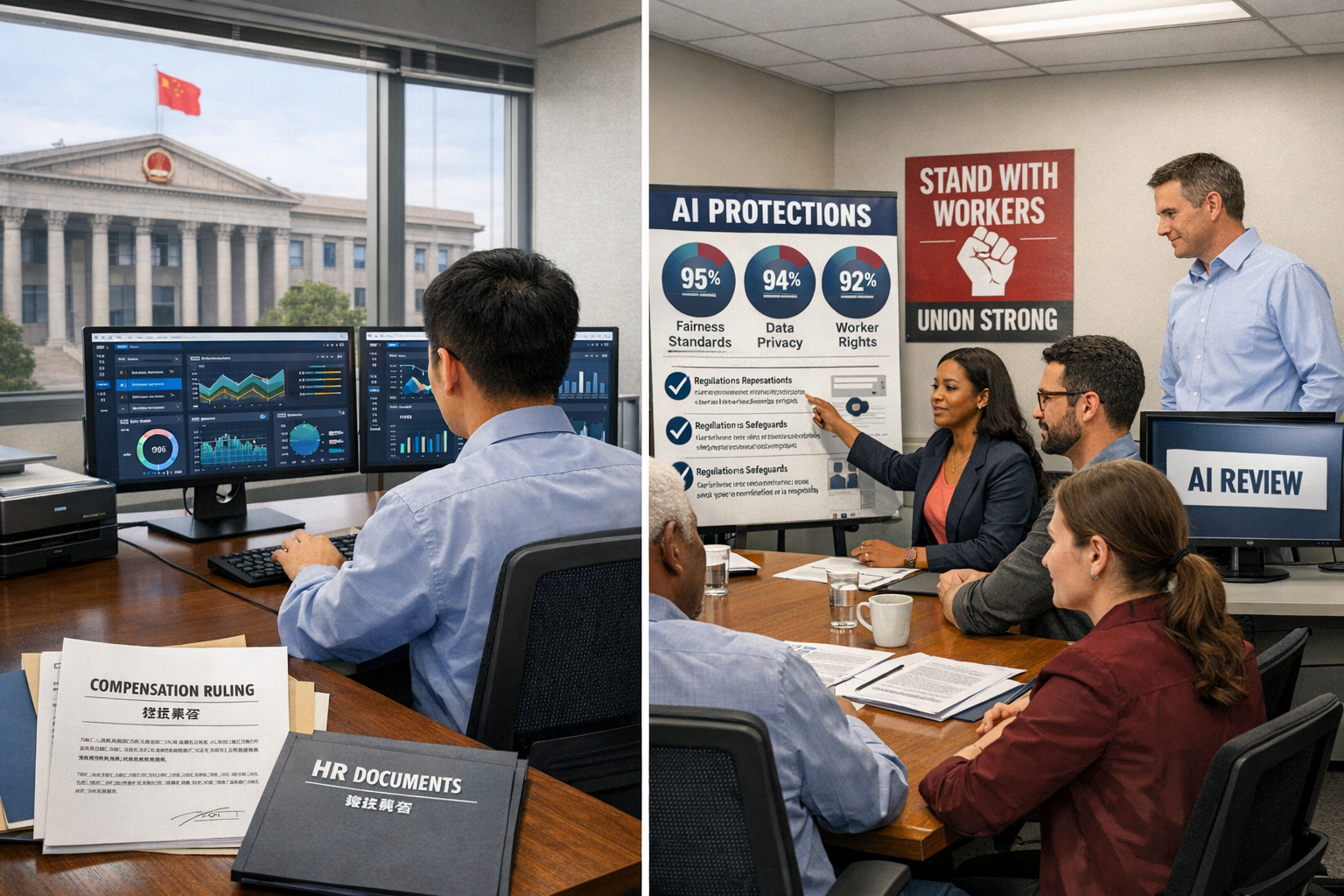
Artificial intelligence’s impact on work has long been discussed in broad, anxious terms — a future of disappearing jobs, deskilling and algorithmic management. This week, that debate grew more concrete, as new developments in China and the United States suggested that the fight over workplace AI is moving from prediction to policy, and from theory to law.
In Hangzhou, a Chinese court upheld compensation for a tech worker after his employer sought to cut his salary and dismiss him when artificial intelligence systems took over much of his work. In the United States, a new AFL-CIO poll found overwhelming support among workers for union-backed protections governing how AI is used on the job.
Taken together, the two developments point to a question that is becoming central as AI spreads through offices, warehouses and customer-service desks: If machines can do more of the work, who absorbs the disruption — employers, workers or the state?
A court tests the limits of AI-driven dismissal
The Chinese case has drawn unusual attention because it offers something still relatively rare in the global AI debate: a legal ruling tied directly to a worker displaced by automation.
According to Chinese state media and court disclosures, the worker, identified by his surname, Zhou, had joined a technology company in Hangzhou in 2022 as a quality assurance supervisor overseeing large language models used in AI products. As AI systems assumed a larger share of his duties, the company moved to reassign him, cut his monthly pay from 25,000 yuan to 15,000 yuan, and ultimately terminate him.
The court found that the company’s actions did not meet the legal standard required to justify such a move. AI-related replacement, it said, did not on its own constitute a sufficiently “major change in objective circumstances” under Chinese labor law, and the reassignment offer was deemed unreasonable. Zhou was awarded compensation worth more than £28,000.
The ruling does not amount to a nationwide ban on layoffs tied to AI, and it is not yet clear how broadly it will shape future disputes. But it carries significance as a signal from a Chinese legal system operating under intense national pressure to encourage technological advancement while preserving social stability.
Chinese authorities have increasingly published so-called typical cases to guide employers, workers and lower tribunals. State media framed the Hangzhou dispute as part of that balancing act. Reports also pointed to a separate Beijing arbitration case released in late 2025 involving a worker displaced by AI, suggesting that officials may be beginning to assemble an early body of labor guidance around automation.
That effort reflects a tension at the heart of China’s economic strategy. The country has promoted AI aggressively as a driver of competitiveness and productivity. But it has also remained deeply sensitive to labor unrest and the political risks of abrupt job displacement. The Hangzhou case suggests that, at least in some circumstances, courts may be reluctant to allow employers to present automation as a clean legal justification for pushing workers out on worse terms.
American workers back guardrails
In the United States, the flashpoint is less judicial than political. The AFL-CIO, the nation’s largest labor federation, released polling on Monday showing sweeping support for worker protections tied to AI.
The survey, conducted in April by David Binder Research, found that 95 percent of workers supported requiring a human being to serve as the final decision-maker in employment matters affecting individual workers. Ninety-four percent backed training protections, and 92 percent supported transparency and accountability when employers use AI.
The memo released by the federation also found that 38 percent of workers viewed unions as the institution most likely to protect them from harms caused by AI — far ahead of employers, Republicans or Democrats.
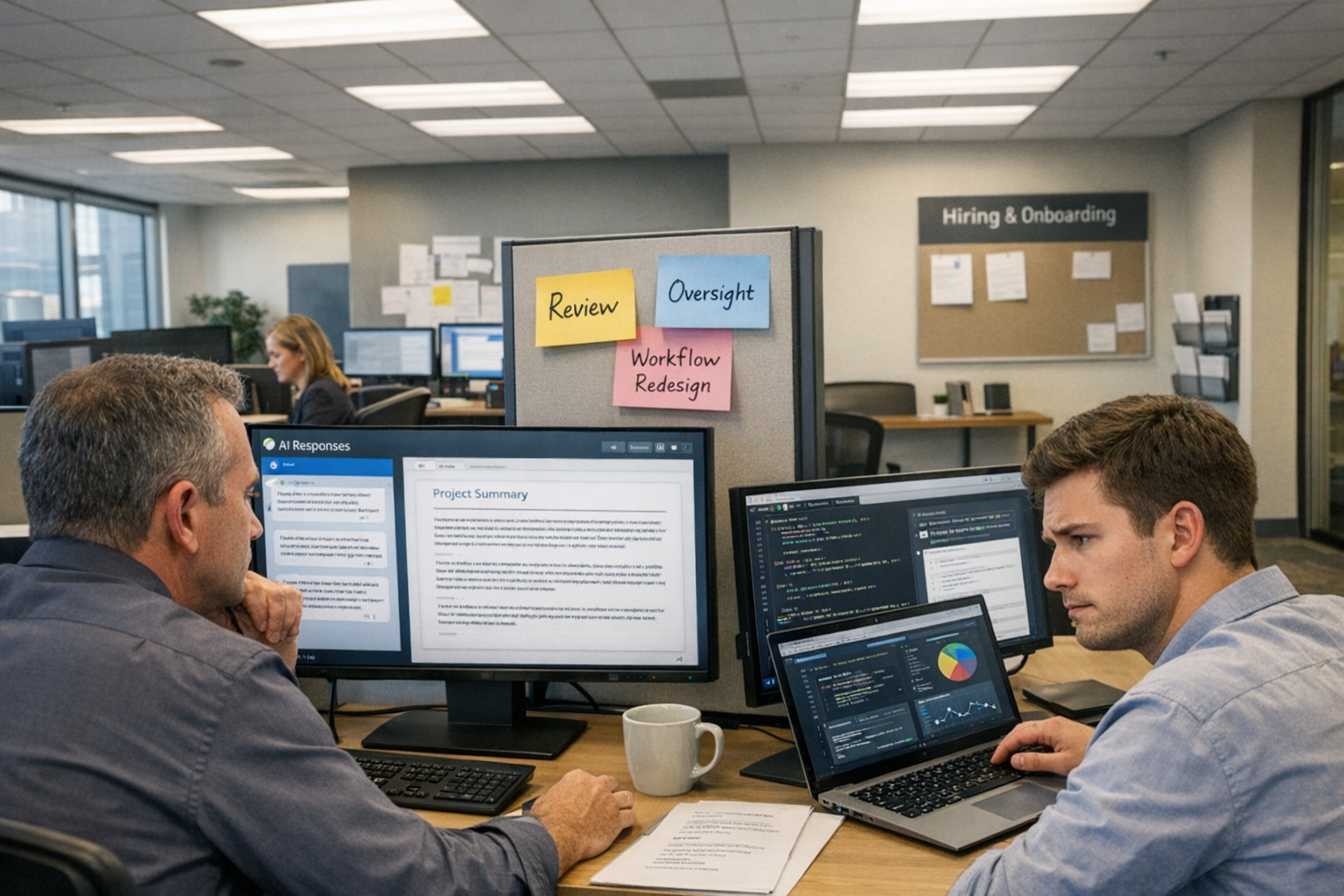
That result is notable at a moment when unions are trying to turn diffuse public unease about artificial intelligence into specific bargaining demands. Through its Workers First Initiative on AI, the AFL-CIO has pushed for human oversight, disclosure when AI is used to monitor or evaluate employees, training and retraining protections, and safeguards against discrimination and surveillance.
The poll does not itself create policy, and labor’s recent successes in shaping AI rules have been uneven. But the findings suggest that when workers are asked not whether they fear AI in the abstract but whether they want constraints on how it is deployed, there is little ambiguity in the answer.
From job-loss anxiety to enforceable rights
The significance of these developments lies partly in how they shift the conversation. For several years, public debate around AI and employment has often revolved around forecasts: how many jobs might disappear, which professions are most vulnerable, and whether new technology will eventually create more work than it destroys.
Those questions remain unsettled. What is emerging now, however, is a more immediate struggle over workplace power: whether employers can use AI to downgrade jobs, monitor workers more intensively, or automate decisions about pay, discipline and dismissal without meaningful accountability.
The Chinese ruling and the AFL-CIO polling approach that issue from different systems and political traditions, but they converge on a similar principle. AI adoption may proceed, but the costs of transition should not fall entirely on workers.
In China, that may mean compensation and a narrower reading of what counts as a lawful basis for termination. In the United States, it may mean demands for bargaining rights, human review, training, notice and limits on algorithmic decision-making.
What comes next
Much remains uncertain. The Hangzhou decision could prove influential, or it could remain a fact-specific case with limited reach beyond similar disputes. Employers may respond by offering more robust severance or reassignment packages. They may also restructure jobs in ways that are harder to challenge in court.
In the United States, the gap between worker sentiment and actual regulation remains wide. Congress has struggled to advance major AI legislation, and many workplace battles are likely to play out through union contracts, statehouses and agency enforcement rather than sweeping federal law.
Still, these new flashpoints underscore that the labor consequences of AI are no longer a distant thought experiment. They are becoming subjects of court rulings, union campaigns and institutional bargaining.
And as that shift accelerates, the central issue may be less whether AI changes work — it already is — than who gets to write the rules for what comes next.
Sources
Further reading and reporting used to add context:
- https://www.theguardian.com/us-news/2026/may/12/workers-ai-policy-unions
- New Polling: Over 9 in 10 Favor Pro-Worker AI Agenda, Trust Unions More Than Either Party to Deliver | AFL-CIO
- https://www.theguardian.com/technology/series/reworked/2026/may/12/all
- https://www.wnylabortoday.com/news/2026/05/14/labor-news-from-washington-d.c./from-the-national-afl-cio-new-polling-shows-more-than-9-in-10-favor-pro-worker-ai-agenda-trust-unions-more-than-either-party-to-deliver/
- https://english.elpais.com/economy-and-business/2026-05-07/a-chinese-court-sets-limits-on-the-dismissal-of-a-worker-replaced-by-ai.html?outputType=amp
- https://aihola.com/article/china-court-ai-layoff-ruling
- Chinese court defends labor rights in new AI-replacement case – People's Daily Online
- https://www.siliconreport.com/hangzhou-court-rules-employers-cannot-dismiss-staff-solely-to-replace-them-with-ai-a647ae1f67da2205
- https://fortune.com/2026/05/03/chinese-court-layoffs-workers-ai-replacement-labor-market/
- https://elpais.com/sociedad/2026-05-07/un-tribunal-chino-pone-limites-al-despido-de-un-trabajador-sustituido-por-la-ia.html
- https://ground.news/article/chinese-court-orders-compensation-for-worker-replaced-by-ai
- https://www.tomshardware.com/tech-industry/artificial-intelligence/chinese-court-rules-companies-cant-fire-workers-just-because-ai-is-cheaper-ruling-says-automation-alone-doesnt-justify-layoffs
- https://gigazine.net/gsc_news/en/20260501-china-court-labor-ai-replace/
- https://morningoverview.com/chinese-court-rules-companies-cannot-terminate-staff-just-to-replace-them-with-ai-second-such-ruling-in-six-months/
- https://www.pcgamer.com/software/ai/no-china-hasnt-made-it-illegal-to-fire-humans-and-replace-them-with-ai-but-yes-its-made-it-much-more-expensive-for-companies-to-do-so/
- https://www.techradar.com/pro/china-says-it-is-illegal-for-companies-to-fire-humans-if-ai-takes-their-jobs
- https://www.reddit.com/r/technology/comments/1tbggqw/us_workers_overwhelmingly_support_unionbacked/
- https://aflcio.org/sites/default/files/2025-10/Final%20for%20Website%20-%20ARTIFICIAL%20INTELLIGENCE%20Principles%20to%20Protect%20Workers_10.15.25_0.pdf




Leave a Reply