
A New Front in the A.I. Boom: The Data Center Backlash
The race to build the infrastructure for artificial intelligence is running into a stubborn obstacle: the places where that infrastructure must actually go.
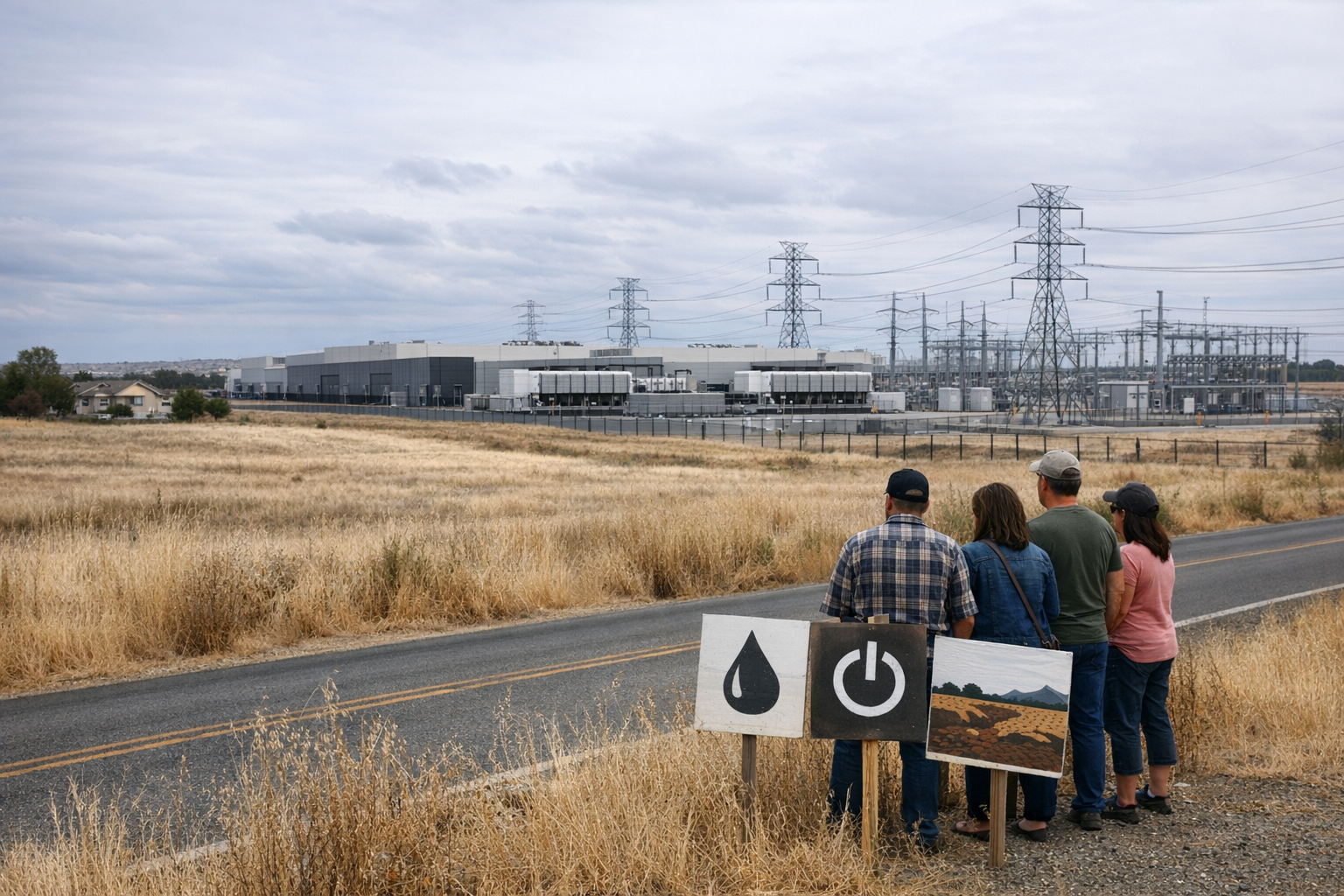
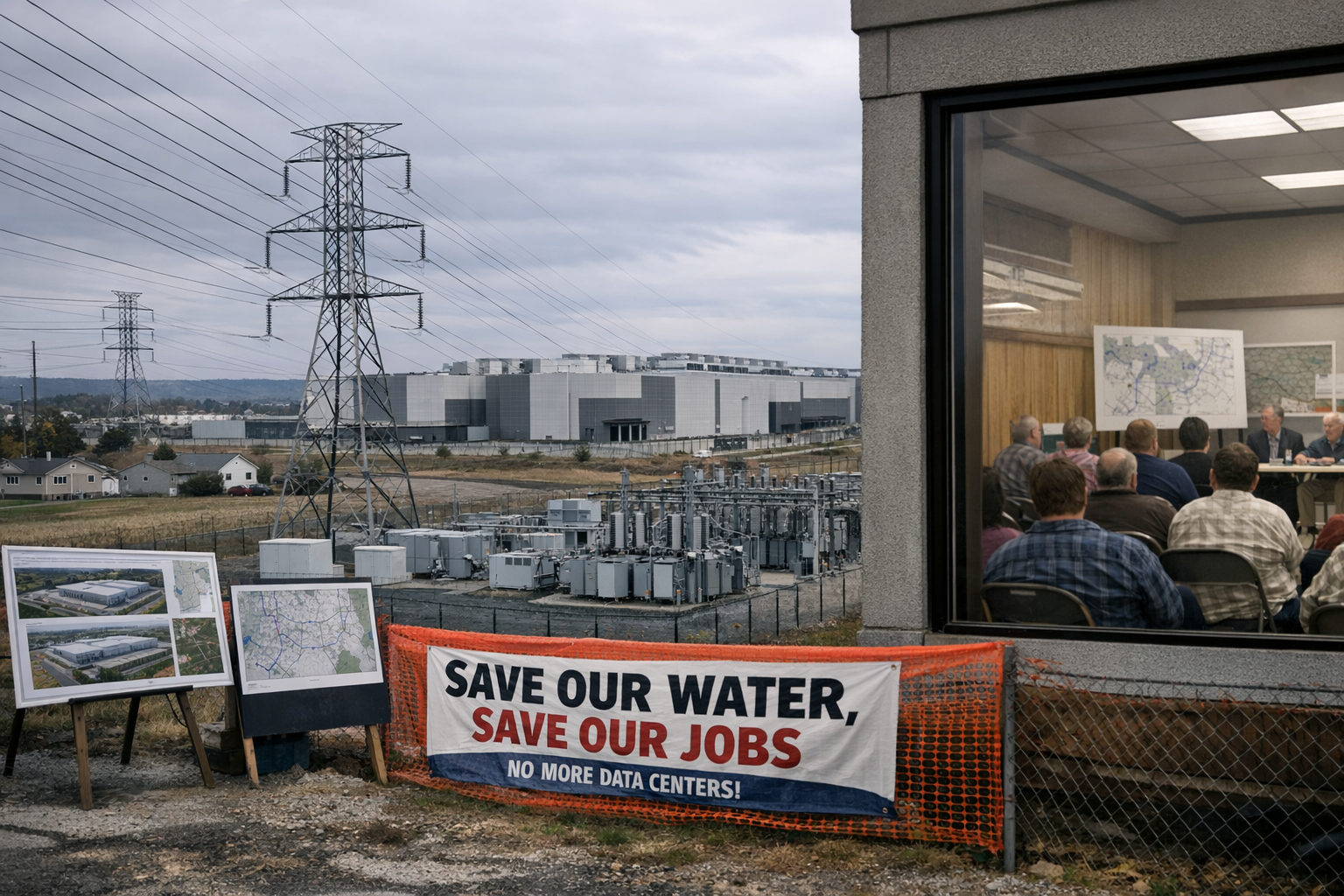
Across the United States, Britain and Australia, a wave of opposition is turning data centers from an obscure part of the digital economy into a potent local political issue. Residents, environmental groups and some public officials are increasingly challenging projects they say would strain electric grids, consume scarce water, rely on fossil fuels and reshape communities with too little public scrutiny.
In Britain, more than 100 proposed data centers are seeking gas connections because of long waits to connect to the national grid, according to reporting by The Guardian, a development that has raised alarms about whether the country’s climate goals can withstand the electricity demands of the A.I. buildout. In Western Australia, a planned 120-megawatt data center near Perth was withdrawn after intense opposition from local residents concerned about its effects on culturally significant sites. And in Utah, officials approved an initial project area for what would be one of the world’s largest A.I.-focused campuses, even as critics warned that its power needs could exceed the electricity consumption of the entire state.
Together, the disputes suggest that the next phase of the A.I. boom may be shaped as much by zoning boards, county commissions and grid operators as by chipmakers and tech giants.
From Technical Issue to Political Fight
For years, data centers were often treated as a quiet form of economic development: large, secure buildings that promised construction jobs, tax revenue and a place in the digital future. The spread of generative A.I. has changed that equation.
A.I. systems require immense computing power, and the facilities that house the servers behind them are larger and more energy-intensive than many earlier generations of data centers. That demand is now colliding with limits that are tangible to voters: clogged transmission queues, drought conditions, rising utility concerns, industrial noise, land use conflicts and questions over public subsidies.
Recent industry research cited in British reporting found that data centers account for roughly 5.9 percent of electricity use in Britain and about 6 percent in the United States. The same research warned that once data-center demand rises above roughly 5 percent of a national grid, political resistance tends to intensify.
That threshold appears to be arriving.
Britain’s Climate Dilemma
Nowhere is the contradiction sharper than in Britain, where officials have encouraged digital infrastructure investment while developers face years-long delays for grid connections.
The result, according to recent reporting, is that more than 100 new data centers have requested gas connections totaling more than 15 terawatt-hours a year. Some facilities may use gas not merely as emergency backup, but as an ongoing power source. For a country that has set legally binding climate targets and sought to reduce dependence on fossil fuels, the prospect is awkward: A.I. growth may be pushing one of its foundational industries toward dirtier energy just to get online.
The question is no longer simply whether Britain can attract data-center investment. It is whether it can do so without locking in a new layer of carbon emissions.
Utah’s Vast Bet
In Utah, the debate has taken on an almost surreal scale.
The proposed Stratos project in Box Elder County has been described in official and related materials as covering about 40,000 acres, or roughly 62 square miles, across three sites. Critics have pointed to projections that the campus could ultimately require as much as 9 gigawatts of power, an amount greater than Utah’s current statewide electricity use, and consume significant quantities of water in a drought-prone region.
State and local officials have emphasized that recent votes did not authorize the full project and that additional air, water and other permits would still be required. The Utah Inland Port Authority’s Military Installation Development Authority board approved the project area in late April, and the Box Elder County Commission followed in early May. But even at this preliminary stage, the plan has become a symbol of what many residents fear the A.I. boom could demand of their communities.
The fight is not just over one campus. It is over whether governments are prepared to approve infrastructure at a scale once associated with heavy industry while treating it as if it were simply another branch of the tech economy.
Australia and the Power of Local Resistance
In Hazelmere, near Perth, opponents showed that local resistance can do more than delay a project. It can stop one.
A developer withdrew plans for the three-story GreenSquare data center, a 15,000-square-meter facility intended to support cloud computing and A.I. growth, after fierce backlash over its impact on culturally significant sites. The collapse of the proposal underscored how opposition to data centers is broadening beyond conventional environmental complaints to include heritage, identity and the character of a place.
Similar tensions are surfacing elsewhere. In Wisconsin, organizing against a large proposed campus in Port Washington has coalesced around concerns that have become familiar in these disputes: generous tax incentives, uncertainty over permanent job creation, and the burden a large facility might place on local water and energy systems. What was once scattered local unease is becoming more coordinated and more politically fluent.
Why This Matters Now
The urgency comes from timing. The technology industry is moving quickly, and governments in many countries are eager to claim a share of the A.I. economy. But the physical systems needed to support that growth — electric transmission, water infrastructure, land-use approvals and generation capacity — move much more slowly.
That mismatch is producing a new kind of bottleneck. If grid connections take years, developers may turn to on-site gas generation. If water is scarce, communities may ask why server farms should compete with households, farms or ecosystems. If public officials offer large incentives for facilities that create relatively few permanent jobs, skepticism hardens into anger.
The backlash also points to a broader political risk for the tech industry. For much of the past decade, debates over A.I. centered on misinformation, labor disruption, copyright and safety. Increasingly, the infrastructure behind A.I. is becoming a public issue in its own right — visible, local and measurable in utility bills, water withdrawals and industrial footprints.
Whether governments respond with tighter siting rules, more disclosure requirements and tougher energy standards remains unclear. So does the question of how many future facilities will rely on fossil-fuel generation when clean power and transmission are not available fast enough.
What is becoming clearer is that the battle over artificial intelligence will not be fought only in code, corporate boardrooms or Washington hearing rooms. It will also be fought in county meetings, planning disputes and neighborhoods that are being asked to host the machines of the future.
Sources
Further reading and reporting used to add context:
- https://www.techradar.com/pro/utah-just-approved-a-data-center-twice-the-size-of-manhattan-that-will-consume-more-electricity-than-the-entire-state
- More than 100 UK datacentres plan to burn gas to generate electricity | Gas | The Guardian
- https://www.theguardian.com/us-news/2026/may/13/utah-approves-datacenter-backlash
- https://www.theguardian.com/technology/2026/may/15/developer-withdraws-plans-for-perth-datacentre-after-fierce-community-opposition
- https://www.boxelderstratos.com/
- https://www.theguardian.com/australia-news/indigenous-australians/2026/may/15/all
- Datacentres using 6% of electricity supply in UK and US, research says | Technology | The Guardian
- https://www.boxeldercountyut.gov/647/Stratos-Project-Fact-Sheet
- https://www.boxeldercountyut.gov/661/Stratos-Page-FAQ-Page
- https://www.boxeldercountyut.gov/DocumentCenter/View/2116/Stratos-Project-Fact-Sheet
- https://www.theguardian.com/us-news/2026/jan/13/datacenters-us-political-opposition
- https://thestratosproject.com/
- https://www.tomshardware.com/tech-industry/kevin-o-learys-9-gw-utah-data-center-campus-approved
- https://www.boxelderanswers.com/
- https://stratos.fiftheast.workers.dev/
- FAQ on Stratos Project
- https://www.boxeldercountyut.gov/DocumentCenter/View/2141/Stratos-Feedback-and-Information-PDF
- https://www.boxeldercountyut.gov/DocumentCenter/View/2135/Wnat-to-Learn-More-stratos
- https://www.reddit.com/r/SaltLakeCity/comments/1tcax4h/anyone_have_actual_links_to_actual_data_for_the/
- https://www.reddit.com/r/InterstellarKinetics/comments/1t5i1eo/breaking_utah_officials_unanimously_approved/
- https://www.reddit.com/r/ObscurePatentDangers/comments/1t03jpj/mr_wonderful_wants_to_build_the_largest_data/
- https://www.theguardian.com/commentisfree/2026/may/16/pity-the-poor-ai-datacenters-facing-discrimination
- https://www.theguardian.com/us-news/ng-interactive/2026/may/17/comedian-charlie-berens-ai-datacenters
- https://www.theguardian.com/environment/energy/2026/may/13/all
- https://www.theguardian.com/world/wisconsin
- https://www.theguardian.com/tone/features/2026/may/17/all
- https://www.theguardian.com/technology/2026/apr/26/uk-departments-at-odds-over-energy-demands-of-ai-datacentres
- https://www.theguardian.com/technology/2026/feb/23/new-datacentres-risk-doubling-uk-electricity-use-ofgem-peak-demand
- https://www.theguardian.com/technology/2026/mar/16/ai-artificial-intelligence-work
- https://www.theguardian.com/technology/computing/2026/apr/17/all
- https://www.theguardian.com/technology/2026/apr/24/officials-hugely-underestimated-impact-of-ai-datacentres-on-uk-carbon-emissions
- https://advertising.theguardian.com/assets/files/media-kit-2026-1772022840.pdf
- https://usadvertising.theguardian.com/assets/files/the-guardian-us–corporate-sustainability_-consumer-sentiments-research-x-script.pdf










Leave a Reply