
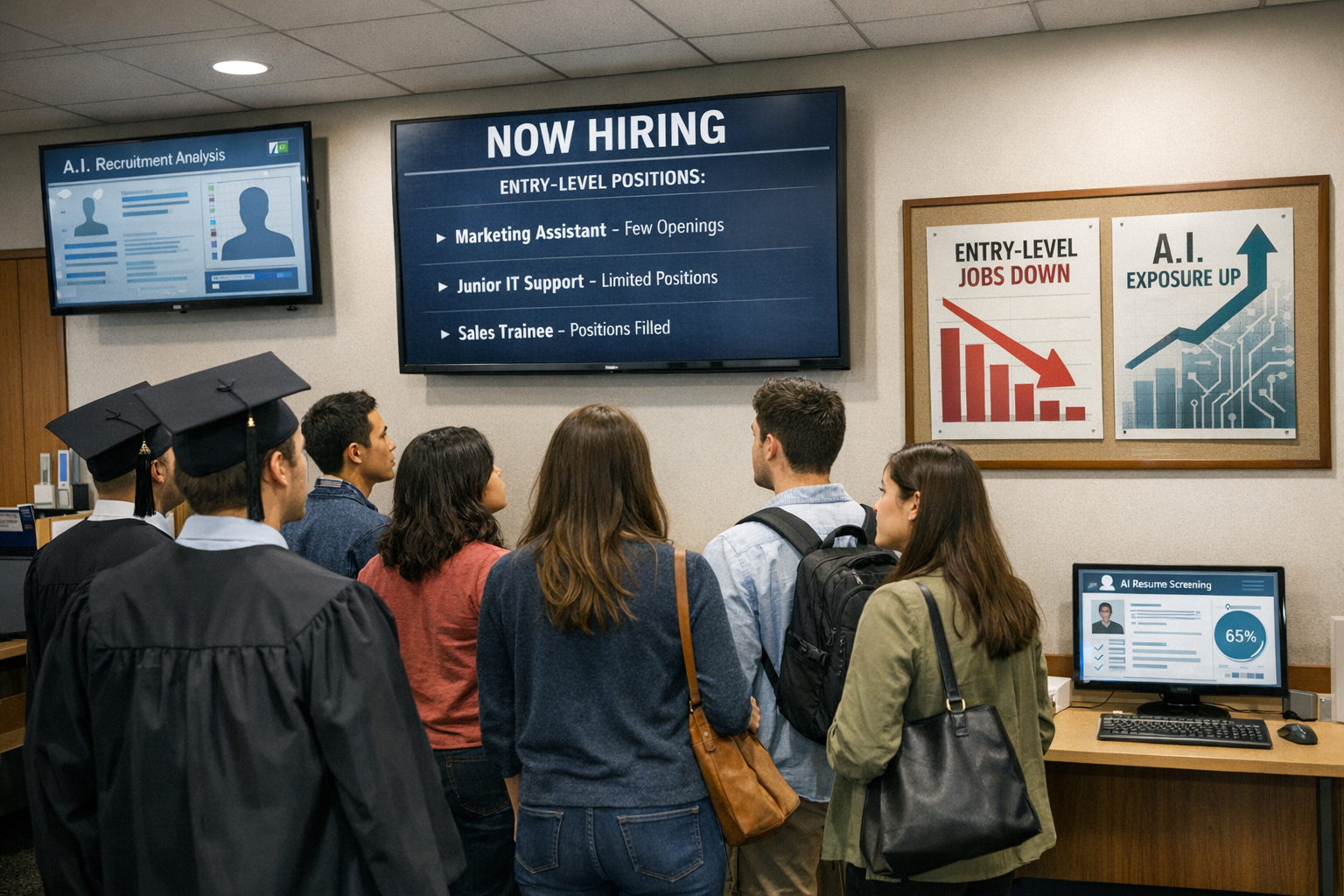
A New Anxiety Takes Hold at the Bottom of the Career Ladder
The latest skirmish in America’s argument over artificial intelligence did not unfold in a boardroom or on Capitol Hill. It broke out at graduation ceremonies.
At Middle Tennessee State University this spring, students booed when Scott Borchetta, the chief executive of Big Machine Records, praised A.I. as a force remaking the music business. When he pressed on — “Deal with it,” he told them — the reaction only hardened. At other commencements, including one featuring former Google chief executive Eric Schmidt, students similarly bristled at upbeat talk about a technology many of them see less as an opportunity than as a threat to the first jobs they have spent years preparing to get.
The unease has spread well beyond campus. News and consumer outlets have lately recast the A.I. labor debate into a more intimate register: not whether machines will wipe out work altogether, but whether workers, especially young ones, can still find a foothold. One recent article invited readers to click through a quiz to find out whether A.I. would “destroy” their career. Another framed A.I. literacy as mandatory workplace survival training.
Together, the episodes capture a shift in the public mood. The big fear is no longer simply a science-fiction “jobs apocalypse.” It is something more immediate and, in some ways, more plausible: that the bottom rung of white-collar careers is starting to give way.
No Mass Unemployment — But Signs of Strain
So far, the broadest economic warnings have not materialized. Across developed economies, employment has remained relatively stable, and economists have found little evidence of an economy-wide unemployment shock directly attributable to generative A.I.
But beneath those headline numbers, researchers are finding signs of pressure in the places where careers usually begin.
A recent Census Bureau working paper found that in industry-state labor markets most exposed to A.I., early-career employment fell 12 percent over the 10 quarters after ChatGPT’s release. The effect, the paper said, showed up mainly through weaker hiring rather than a wave of layoffs. In other words, companies do not appear to be firing junior workers en masse; they may simply be bringing fewer of them in.
A separate Federal Reserve paper reached a similarly cautious conclusion about software jobs. Employment for coders is still growing overall, but growth has slowed markedly since ChatGPT entered mainstream use. That suggests not collapse, but concentrated pressure in occupations where A.I. tools can perform at least some routine tasks once assigned to younger workers.
This distinction matters. Labor markets can look healthy even as pathways into them narrow. If firms trim internships, analyst programs and junior roles while keeping experienced employees, the overall employment picture may remain steady for a time. But younger workers can still find themselves shut out.
Graduates See the Risk Before Economists Can Fully Measure It
For many students, that possibility feels less like an abstraction than a lived reality.
A survey released this month by Monster found that 89 percent of graduates feared A.I. or automation could replace entry-level roles. Fifty-eight percent said they felt anxious about using A.I. at work, and only 36 percent said college was preparing them for an A.I.-shaped workplace.
Hiring data points in the same direction. Handshake, the college recruiting platform, has shown that entry-level job postings remain down from a year earlier, though the decline has moderated — roughly 2 percent this year, compared with 15 percent last year. That suggests some stabilization, but not a return to the conditions many graduates expected when they enrolled.
The mismatch helps explain why commencement speeches celebrating technological change have landed so poorly. To students staring down a tighter labor market, evangelism about A.I.’s transformative power can sound less like inspiration than indifference. In some ceremonies, even the technology itself became a symbol of institutional tone-deafness: at Glendale Community College, an A.I. system mishandled graduates’ names, prompting boos from the crowd.
What students seem to be asking is not whether A.I. is important. It is whether anyone in authority understands what its rise may mean for people trying to start from zero.
The First Tasks Are the Easiest to Automate
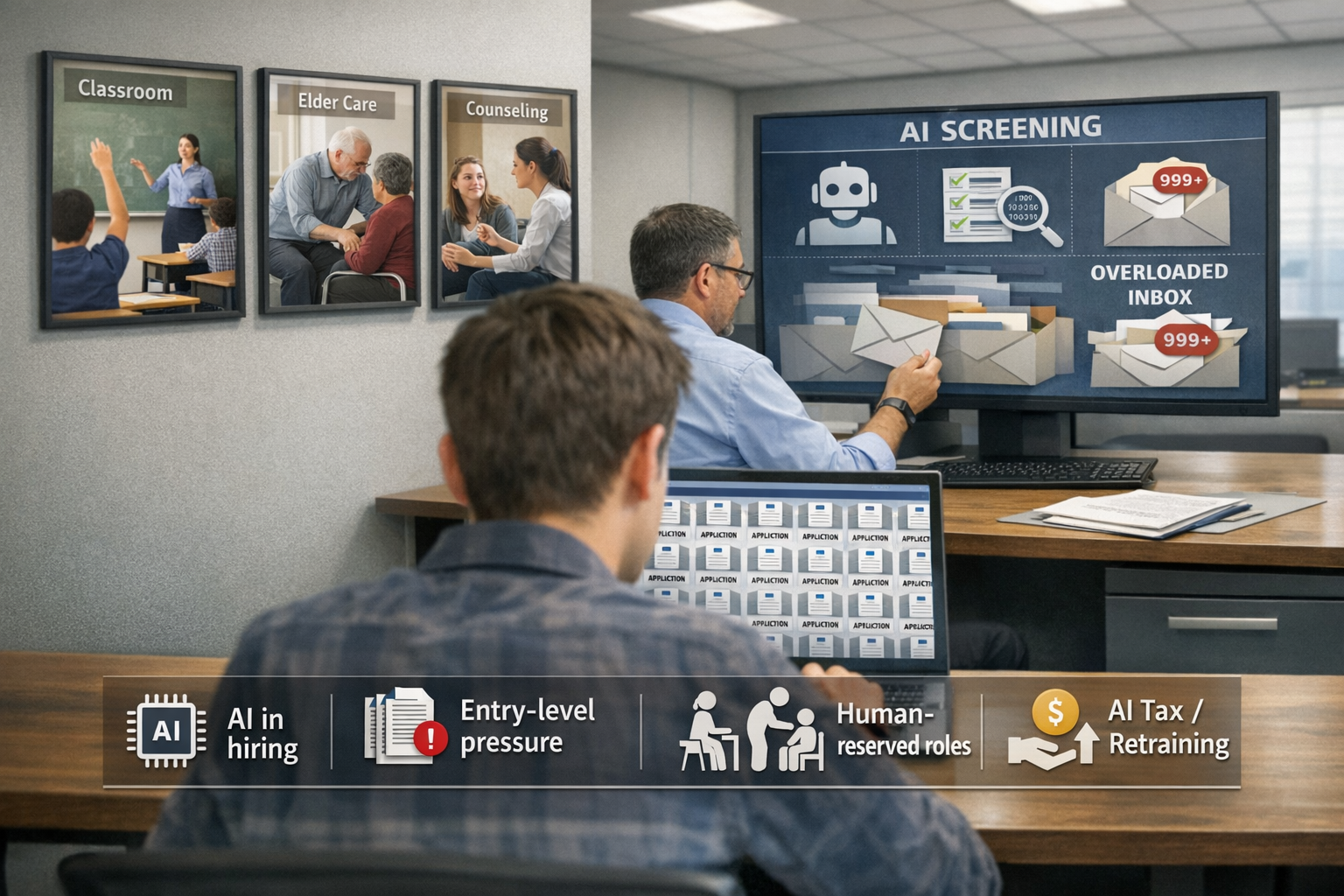
The reason entry-level jobs have become a focal point is simple. Much of junior white-collar work consists of the kinds of tasks generative A.I. does well enough to change employer behavior: drafting, summarizing, coding snippets, preparing research notes, organizing information, producing first passes.
Those tasks were never the whole job. But they were often the training loop — the repetitive work through which young employees learned judgment, context and craft. If companies automate a meaningful share of that work without creating new apprentice-like roles, they may save time in the short term while quietly eroding the pipeline that produces experienced professionals later.
That prospect has become central to the debate. Economists such as David Autor of M.I.T. have argued that past technological waves often created new kinds of work even as they displaced old tasks. The open question is whether A.I. will do the same for young workers, or whether it will short-circuit the apprenticeship model that helped people build careers in law, finance, media, software and other knowledge industries.
For now, the answer is unsettled. Some firms may be replacing junior labor with software. Others may be pausing hiring while they experiment with A.I. tools. Still others may simply be cutting costs after years of post-pandemic overexpansion, with A.I. serving as both rationale and accelerant.
A Debate Sharpens Over What Comes Next
That uncertainty is one reason the public argument has become so charged. Tech executives have increasingly tried to strike a tempered note, emphasizing that A.I. has not yet caused the white-collar collapse many feared. Sam Altman, OpenAI’s chief executive, recently said A.I. was unlikely to produce a “jobs apocalypse” and suggested that work was bending rather than breaking because people are still needed for judgment, trust and messy human communication.
Critics hear something more self-serving in that reassurance. Senator Bernie Sanders has argued that some of the world’s most powerful companies are investing enormous sums in A.I. and robotics precisely to reduce reliance on human labor. On social media, skeptics have seized on the contrast between executive optimism and the experience of younger workers confronting fewer openings and steeper expectations.
That tension is likely to shape the next phase of labor policy. If the main near-term effect of A.I. is not mass joblessness but reduced access to starter jobs, the policy response will look different. It may mean more pressure on colleges to teach A.I.-adjacent skills, more demand for employer-funded training, and more scrutiny of whether firms are preserving genuine entry routes into professions rather than expecting graduates to arrive already experienced.
Why This Matters Now
The dispute over A.I. and work has become more urgent because it is moving from theory into institutions people encounter at formative moments: classrooms, commencements, first job searches, annual workplace trainings. The technology is no longer just a topic for futurists. It is showing up at the threshold between education and employment.
And while there is still no clean evidence that A.I. is sweeping away jobs across the economy, there is mounting evidence that it may be making that threshold harder to cross.
That is a subtler story than technological catastrophe, but for a generation trying to begin adult life, it may be the more consequential one.
Sources
Further reading and reporting used to add context:
- https://www.techradar.com/pro/next-boss-says-dramatic-fall-in-entry-level-roles-could-cause-job-market-chaos-lord-wolfson-says-fall-highlights-the-crisis-is-in-youth-unemployment-at-the-moment
- https://www.pcgamer.com/software/ai/an-ai-speaker-messed-up-and-skipped-the-names-of-students-at-a-college-commencement-ceremony-and-yes-there-were-many-boos/
- https://www.axios.com/local/phoenix/2026/05/20/ai-backlash-college-graduations-job-fears
- https://www.theatlantic.com/ideas/2026/05/ai-graduation-speeches-booing/687266/?utm_source=apple_news
- https://www.theatlantic.com/podcasts/2026/05/higher-education-college-crisis/687233/?utm_source=apple_news
- US students on why they booed their pro-AI graduation speakers: ‘They’re not reading the room’ | Technology | The Guardian
- https://fortune.com/2026/05/01/automating-gen-z-entry-level-jobs-could-backfire-mit-ai-researcher-andrew-mcafee-talent-pipelines-at-risk//
- https://www.wired.com/story/ai-or-die-trying/
- https://news.mit.edu/2026/technology-creates-jobs-young-skilled-workers-ai-0521
- https://www.techspot.com/news/112006-tech-layoffs-hit-80000-early-2026-ai-blamed.html
- https://www.techradar.com/pro/why-cutting-junior-jobs-is-quietly-deepening-techs-ai-skills-shortage
- https://cloudradix.com/blog/ai-jobs-reality-check-entry-level-squeeze-ai-employees-2026/
- https://www.townandcountrymag.com/education-college/a71336987/commencement-2026-booing-ai-speakers-student-reactions-trend/
- https://tech.yahoo.com/ai/articles/mit-ai-expert-warns-against-120500071.html
- https://www.techspot.com/news/112493-tech-layoffs-pass-100000-2026-tracker-points-ai.html
- https://www.themodelwire.com/article/a-reality-check-on-the-ai-jobs-hysteria-01KSHS9QV3521F95ZEPDNQ450R
- https://www.ibm.com/think/news/entry-level-roles-get-reset-ai
- https://www.reddit.com/r/IntelligenceSupernova/comments/1tof5id/a_reality_check_on_the_ai_jobs_hysteria/
- https://www.tomshardware.com/tech-industry/artificial-intelligence/survey-reveals-that-99-percent-of-ceos-now-expect-ai-driven-layoffs-companies-are-racing-to-replace-junior-workers-with-ai-even-as-many-executives-remain-uncertain-about-the-returns-on-ai-investments
- https://www.techradar.com/pro/todays-disruptive-environment-is-anything-but-normal-report-warns-younger-workers-set-to-be-hit-by-ai-hiring-as-bosses-focus-more-on-midlevel-roles
- 89% of Grads Fear AI Replacing Entry Level Jobs | Monster
- https://www.federalreserve.gov/econres/feds/ai-and-coder-employment-compiling-the-evidence.htm
- https://www.wired.com/story/quiz-will-ai-destroy-your-career/
- https://www.insidehighered.com/news/student-success/life-after-college/2026/04/30/ai-skills-surge-entry-level-jobs-lag
- https://state-of.biz/en/fed/feds-paper-ai-and-coder-employment-compiling-the-evidence
- https://www.weforum.org/stories/2026/03/how-ai-is-changing-the-nature-of-entry-level-work/
- https://www.census.gov/library/working-papers/2026/adrm/CES-WP-26-27.html
- https://blockainews.com/news/fed-study-chatgpt-programmer-jobs-500k-missing-april-27/
- https://www.nbcpalmsprings.com/2026/05/26/experts-say-ai-may-change-entrylevel-jobs-not-eliminate-them
- https://www.techradar.com/pro/how-else-are-people-going-to-learn-to-do-the-job-mit-ai-expert-warns-against-automating-gen-z-entry-level-jobs
- https://www.semafor.com/article/05/14/2026/ai-is-coming-for-some-jobs
- https://www.windowscentral.com/artificial-intelligence/microsofts-head-of-ai-says-white-collar-jobs-could-vanish-within-the-next-12-to-18-months-as-automation-bots-replace-you
- https://www.bcg.com/publications/2026/ai-will-reshape-more-jobs-than-it-replaces
- https://www.federalreserve.gov/econres/feds/files/2026018pap.pdf
- You’re (not) Hired: Artificial Intelligence and Early Career Hiring in the Quarterly Workforce Indicators
- https://www.reddit.com/r/ArtificialInteligence/comments/1tovu1z/wired_just_put_out_a_quiz_that_scores_the_ai/
- https://arxiv.org/abs/2601.02554







Leave a Reply