
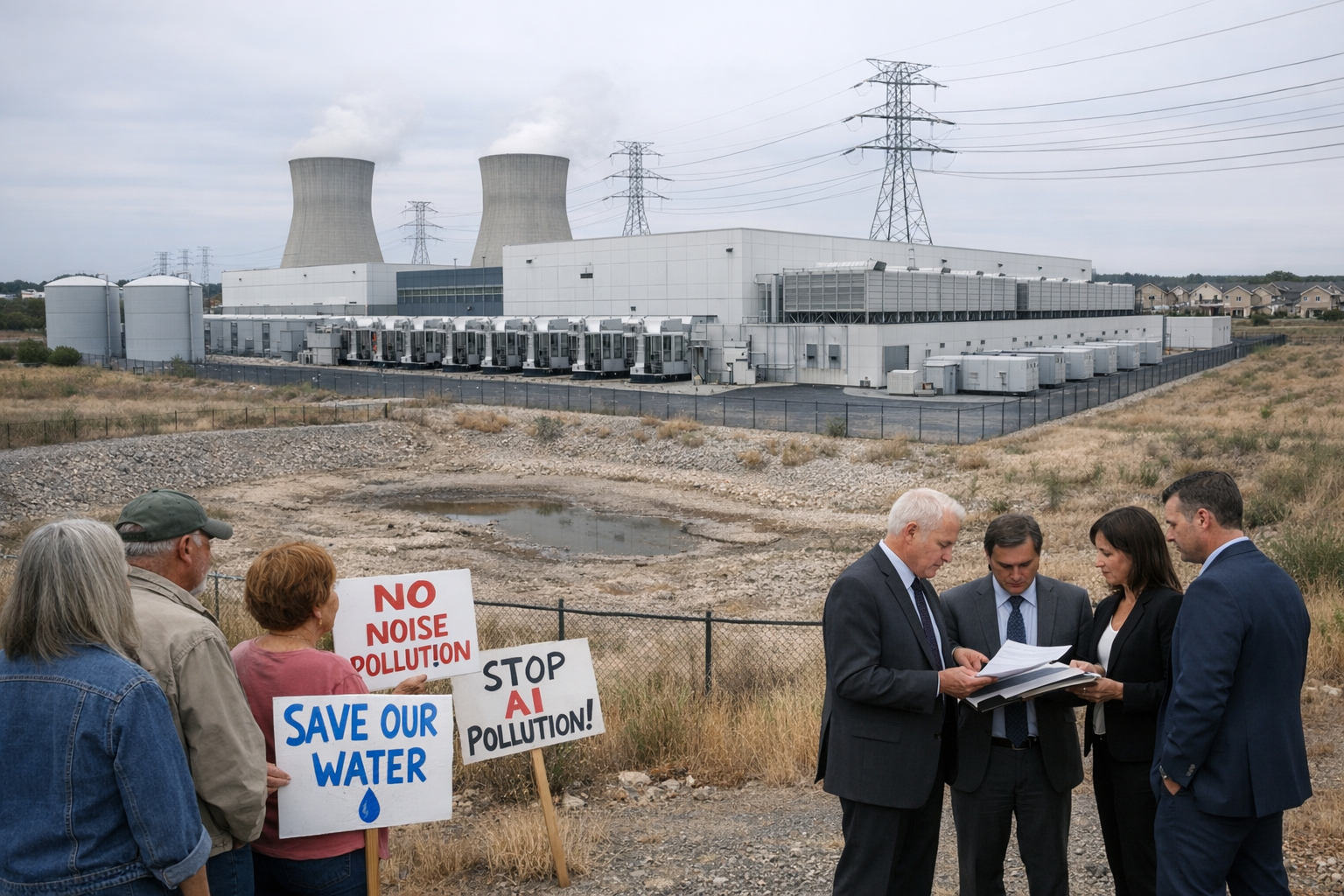
The rapid expansion of data centers to power artificial intelligence is colliding with a widening wave of environmental opposition, as local disputes over noise, water and power use harden into lawsuits, moratoriums and a broader political fight over who pays for the infrastructure behind the AI boom.
What was once a patchwork of neighborhood complaints is increasingly becoming an organized campaign. New research released this month found that data centers are emerging as a growing target in climate-related litigation around the world, with cases focusing on electricity sources, water consumption and air pollution. Days later, Erin Brockovich, the environmental advocate best known for helping win a landmark groundwater contamination case against Pacific Gas & Electric, said she was turning her attention to AI data centers after hearing from thousands of residents alarmed by projects near their homes.
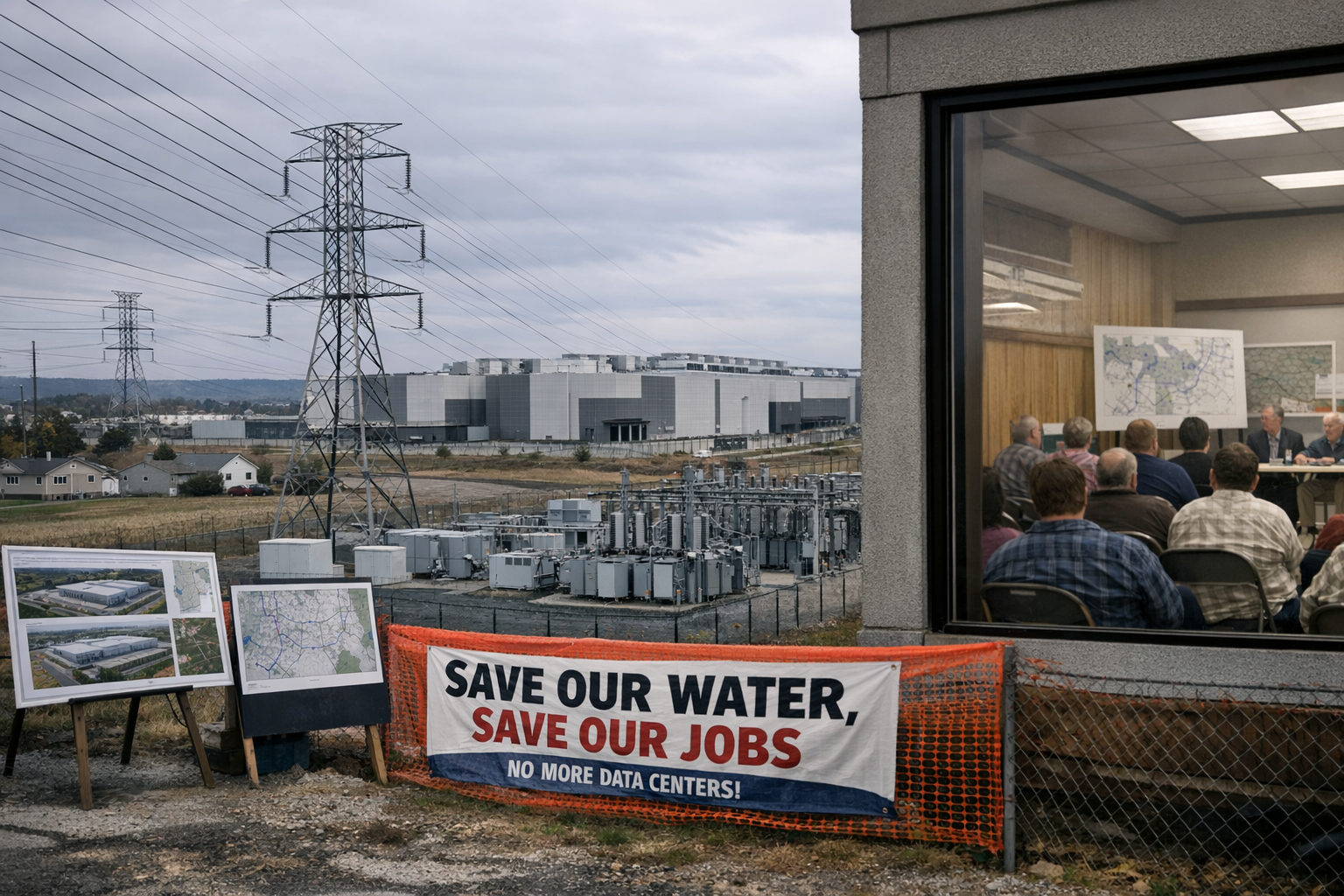
The shift suggests that the AI buildout, long framed by technology companies and policymakers as an economic and strategic imperative, is now facing a more complicated reality: communities, lawyers and campaigners are increasingly trying not just to protest new projects, but to slow them, reshape them or block them altogether.
From local resistance to legal strategy
A review by the Grantham Research Institute on Climate Change and the Environment at the London School of Economics found a rising number of climate-related legal cases involving data centers, part of a broader universe of roughly 3,600 climate lawsuits filed globally since 2015. The disputes span countries including the United States, Britain, Ireland and Chile, and challenge a range of issues — permits, fossil-fuel infrastructure, renewable-energy requirements and government approvals that critics say failed to adequately weigh climate effects.
That legal trend is unfolding as some governments move in the opposite direction, seeking to speed grid connections and energy approvals for massive new electricity users such as AI data centers. The clash is sharpening a central question in the AI economy: whether the urgency to build computing capacity will override long-established environmental review and local consent processes.
Recent fights in the United States show how varied those conflicts have become. In Seattle, officials recently moved to impose a moratorium on new AI data centers. In Oregon, opponents have sued over tax breaks granted to data-center developments, arguing that public subsidies are helping underwrite projects with significant environmental and community costs. In Mississippi and Tennessee, a separate fight over air pollution tied to xAI-related infrastructure has drawn in the Justice Department, which has sought to halt Clean Air Act litigation.
Together, the cases point to a new phase of resistance. Instead of treating data centers as largely invisible back-end infrastructure, critics are beginning to challenge the web of decisions that make them possible — from power procurement and water access to tax treatment and permitting.
Water, power and pollution
The backlash reflects growing concern over the physical footprint of AI, whose advanced systems require enormous computing power and, in many cases, vast amounts of electricity and water to keep servers cool.
For years, concerns about data centers centered mainly on energy demand. But the argument is broadening. Opponents are increasingly focusing on whether new facilities lock in fossil-fuel generation, strain local water supplies, increase air pollution through backup generators and related energy infrastructure, or consume land and public resources with too little scrutiny.
That shift is evident internationally. In Ireland, where data centers have become a major issue for the electricity grid, regulators and campaigners have wrestled with how much power the sector should be allowed to consume. In Latin America and Europe, climate and permitting cases are increasingly testing whether governments can approve major digital infrastructure without fuller accounting of environmental impacts.
The debate is also moving toward disclosure. On June 23, Secretary General António Guterres of the United Nations announced an AI Environmental Transparency Initiative, urging major AI companies to disclose the carbon, water and land footprints of their systems and to power data centers with renewable energy by 2030. The appeal reflected a broader recognition that the environmental costs of AI are no longer peripheral to the technology’s growth; they are becoming part of the public debate over its legitimacy.
A high-profile new opponent
Ms. Brockovich’s entry into the fight gives that debate a more prominent public face.
After issuing a call for residents concerned about nearby data centers to contact her, she said she received thousands of responses within a month. For campaigners trying to connect scattered local disputes into something larger, her involvement is symbolically potent: a figure associated with one of the country’s most famous environmental justice battles is now casting AI infrastructure as the next major community threat.
Her intervention also underscores how opponents are framing the issue. The argument is not only that data centers use immense resources, but that communities often feel they have little say as projects backed by some of the world’s richest companies move forward. In many places, residents are confronting facilities they say could alter local landscapes, increase industrial activity and strain public resources, while the economic benefits remain uncertain or unevenly distributed.
That sense of imbalance has become a powerful organizing tool. Critics increasingly describe the AI boom not just as a technological transition, but as a transfer of environmental burden — with local residents absorbing the impacts of infrastructure built to support globally profitable computing services.
Why the conflict is intensifying now
The timing is not accidental. Demand for AI computing has set off an aggressive push by technology companies and developers to secure land, electricity, water and faster grid connections. Utilities and regulators are under pressure to serve extremely large new loads quickly, even as many power systems are already struggling with reliability, decarbonization goals and rising demand from other sectors.
That has made each data-center proposal more politically charged. A project is no longer simply a local land-use question; it can also influence regional power planning, emissions trajectories and water allocation. Public officials who welcome investment and jobs are increasingly being pressed to explain what communities are giving up in return.
Whether the emerging wave of legal and political resistance will meaningfully slow the industry remains unclear. Courts may be reluctant to halt projects outright, and governments eager to maintain technological competitiveness may continue to prioritize speed. Companies, for their part, are betting that cleaner power deals, improved cooling technologies and voluntary disclosure can ease at least some of the criticism.
But the conflict is plainly broadening. What began as a series of local complaints about large, energy-hungry buildings is evolving into a larger struggle over climate policy, environmental justice and industrial strategy in the age of AI. As data centers become indispensable to the technology industry’s ambitions, they are also becoming a focal point for the question that shadows the entire sector: who should bear the costs of progress?
Sources
Further reading and reporting used to add context:
- https://www.axios.com/local/portland/2026/06/24/data-center-backlash-ai-expansion-oregon
- https://www.axios.com/2026/06/24/microsoft-lower-water-use-ai
- https://www.axios.com/2026/06/25/water-energy-ai-flashpoint
- https://www.tomsguide.com/ai/nvidia-claims-its-new-ai-data-centers-use-almost-no-water-heres-what-that-actually-means
- https://www.techradar.com/pro/if-ai-is-to-help-build-a-better-future-it-must-be-honest-about-what-it-costs-us-now-un-urges-ai-giants-to-reveal-full-extent-of-environmental-damage
- https://www.theguardian.com/environment/2026/jun/29/were-up-against-forces-that-have-all-the-money-in-the-world-erin-brockovich-on-her-battle-against-ai-datacentres
- https://techcrunch.com/2026/06/18/ai-data-centers-just-got-a-government-mandated-fast-lane-to-the-grid/
- Datacentres are growing target of global climate-related legal cases, report finds | Environmental activism | The Guardian
- https://www.lse.ac.uk/granthaminstitute/news/datacentres-are-growing-target-of-global-climate-related-legal-cases-report-finds/
- https://www.theguardian.com/environment/environment%2Btechnology/computing
- https://www.washingtonpost.com/technology/2026/06/16/justice-department-aims-block-lawsuit-against-xai-polluting-data-centers/
- https://www.theguardian.com/us-news/2026/jun/09/seattle-ai-datacenters-ban
- FERC Launches Aggressive Targeted Action to Speed Large Load Integration | Federal Energy Regulatory Commission
- https://www.investing.com/news/commodities-news/top-us-energy-regulator-pushes-grids-to-overhaul-data-center-power-rules-4750395
- https://www.washingtonpost.com/business/2026/06/16/musk-xai-data-center-memphis-pollution-naacp/8d01e91a-69cf-11f1-830e-133d20cadd28_story.html
- https://www.axios.com/2026/06/18/ai-data-centers-federal-commission-faster-connections
- https://www.mcguirewoods.com/client-resources/alerts/2026/6/ferc-issues-section-206-show-cause-orders-directing-all-six-rtos-isos-to-justify-or-reform-large-load-integration-rules/
- https://www.lse.ac.uk/granthaminstitute/wp-content/uploads/2026/06/Global-Trends-in-Climate-Litigation-final.pdf
- https://www.lse.ac.uk/granthaminstitute/wp-content/uploads/2026/06/Global-Trends-Report_Summary.pdf
- https://www.lse.ac.uk/granthaminstitute/wp-content/uploads/2026/06/Global-trends-in-climate-litigation_annexes.pdf
- https://apnews.com/article/cdba9edbe2081aec15b115d043b5f75c
- https://www.un.org/en/ai%E2%80%99s-environmental-costs-threaten-water-land-and-climate
- https://www.eurekalert.org/news-releases/1133347
- https://www.investing.com/news/commodities-news/un-chief-calls-on-ai-firms-to-come-clean-on-environmental-costs-4754750
- https://www.un.org/global-dialogue-ai-governance/en
- https://fortune.com/2026/06/23/un-guterres-ai-climate-impact-disclosure-data-centers/
- https://www.miragenews.com/un-chief-urges-ai-firms-to-reveal-environmental-1697818/
- https://www.esgdive.com/news/un-secretary-general-guterres-urges-ai-giants-to-disclose-environmental-impact-renewables-2030/823554/
- https://www.thenationalnews.com/climate/2026/06/23/un-chief-launches-ai-green-charter-to-curb-data-centres/
- https://www.un.org/global-dialogue-ai-governance/sites/default/files/2026-06/Concept%20Note%20on%20Sustainable%20AI%20dialogue.pdf
- https://www.malaymail.com/news/world/2026/06/23/un-chief-demands-tech-giants-be-honest-about-the-hidden-water-power-and-carbon-cost-of-the-ai-boom/224868
- https://theindianawaaz.com/un-secretary-general-guterres-calls-on-ai-companies-to-disclose-environmental-impact/
- https://energynews.oedigital.com/environment/2026/06/23/un-chief-calls-on-ai-companies-to-be-transparent-about-environmental-costs
- https://www.pakistantoday.com.pk/2026/06/23/un-chief-urges-ai-firms-to-disclose-environmental-costs
- https://www.un.org/independent-international-scientific-panel-ai/sites/default/files/2026-06/Media%20Advisory%20AI%20Scientific%20Panel%20Report%20launch%20July%201.pdf
- https://www.un.org/global-dialogue-ai-governance/sites/default/files/2026-04/260414_ai_dialogue_inclusive_participation_support_proposal_1.pdf
- https://www.reddit.com/r/actutech/comments/1ueeo2v/ant%C3%B3nio_guterres_demande_plus_de_transparence_sur/
- https://www.amnesty.org/en/wp-content/uploads/2026/06/AMR0411462026ENGLISH.pdf
- https://techxplore.com/news/2026-06-ai-companies-environmental-impact-commit.pdf
- https://sdgs.un.org/sites/default/files/2026-01/2025.pdf











Leave a Reply