
YouTube Moves to Police A.I. Video More Aggressively
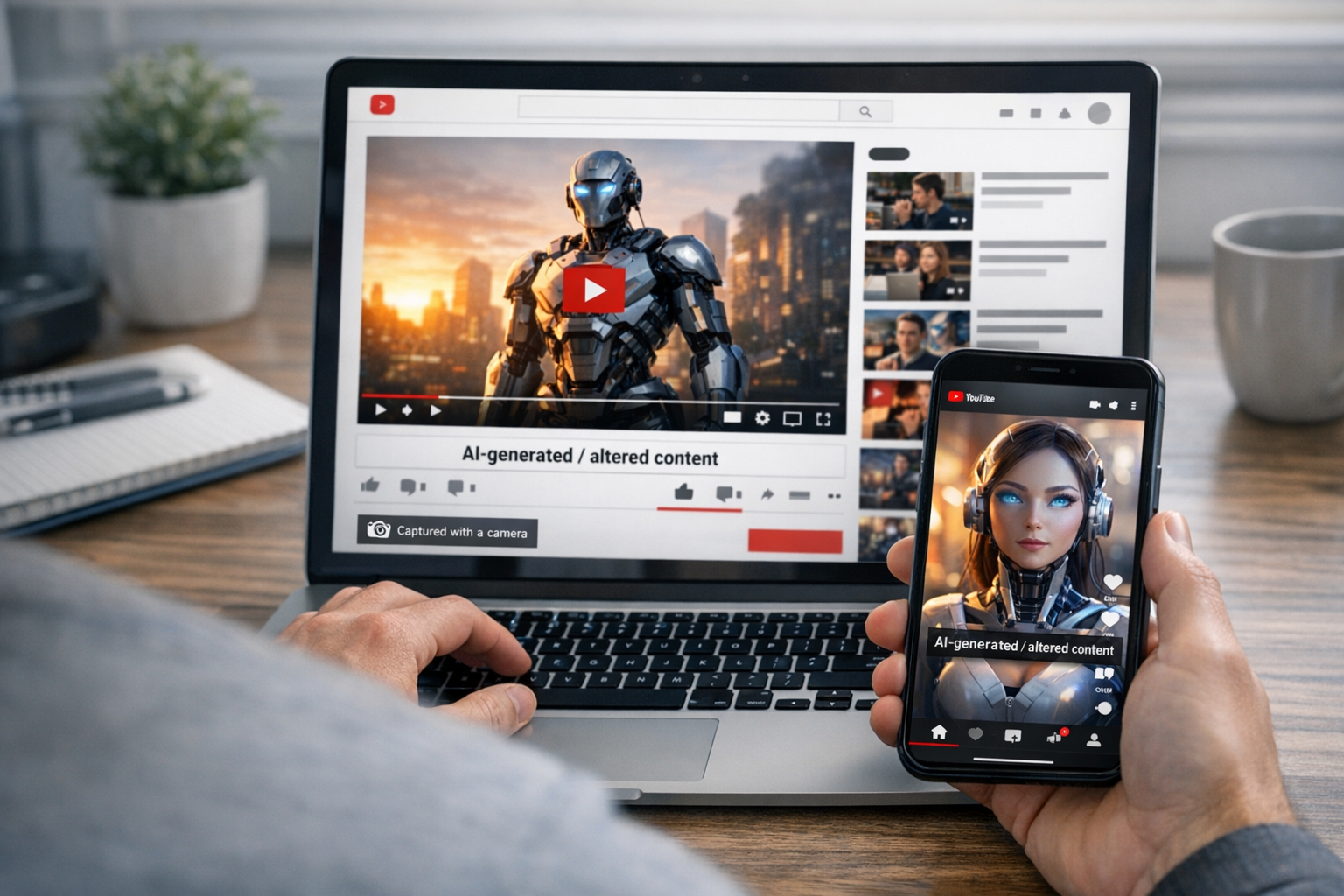
YouTube said this week that it would make labels for A.I.-generated video harder to miss and would begin automatically flagging some clips when creators fail to disclose significant synthetic alterations, a sign that one of the world’s largest media platforms is moving from tentative guidance to large-scale enforcement.
The changes, announced May 27, will place labels directly below long-form videos and as an on-screen overlay for Shorts, where they are more likely to be seen by viewers scrolling quickly. Beginning this month, YouTube also plans to use its own detection signals to identify videos that contain significant photorealistic or heavily A.I.-altered material, even when uploaders do not mark them as such.
The company said the labels would not affect a video’s recommendations or eligibility for monetization, a notable choice that suggests YouTube is trying to increase transparency without punishing a rapidly growing category of creators.
The move reflects a broader change in how platforms are responding to synthetic media. For years, the debate centered on hypothetical deepfakes and election misinformation. Now the challenge is more mundane and more pervasive: how to label, sort and contextualize vast amounts of A.I.-assisted content that may be entertaining, educational or harmless, but still blurs the line between what was recorded and what was generated.
From Disclosure to Detection
Until recently, much of the burden fell on creators to voluntarily disclose when realistic-looking content had been altered or generated with A.I. YouTube’s new approach suggests the company no longer sees self-reporting alone as sufficient.
That matters because the volume and sophistication of synthetic media have risen sharply. Video tools can now generate lifelike faces, voices and environments at low cost, allowing creators to produce scenes that appear documentary in style even when they were never filmed. In response, platforms have begun building a vocabulary of authenticity signals.
YouTube has also been introducing a separate “Captured with a camera” disclosure tied to C2PA metadata, part of an emerging industry effort to verify when media originated from a physical camera rather than a generative system. Taken together, the labels point to a new logic of trust online: not simply warning users about what may be artificial, but also highlighting what can be more credibly traced to real-world capture.
That distinction may become increasingly important as synthetic and conventional media begin to resemble each other more closely.
A.I. Content Is Already Becoming a Genre
The policy shift comes as A.I.-native video formats are finding large audiences. On YouTube and other platforms, creators have begun producing “history influencer” videos that imagine vloggers reporting from the past — walking through Tudor London, narrating life aboard the Titanic, or speaking directly to the camera from other meticulously rendered historical settings.
Channels such as Chloe VS History and Nova VS History have helped popularize the format, presenting the past in the idiom of contemporary social media: first-person narration, casual speech, selfie-style framing and quick cuts. Supporters say the videos make history vivid and accessible, especially for younger viewers accustomed to short-form visual storytelling.
But their popularity has also sharpened questions about what, exactly, viewers are being asked to trust. These videos are often not trying to deceive in the narrow sense; many are openly stylized and framed as creative interpretation. Yet they still occupy a gray zone between education, entertainment and simulation, where realism can lend authority even when scenes are invented.
That ambiguity is part of what makes YouTube’s labeling push consequential. The platform is not only responding to malicious impersonations or political manipulation. It is also grappling with a future in which synthetic media is mainstream culture.
The Broader Authenticity Problem
The concern extends beyond video fakery. The Wharton professor Ethan Mollick has argued that social feeds are increasingly filled with A.I.-shaped posts that begin to feel eerily alike — polished, frictionless and optimized, but less clearly rooted in individual human experience. In that view, the problem is not just falsehood; it is a gradual erosion of meaning and authorship, as more of the internet becomes populated by outputs that are easy to make and hard to place.
That helps explain why labeling has emerged as an early policy response. It is one of the few tools platforms can deploy at scale without removing large volumes of content or trying to make difficult judgments about artistic legitimacy. A label can signal caution while allowing the material to remain available.
Whether that will be enough is unclear. Platforms have long relied on disclosure labels in areas like state-affiliated media, manipulated imagery and fact-checking, with mixed results. Some users ignore them. Others interpret them through partisan or cultural priors. And as synthetic content becomes more common, labels may lose some of their force simply through repetition.
There are also practical questions. YouTube’s automatic detection system could misidentify videos, fail to catch sophisticated edits, or trigger disputes from creators who believe their work has been mislabeled. The company’s decision not to tie labels to recommendation or monetization penalties may reduce backlash, but it could also limit the behavioral impact if creators face little downside for producing synthetic material.
Why This Matters Now
The internet is entering a period in which authenticity is no longer assumed and must increasingly be signaled. That shift carries implications not only for politics and misinformation, but for culture itself: for education, documentary storytelling, advertising, memory and the status of evidence on visual platforms.
YouTube’s latest changes amount to an acknowledgment that the old distinction between “real video” and “fake video” is becoming less useful. In its place, platforms are building layered systems of disclosure, detection and provenance. The hope is that viewers can navigate a feed where some material is camera-captured, some is heavily altered and some is fully synthetic.
The harder question is whether audiences will still care about those distinctions once A.I.-generated formats become familiar, compelling and fun to watch. For now, YouTube is betting that they should at least be told.
Sources
Further reading and reporting used to add context:
- ‘We can stitch together our past’: the AI-generated time-travellers vlogging from history | AI (artificial intelligence) | The Guardian
- https://www.theguardian.com/technology/artificialintelligenceai/2026/may/26/all
- Disclosing use of GenAI content – Android – YouTube Help
-
Improving AI labels for viewers and creators
– YouTube Blog
- https://support.google.com/youtube/answer/7687979?hl=en-on
- https://support.google.com/youtube/answer/15446725?hl=en
- https://www.theguardian.com/tone/news/2026/may/26/all
- https://support.google.com/youtube/answer/16440338?hl=en
- https://support.google.com/youtube/answer/13304829?hl=en-on
- https://support.google.com/youtube/answer/15509945?hl=en-EN
- https://support.google.com/youtube/answer/7687980?hl=en
- https://www.oneusefulthing.org/p/choosing-to-stay-human?action=share"=
- https://advertising.theguardian.com/assets/files/rate-card-2026-%281%29.pdf
- https://advertising.theguardian.com/assets/files/media-kit-2026-1772022840.pdf







Leave a Reply