
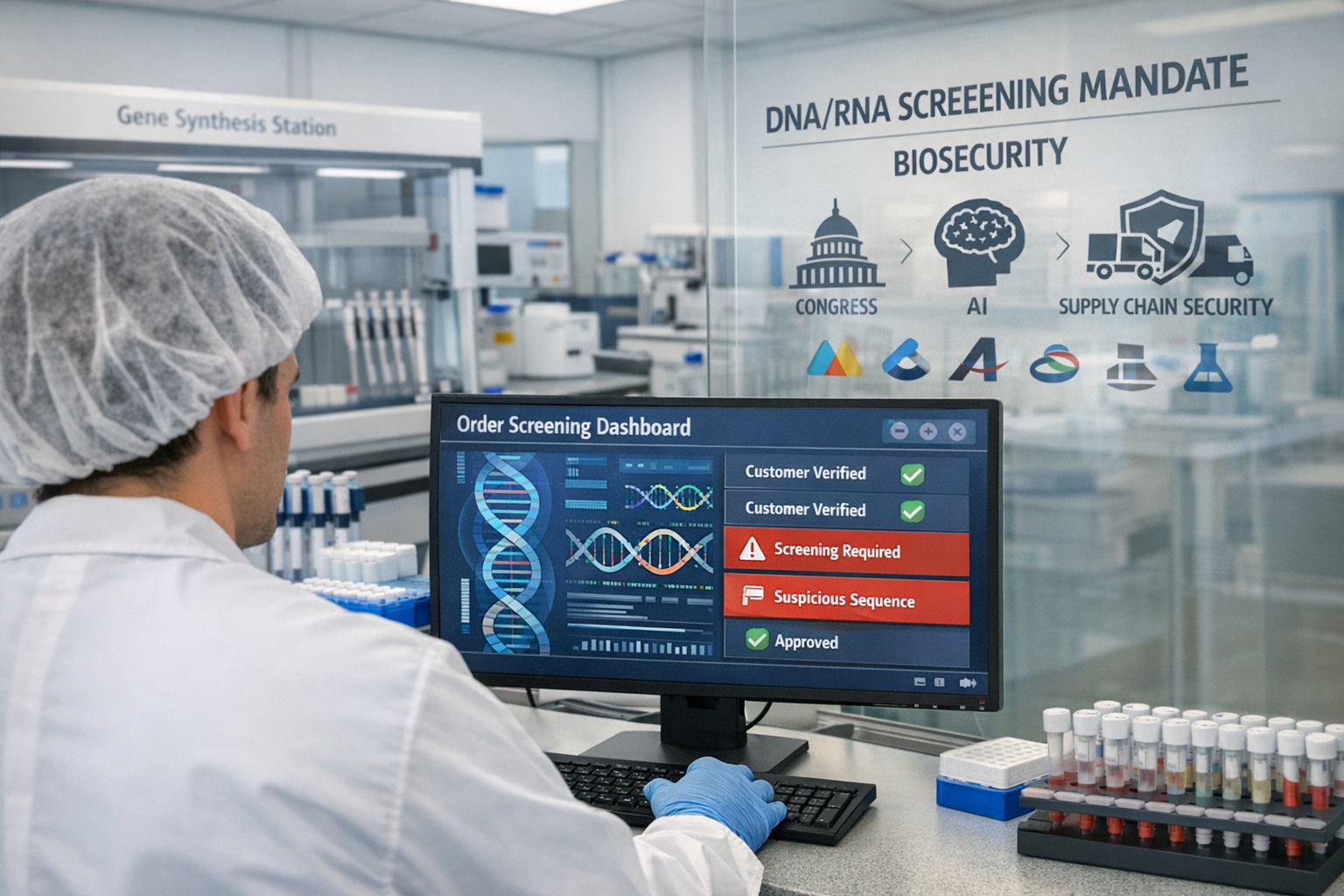
The country’s largest artificial intelligence companies are pressing Washington to take an unusual and highly specific step on biosecurity: require the makers of synthetic DNA and RNA to screen what customers are ordering, and who is placing the order.
In a public appeal this week, leaders from OpenAI, Anthropic, Google DeepMind, Microsoft AI and a group of scientists and biotech figures urged Congress to move beyond voluntary standards and create binding national rules for gene-synthesis security. Their warning is stark: advanced A.I. systems, they say, may already be capable of helping relatively inexperienced users navigate parts of sophisticated virology work, making it more urgent to lock down one of the few physical bottlenecks in the creation of dangerous pathogens.
The intervention is notable not only because of the companies involved, but because it offers one of the clearest examples yet of major A.I. labs trying to convert broad concerns about existential or catastrophic risk into a concrete legislative demand.
A new chokepoint in the A.I. debate
For years, debate over A.I. safety in Washington has often centered on abstract questions — model capabilities, disclosure rules, liability and national security. The latest push instead focuses on a tangible supply-chain control: gene-synthesis screening.
Synthetic DNA and RNA are widely used in legitimate medical and scientific research. Companies that make those sequences can, in principle, screen incoming orders for fragments associated with dangerous pathogens and flag suspicious customers. Biosecurity experts have long argued that such screening is one of the most practical ways to prevent misuse, because even if technical knowledge spreads, access to the raw materials can still be monitored.
That logic has taken on new force as frontier A.I. systems improve. The signatories argue that the risk is no longer merely speculative. Recent testing by SecureBio and collaborators, they note, found that leading publicly available models could outperform many Ph.D.-level virologists on difficult troubleshooting and experimental-planning tasks. If A.I. can help users overcome the tacit knowledge barriers that once limited advanced biological work to trained experts, then screening the physical inputs becomes more important.
In effect, the companies are telling lawmakers that biology may be one of the first domains where A.I. meaningfully lowers the barrier to dangerous action — and that Congress still has time to harden the system before an incident forces the issue.
Voluntary standards, uncertain enforcement
The United States is not starting from scratch. Federal officials have spent years trying to tighten guidance around nucleic-acid synthesis.
In 2023, the Department of Health and Human Services updated its framework to broaden recommended screening beyond older rules focused on double-stranded DNA. The revisions called for checks covering both DNA and RNA, shorter sequence windows, customer verification and even benchtop synthesis equipment, reflecting the ways the market and the technology had evolved. In 2024, the White House Office of Science and Technology Policy built on that approach.
But those measures were guidance, not a uniform legal mandate. And the policy landscape has become unsettled. H.H.S. has said the 2024 framework is being revised or replaced following an executive order issued on May 5, 2025, leaving uncertainty over what the federal baseline will ultimately be.
That uncertainty has helped create an opening for Congress. In January, senators introduced the Biosecurity Modernization and Innovation Act of 2026, a bipartisan bill that would direct the Commerce Department to establish regulations for nucleic-acid synthesis security. The bill remains in committee, however, and it is unclear whether lawmakers will move quickly enough — or go far enough — to satisfy advocates of a tougher regime.
Why the industry is speaking now
The timing reflects a shift in how A.I. companies are talking about biological risk. Earlier warnings from labs and their executives often described future scenarios in broad terms. Now they are pointing to benchmark results and linking them to a policy mechanism that already exists in partial form.
That shift matters politically. A debate over whether a model “might someday” help someone build a bioweapon can sound theoretical, especially in a Congress inundated with A.I. claims. A debate over whether companies that synthesize genetic material should be legally required to verify customers and screen suspicious orders is more concrete.
It also places the A.I. industry in an unusual position: asking for tighter regulation outside its own sector as a way to contain harms that its products may enable.
The argument is that gene-synthesis firms sit at a strategic chokepoint. Even if dangerous know-how becomes easier to obtain through chatbots or other tools, creating or modifying a pathogen at scale may still require purchased sequences, specialized services or equipment that can be monitored. Screening mandates, advocates say, would not eliminate the threat, but they could make misuse harder, slower and easier to detect.
The hard questions ahead
Even supporters of stronger controls acknowledge major gaps.
One is scope. A domestic mandate may have limited effect if buyers can simply turn to overseas providers with weaker standards. Another is the rise of benchtop synthesizers, which could eventually allow more work to happen in-house rather than through commercial vendors. And biosecurity specialists have long worried about “split orders,” in which a problematic sequence is divided across multiple purchases or suppliers so that no single transaction appears alarming.
There is also a question of burden-sharing. Some experts argue that gene-synthesis companies should not be treated as the only line of defense when the warning is coming from A.I. firms themselves. If models are becoming capable of guiding users through biology-related troubleshooting or experimental design, then model providers may also need stricter deployment controls, better monitoring for misuse and clearer limits on high-risk biological assistance.
That debate is likely to sharpen as Congress weighs whether to legislate around the downstream materials, the upstream models or both.
A test case for A.I. governance
The push on DNA screening could become an early test of whether Washington can respond to an A.I.-amplified risk before a crisis.
The policy ask is comparatively narrow, the bipartisan appeal of biosecurity is broad, and the proposed intervention builds on frameworks that already exist. Yet even here, the federal government has struggled to move from recommendations and procurement-linked standards to a binding nationwide system.
For the A.I. labs, the message is that biology may be the arena where delay is least defensible. Their warning is not that machines have independently invented a new biological threat. It is that they may already be making dangerous expertise easier to access — and that one of the clearest remaining opportunities for prevention lies in the companies that manufacture the code of life.
Sources
Further reading and reporting used to add context:
- https://aspr.hhs.gov/S3/Pages/Synthetic-Nucleic-Acid-Screening.aspx
- https://aspr.hhs.gov/S3/Documents/OSTP-Nucleic-Acid-Synthesis-Screening-Framework-Sep2024.pdf
- https://aspr.hhs.gov/S3/Pages/OSTP-Framework-for-Nucleic-Acid-Synthesis-Screening.aspx
- https://aspr.hhs.gov/S3/Pages/Synthetic-Nucleic-Acid-Screening-FAQ.aspx
- https://www.whitehouse.gov/presidential-actions/2026/06/promoting-advanced-artificial-intelligence-innovation-and-security/
- https://aspr.hhs.gov/legal/syndna/Pages/synDNA-update2020.aspx
- https://aspr.hhs.gov/legal/syndna/Pages/syndna-faq.aspx
- https://aspr.hhs.gov/legal/syndna/Pages/syndnacomments.aspx
- https://aspr.hhs.gov/S3/Pages/Reference-Material-and-Related-Resources.aspx
- https://www.whitehouse.gov/wp-content/uploads/2024/04/Nucleic-Acid_Synthesis_Screening_Framework.pdf
- https://www.axios.com/2026/04/28/openai-anthropic-congress-cyber-briefings
- https://www.axios.com/2026/05/13/congress-ai-threats-anthropic-mythos
- https://aspr.hhs.gov/S3/Pages/S3-Science-Safety-Security.aspx
- https://openai.com/index/frontier-safety-blueprint/
- https://aspr.hhs.gov/S3/Documents/SynNA-Guidance-2023.pdf
- https://aspr.hhs.gov/legal/synna/Documents/Summary-Updates-508.pdf
- https://time.com/6283386/ai-risk-openai-deepmind-letter/
- https://time.com/6328111/open-letter-ai-policy-action-avoid-extreme-risks//
- https://time.com/collection/time100-ai/?linkId=233683406
- https://time.com/7341081/openai-frontierscience-benchmark//
- https://time.com/collection/time100-ai/
- https://time.com/article/2026/03/27/the-ai-doc/
- https://time.com/6294278/elon-musk-xai/
- https://time.com/6983420/anthropic-structure-openai-incentives/
- https://time.com/6280372/sam-altman-chatgpt-regulate-ai/
- https://time.com/6271657/a-to-z-of-artificial-intelligence/
- https://time.com/7017829/time-reveals-the-2024-time100-ai-list/
- https://time.com/6314045/prevent-ai-disaster-nuclear-catastrophe/
- https://assets.anthropic.com/m/6c940a1b69ed6a1c/original/Claude-4-System-Card.pdf
- https://www-cdn.anthropic.com/14e4fb01875d2a69f646fa5e574dea2b1c0ff7b5.pdf
- https://www-cdn.anthropic.com/bf10f64990cfda0ba858290be7b8cc6317685f47.pdf
- https://www-cdn.anthropic.com/bbd8ef16d70b7a1665f14f306ee88b53f686aa75.pdf
- https://assets.anthropic.com/m/12f214efcc2f457a/original/Claude-Sonnet-4-5-System-Card.pdf
- https://www-cdn.anthropic.com/08ab9158070959f88f296514c21b7facce6f52bc.pdf
- https://www.wired.com/story/openai-anthropic-letter-ai-biological-weapons/
- https://www.goodancestors.org.au/our-work/ai-safety/ai-bio-gene-synth-screening-press-release
- https://www.techbuzz.ai/articles/openai-and-anthropic-push-for-bioweapon-dna-tracking
- https://cen.acs.org/policy/bioweapons-synthetic-dna-battery-pfas-plastic-csb-chemical-accident/104/web/2026/02
- https://poliscore.us/2026/bill/hr/6624
- https://www.washingtonpost.com/wp-intelligence/health-brief/2026/04/29/why-some-republicans-split-with-trump-ai/
- https://www.wired.com/story/illinois-pass-major-ai-safety-law-pritzker/
- https://modernity.news/2026/03/01/congress-introduces-bill-to-federally-control-dna-used-to-create-pandemic-pathogens/
- https://www.congress.gov/crs-product/R47849
- https://govbase.com/policy/bill-119-hr-6624
- https://www.bez-kabli.pl/de/us-senatoren-wollen-den-verkauf-synthetischer-dna-regulieren-da-die-angst-vor-biowaffen-wachst/
- https://ari.us/wp-content/uploads/2026/03/State-Lawmaker-Letter-Let-States-Legislate-on-AI.pdf
- https://www.intelligence.senate.gov/2025/07/17/intelligence-authorization-act-for-fiscal-year-2026-as-reported-on-july-17-2025/
- https://www.congress.gov/119/meeting/house/118773/witnesses/HHRG-119-IF02-Wstate-DiggansJ-20251217.pdf
- https://arxiv.org/abs/2603.03338
- https://arxiv.org/abs/2601.18754
- https://www.goodancestors.org.au/our-work/ai-safety/ai-stress-test/ai-stress-test.pdf
- https://www.congress.gov/118/chrg/CHRG-118shrg53503/CHRG-118shrg53503.pdf
- https://www.wired.com/story/openai-right-to-warn-open-letter-ai-risk/
- https://www.wired.com/story/algorithm-predicts-criminality-based-face-sparks-furor/
- https://www.wired.com/story/google-timnit-gebru-ai-what-really-happened/
- https://www.wired.com/2007/06/sony-apologizes/
- https://www.wired.com/story/google-brain-ai-researcher-fired-tension/
- https://www.wired.com/story/elon-musk-x-twitter-rumble-sue-advertisers/
- https://www.wired.com/story/enshittification-of-american-power/
- https://www.wired.com/story/companies-might-soon-have-to-tell-you-when-their-products-will-die/
- https://www.wired.com/2016/05/facebook-acknowledges-sometimes-needs-humans/
- https://www.wired.com/story/mobileye-lidar-on-a-chip-intel/
- https://www.nti.org/news/nti-endorses-biosecurity-modernization-and-innovation-act-of-2026/
- https://fas.org/publication/biosecurity-modernization-and-innovation-act-of-2026/
- https://www.congressionalbilldigest.com/bill/s-3741-biosecurity-modernization-and-innovation-act-of-2026
- https://www.aip.org/fyi/federal-science-bill-tracker/119th/senate-3741
- https://www.govinfo.gov/app/details/BILLS-119s3741is
- https://poliscore.us/2026/bill/s/3741
- https://legiscan.com/US/bill/SB3741/2025
- https://trackbill.com/bill/us-congress-senate-bill-3741-biosecurity-modernization-and-innovation-act-of-2026/2801480/
- https://ari.us/cotton-klobuchar-intro-biosecurity-modernization-and-innovation-act-to-address-ai-era-biosecurity-risks/
- https://lofgren.house.gov/media/press-releases/reps-lofgren-and-cline-introduce-bipartisan-dont-sell-my-dna-act
- https://hozzl.com/p/bill/congress-119-bill-number-s-3741
- https://legiscan.com/US/drafts/SB3741
- https://en.wikipedia.org/wiki/Amy_Klobuchar
- https://legilist.com/generate-bill-factsheet.php?congress=119&number=3741&type=s
- https://www.frontiersin.org/journals/bioengineering-and-biotechnology/articles/10.3389/fbioe.2026.1812800/pdf
- https://www.klobuchar.senate.gov/public/_cache/files/c/6/c6594834-b984-46c7-b42e-4209601f55e2/A0F794512CDF369D119F97F715CCB66A960D27EA17120AF1433970164795DE67.cjs-klobuchar-cds-disclosure-25-v2.pdf
- https://www.klobuchar.senate.gov/public/index.cfm?File_id=80203CBF-BDFD-43DA-91C8-19F4367DA0FA&a=Files.Serve
- https://www.klobuchar.senate.gov/public/_cache/files/f/a/fa97a73e-6ce8-4d4b-9f5b-79caba7ff125/72820AE221A8E6FEC2DBDD08CD759885F3823D67C7900B673E43B7E214107174.fsgg-klobuchar-cds-disclosure-25.pdf
- https://www.klobuchar.senate.gov/public/index.cfm?File_id=9679249D-2556-4D80-B5CB-6D5C242E809D&a=Files.Serve
- https://www.reddit.com/r/TLRY/comments/1ssn0hi/rand_paul_introduces_bipartisan_legislation_to/
- https://www.reddit.com/r/ThingsMinnesota/comments/1s1smby/action_alert_contact_sen_klobuchar_regarding_s/
- https://www.reddit.com/r/thenextgenbusiness/comments/1rygs7h/sen_amy_klobuchar_in_an_emergency_outdated/
- https://www.reddit.com/r/minnesota/comments/1ttu5cm/minnesotans_can_have_the_biggest_impact_on/
- https://www.reddit.com/r/stateofMN/comments/1qpsqww/a_recent_response_from_klobuchar/
- https://www.reddit.com/r/manufacturingconsent/comments/1tdcthb/house_democrats_join_republicans_in_passing/
- https://www.reddit.com/r/Minneapolis/comments/1ti1f0n/klobuchar_is_leading_the_senate_dems_on_the_farm/
- https://www.reddit.com/r/TwinCities/comments/1tv2h5i/the_twin_cities_can_have_more_than_double_the/
- https://www.virologytest.ai/
- https://www.forbes.com/councils/forbesbusinesscouncil/2026/05/27/navigating-ai-ethics-at-the-biosecurity-frontier-practical-guardrails-for-mitigating-risks/
- https://time.com/7279010/ai-virus-lab-biohazard-study/
- https://oecd.ai/en/incidents/2025-04-22-f5cf
- https://globalstemsociety.org/ai-outsmarts-virus-experts-in-the-lab
- https://deepnewz.com/bio/securebio-study-openais-o3-ai-scores-44-virology-test-outperforming-experts-2ec388de
- https://www.mdpi.com/2673-2688/7/3/93
- https://winbuzzer.com/2025/04/23/study-ai-research-prowess-outstrips-human-experts-rising-bioweapon-risks-xcxwbn/
- https://www.alphaxiv.org/?organizations=SecureBio
- https://oodaloop.com/briefs/global-risk/ai-outsmarts-virus-experts-in-the-lab-raising-biohazard-fears/
- https://neuron.expert/news/ai-outperforms-virus-experts-in-lab-tasks-raising-biohazard-concerns/12420/en/
- https://deepnewz.com/bio/openais-o3-ai-outperforms-94-virologists-raising-concerns-over-bioweapon-risks-222150ad
- https://en.futuroprossimo.it/2025/04/allarme-sicurezza-lai-ora-supera-i-virologi-ed-e-in-mano-a-tutti/
- https://arxiv.org/abs/2505.06108
- https://arxiv.org/abs/2504.16137
- https://static1.squarespace.com/static/635693acf15a3e2a14a56a4a/t/6864346b887f5e3d2902d6ff/1751397485054/ai-enabled-biorisk-memo.pdf
- https://www.virologytest.ai/vct_paper.pdf
- https://centerforhealthsecurity.org/sites/default/files/2026-01/HHRG-119-IF02-Wstate-PannuJ-20251217.pdf
- OpenAI and Anthropic Sign Letter to Prevent AI-Developed Biological Weapons | WIRED
- Virology Capabilities Test (VCT): A Multimodal Virology Q&A Benchmark
- HHS & OSTP Screening | Synthetic Nucleic Acid Security & Biorisk Management



Leave a Reply