
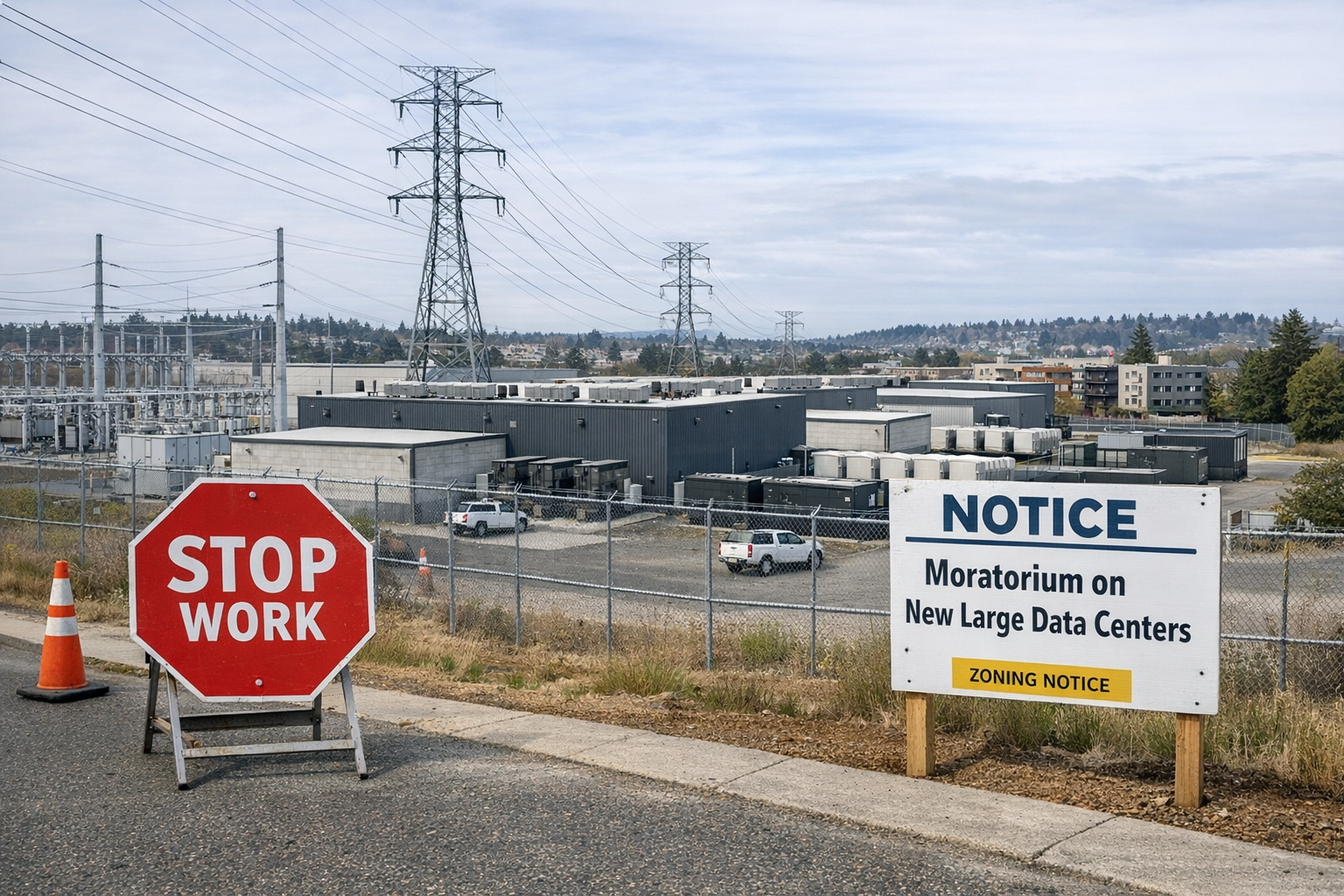
Cities Move From Skepticism to Limits on Data Centers
A growing local backlash against the infrastructure powering the artificial intelligence boom is beginning to harden into law.
In Seattle, the City Council is poised to approve a one-year moratorium on new or expanded large-load data centers, a step that would make the city one of the most prominent American tech hubs to temporarily freeze part of the industry’s physical expansion. In Monterey Park, Calif., voters have gone further, approving a permanent citywide ban on data centers unless residents later decide to reverse it.
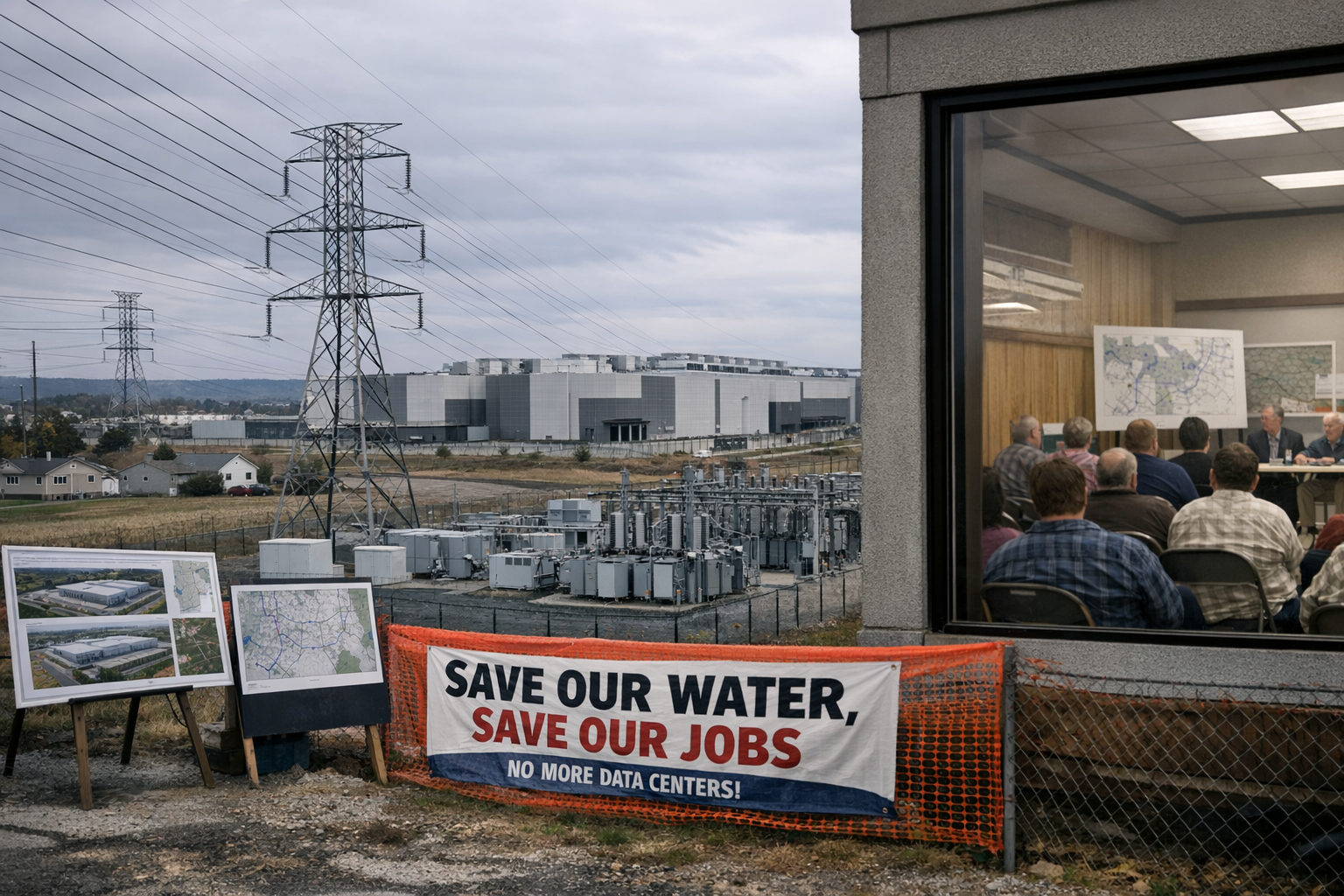
Taken together, the moves suggest that opposition to AI-related development is entering a sharper phase. For months, city halls around the country have wrestled with concerns that data centers — the warehouse-scale buildings packed with servers that train and run AI systems — consume immense amounts of electricity, strain water supplies, generate noise and diesel pollution, and reshape industrial land use with little obvious benefit to nearby residents. Now some local governments, and in Monterey Park’s case voters themselves, are moving beyond hearings and studies to enforceable restrictions.
Seattle’s action is especially striking because of the city’s place in the technology economy. Home to Amazon and a major base for Microsoft, Seattle has long been associated with the companies driving the cloud-computing and AI race. A construction freeze there would be a symbolic rebuke to the idea that every tech-heavy city must accommodate the rapid buildout of AI infrastructure.
Seattle’s Proposed Freeze
Seattle’s push gained momentum after four companies sought to build five large-scale facilities in areas served by the city’s public utility. City officials said those projects could collectively demand as much as 369 megawatts of power, roughly enough electricity for about 300,000 homes. Earlier city discussions framed the moratorium as applying to facilities of at least 10 megawatts, underscoring that the concern is not small server rooms but industrial-scale power users.
Council committees unanimously advanced the measure on June 3, clearing the way for a full council vote that is widely expected to succeed. The proposal would impose a 365-day emergency moratorium while officials develop a more lasting framework for handling large-load customers.
That larger policy debate has centered not only on planning and zoning, but also on who should bear the costs of these facilities. Seattle officials have been preparing separate utility-rate and large-load policies aimed at ensuring that expensive system upgrades tied to huge new electricity demands are not passed on to ordinary households and businesses.
The issue has become more urgent as AI systems require ever larger computing clusters. Training and operating advanced models can demand vast amounts of power, and utilities across the country have been scrambling to forecast whether the next wave of data-center requests will force new investments in substations, transmission lines and generation capacity.
A Permanent Ban by Ballot Box
If Seattle’s moratorium is a temporary pause, Monterey Park’s action represents something more definitive.
In the Los Angeles County city, voters approved Measure NDC in a June 2 special election by an overwhelming margin — 86.38 percent to 13.62 percent — permanently prohibiting data centers within city limits unless voters choose to overturn the ban in the future. While many municipalities have enacted temporary or open-ended moratoriums through council action, Monterey Park appears to be the first place where residents themselves have voted directly for a permanent prohibition.
The vote grew out of a dispute over a proposed data center at 1977 Saturn Street, which galvanized local opposition. Monterey Park had already adopted a moratorium in January and then placed the permanent ban on the ballot in March. The proposed Saturn Street project was later withdrawn, but the political fight it triggered did not dissipate. Instead, it expanded into a broader referendum on whether the city wanted data centers at all.
That distinction matters. A prohibition approved directly by voters can be harder to reverse, both politically and legally, than one adopted by a city council. It also signals a deeper level of public resistance: not simply concern about a particular site or developer, but a citywide judgment about the kind of infrastructure residents are willing to host.
Why Data Centers Have Become a Local Flash Point
For years, data centers were often treated as a specialized planning issue, welcomed by some jurisdictions as a source of construction work and tax revenue. But the AI boom has changed the scale of the discussion.
Newer facilities can draw extraordinary amounts of power, particularly those designed to house chips used for AI training and inference. In many communities, residents and local officials worry that utilities will have to make expensive upgrades to accommodate those loads, with costs eventually spreading to other customers. Others question whether the tradeoff makes sense for facilities that can occupy large tracts of land while employing relatively few people once operational.
Environmental and quality-of-life concerns have also fueled resistance. Opponents have raised alarms about backup diesel generators, persistent mechanical noise, water demands for cooling in some designs, and the broader public-health effects of concentrating heavy infrastructure near neighborhoods already burdened by industrial activity.
Those concerns have surfaced in different forms across the country, but the fights in Seattle and Monterey Park stand out because of what they suggest about the next stage of politics around AI infrastructure. The debate is no longer confined to abstract discussions about energy use and climate goals. It is becoming a local land-use battle, fought over permits, utility rates, zoning codes and ballot measures.
What Comes Next
In Seattle, the immediate question is whether the full council formalizes the moratorium and what kind of permanent rules, if any, follow. City planning documents have pointed toward later legislation that could impose longer-term controls, but officials have also signaled that the goal may be regulation and cost allocation rather than an outright permanent ban.
In Monterey Park, the next test may be whether the measure faces a legal challenge or whether developers simply shift proposed projects to neighboring cities. That possibility could complicate the broader effect of local crackdowns: a city can close its doors, but regional electricity and land-use pressures may simply move down the road.
Still, the political message from both places is unmistakable. As the race to build AI intensifies, some communities are asserting that they do not want to absorb the infrastructure costs unquestioningly. In a moment when technology companies are pouring billions into computing capacity, local officials and voters are beginning to ask a harder question: who benefits from that growth, and who pays for it?
Sources
Further reading and reporting used to add context:
- Councilmembers introducing moratorium on data centers in Seattle – Seattle City Council Blog
- https://www.montereypark.ca.gov/1710/Data-Center-Information
- https://council.seattle.gov/2026/03/10/seattle-city-council-unanimously-approves-emergency-moratorium-on-detention-centers/
- https://www.capitolhillseattle.com/2026/05/seattle-city-council-takes-up-plan-for-data-center-moratorium/
- https://www.theguardian.com/us-news/2026/jun/03/california-monterey-park-datacenters-ban
- https://www.axios.com/local/seattle/2026/05/15/seattle-data-center-moratorium-ai-energy
- https://wilson.seattle.gov/2026/04/18/statement-on-data-centers/
- https://lapublicpress.org/2026/02/la-data-center-monterey-park/
- https://www.cbsnews.com/losangeles/news/monterey-park-data-center-ban-vote-special-election/
- https://www.axios.com/local/charlotte/2026/05/11/data-center-moratorium-city-council-ai-150
- https://www.geekwire.com/2026/data-center-resistance-comes-home-to-seattle-as-council-considers-a-one-year-freeze/
- https://countercurrents.org/2026/05/the-ripple-effects-of-organizing-against-data-centers/
- https://www.axios.com/local/denver/2026/05/19/denver-data-center-moratorium-approved
- https://wilson.seattle.gov/2026/05/01/mayor-wilson-identifies-initial-steps-for-action-on-data-centers/
- https://www.axios.com/local/indianapolis/2026/05/15/the-city-county-council-passed-a-data-center-moratorium-heres-whats-next
- https://www.latimes.com/environment/story/2026-06-02/monterey-park-to-take-landmark-vote-on-banning-data-centers-ban
- https://seattle.legistar.com/View.ashx?GUID=4328AACB-B773-442C-82DC-75FBC4B4CCED&ID=1416057&M=PA
- https://www.foodandwaterwatch.org/wp-content/uploads/2026/05/No-Data-Centers-in-Seattle.pdf
- https://www.montereypark.ca.gov/DocumentCenter/View/18736/Cascade-Article-April-2026
- https://www.reddit.com/r/SeattleWA/comments/1tw8pxo/seattle_advances_ai_data_center_moratorium_bill/
- https://seattle.legistar.com/View.ashx?GUID=5456166A-2625-48B3-83F3-FA83B3CF5673&ID=1400177&M=PA
- https://www.reddit.com/r/sgv/comments/1tw1tfm/measure_to_ban_data_centers_in_monterey_park/
- https://ceqanet.lci.ca.gov/2026050558
- https://www.lacdp.org/ballotmeasures
- https://www.montereypark.ca.gov/1720/2026-Special-Election-Information
- https://www.montereypark.ca.gov/m/NewsFlash/Home/Detail/1343
- https://www.latimes.com/politics/story/2026-06-02/primary-election-2026-live-results-california-los-angeles
- https://www.montereypark.ca.gov/DocumentCenter/View/18989/20260602-June-2-2026-Special-Election-128-EN
- https://clerk.lacity.gov/elections/municipal-elections/ballot-measures
- https://content.lavote.gov/docs/rrcc/documents/measures-appearing-on-the-ballot-3-10-26-v-3.pdf
- https://www.lavote.gov/ballot-marking-device-code-list
- https://clerk.lacity.gov/elections
- https://www.smdp.com/where-to-vote/
- https://govbase.com/tools/elections/ca/ca_2026-06-02_state
- https://www.montereypark.ca.gov/Archive.aspx?ADID=1563
- https://results.lavote.gov/text-results/4338
- https://rrcc.lacounty.gov/Camp/Schedules/9942.pdf
- https://en.wikipedia.org/wiki/2026_Los_Angeles_County_Board_of_Supervisors_election
- https://www.countyofmonterey.gov/government/departments-a-h/elections/elections
- https://elections.cdn.sos.ca.gov/ror/60day-primary-2026/complete-ror.pdf
- https://en.wikipedia.org/wiki/2026_Los_Angeles_County_elections
- https://en.wikipedia.org/wiki/2026_Los_Angeles_elections
- https://en.wikipedia.org/wiki/2006_California_gubernatorial_election
- https://en.wikipedia.org/wiki/2026_California_State_Senate_election
- https://www.reddit.com/r/InterstellarKinetics/comments/1tw3br4/breaking_residents_of_monterey_park_california/
- https://www.seattle.gov/council/meetings/committees-and-agendas/land-use
- https://www.seattlechannel.org/mayor-and-council/city-council/2026-2027-land-use-and-sustainability?videoid=x186951
- https://council.seattle.gov/
- https://app.thecommonnews.com/seattle-wa/committees/land-use-and-sustainability-committee
- https://www.theguardian.com/technology/2026/jun/03/seattle-datacenter-moratorium
- https://council.seattle.gov/2026/03/27/public-safety-chair-kettle-audit-of-camera-and-real-time-crime-center-tools-needs-to-be-completed-by-june-world-cup-events/
- https://www.reddit.com/r/SeattleWA/comments/1tolz7h/seattle_advances_data_center_moratorium_amid/
- https://www.caledoniatownship.org/AgendaCenter/ViewFile/Minutes/_02162026-530
- https://seattle.legistar.com/View.ashx?GUID=E5669E10-2122-43FD-A6F5-EEB8A8D87E45&ID=1408763&M=PA
- https://council.seattle.gov/wp-content/uploads/2025/06/Anti-Displace-Resource-Fair.pdf
- https://www.champaigncountyil.gov/CountyBoard/ELUC/2026/260409_Meeting/260409AgendaFull.pdf
- https://www.reddit.com/r/Seattle/comments/1tw9rk0/seattles_data_center_moratorium_moves_forward/
- https://www.reddit.com/r/Seattle/comments/1t0g5ec/councilmembers_introducing_moratorium_on_data/
- https://seattle.legistar.com/ViewReport.ashx?Extra=WithText&GID=393&GUID=D1003451-3FD8-4594-ADFA-651318C93E38&ID=2232156&M=R&N=Master&Title=Legislation+Details+%28With+Text%29
- https://www.reddit.com/r/SeattleWA/comments/1t0w5k9/seattle_councilmembers_introducing_moratorium_on/
- https://www.montereypark.ca.gov/1710/Proposed-Data-Center-at-1977-Saturn-Stre
- https://content.govdelivery.com/accounts/WASEATTLE/bulletins/41a2b98
- https://seattle.legistar.com/MeetingDetail.aspx?GUID=9F84BAE9-FBCA-4105-8609-F50141324C95&ID=1417911&Options=&Search=
- https://council.seattle.gov/tag/data-centers/
- https://www.dwt.com/blogs/energy–environmental-law-blog/2026/05/data-center-ai-infrastructure-seattle-moratorium
- https://council.seattle.gov/category/top-story/
- https://www.reddit.com/r/ourtownreno/comments/1tudi6k/renos_moratorium_against_any_new_data_centers_is/
- Seattle, home to Amazon and Microsoft, poised to pass moratorium on new datacenters | Technology | The Guardian






Leave a Reply