
A White-Collar Reckoning That Has Yet to Arrive
For more than a year, some of the most prominent figures in artificial intelligence warned of a coming labor shock: entry-level office jobs hollowed out, whole categories of knowledge work erased, a new efficiency wave that would leave millions scrambling. Companies invoking A.I. in restructuring plans only seemed to reinforce the sense that the disruption had already begun.
But the broad white-collar bloodbath has not shown up — at least not yet.
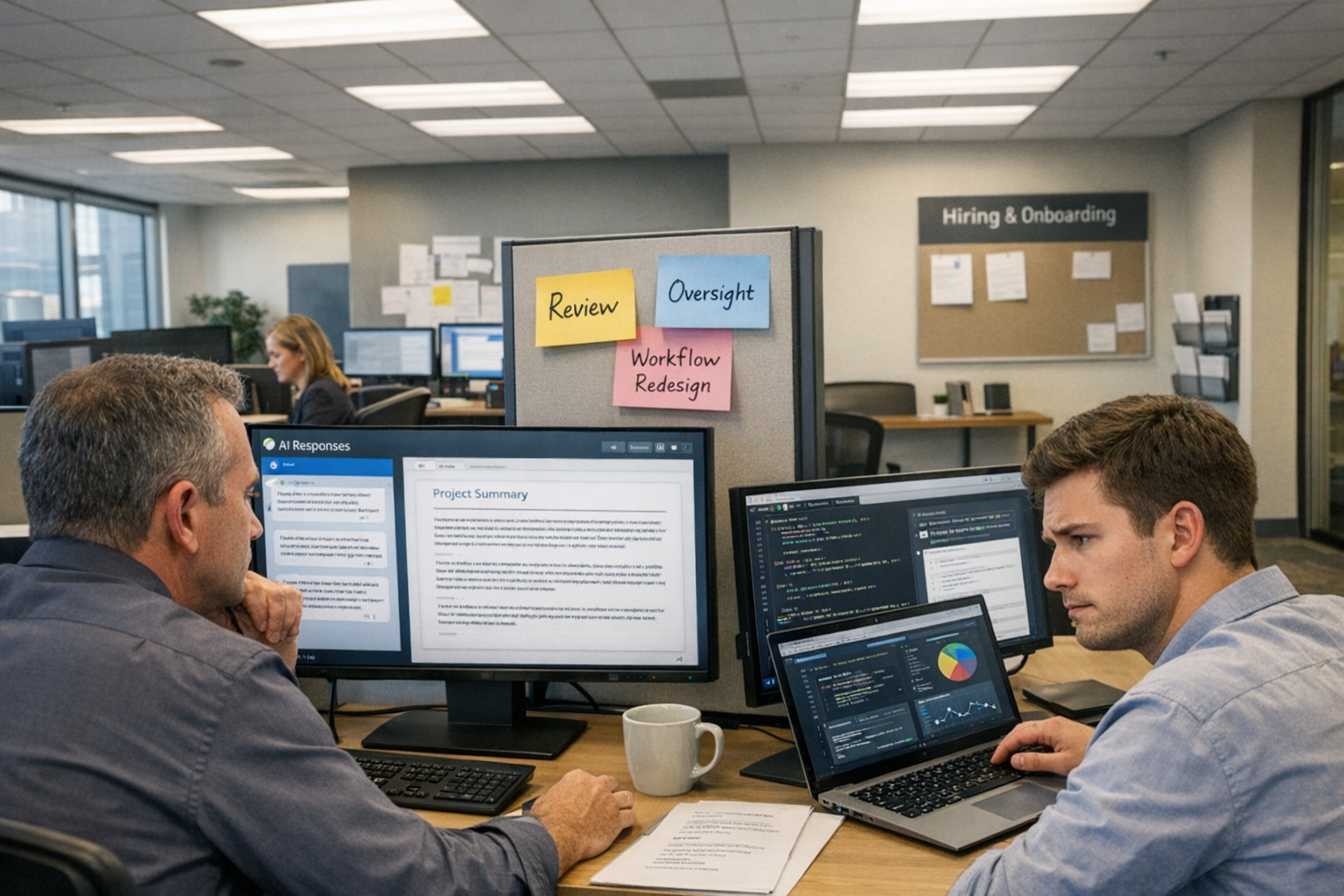
Instead, a subtler and more uneven transformation is taking hold across workplaces. Jobs are changing faster than they are disappearing. Employers are folding generative A.I. into daily operations, workers are using it to draft memos, analyze data and write code, and managers are redesigning tasks around the technology. The immediate result has been less mass unemployment than a steady rewriting of what many jobs require and how they are performed.
That distinction matters. It suggests that the first phase of the A.I. era may not be defined by dramatic layoffs so much as by reorganization: fewer straightforward entry points, higher expectations for judgment and oversight, and a widening gap between workers who can use the tools well and organizations that can integrate them effectively.
OpenAI itself acknowledged as much in a labor framework released this spring, arguing that for many occupations the first-order effect of A.I. is more likely to be restructuring than outright elimination. Economists and labor researchers, looking for evidence of a direct A.I.-driven unemployment surge, have so far found a more complicated picture.
Work Is Being Rewritten
The change is visible less in payrolls than in the texture of jobs.
In many A.I.-exposed roles, workers are now expected to do fewer rote tasks and more reviewing, editing and decision-making. Recruiters and consultants say some entry-level positions increasingly carry demands once associated with more senior staff: communication, discernment, client handling and the ability to spot errors in machine-generated work.
That pattern has emerged alongside rapid adoption. Surveys by the Federal Reserve and private firms have found substantial workplace use of generative A.I., even as unemployment data have not produced a simple, corresponding spike. The technology is being absorbed into offices, but not in the blunt way earlier predictions implied.
The gains, however, do not appear evenly distributed. Companies that can redesign workflows around A.I. — changing who does what, how outputs are checked and where humans remain accountable — are more likely to see real productivity benefits. Others may simply layer A.I. on top of existing processes, creating speed in some places and confusion in others.
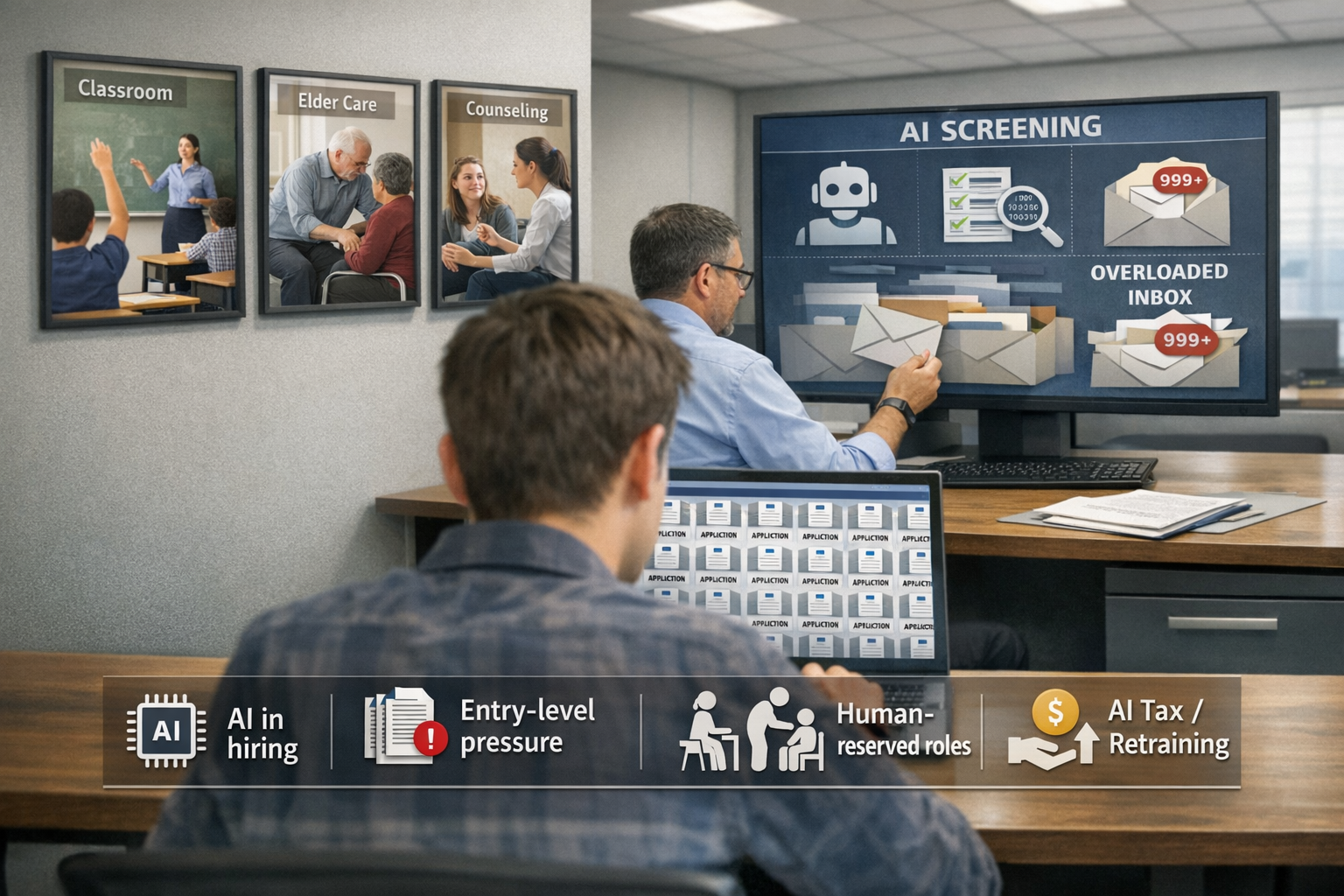
This is one reason the labor effects have been difficult to read. A.I. may be reducing demand for certain tasks without yet eliminating whole occupations. It may also be changing hiring behavior before it changes head counts: slowing junior recruitment, narrowing training pipelines and quietly raising the bar for new entrants.
The Missing Middle in Software
Nowhere is that tension clearer than in software engineering, where generative A.I. has become both a productivity tool and a source of anxiety.
Developers increasingly use large language models to generate code, troubleshoot and accelerate routine work. But some engineers warn that the speed comes at a cost: teams may ship systems they no longer fully understand.
That concern has been described by practitioners as a kind of “cognitive debt” — an accumulation of technical work produced quickly with A.I. assistance, but without the deep human comprehension needed to maintain, debug or improve it over time. In one widely shared critique, the developer Florian Herrengt described engineers repeatedly asking A.I. to fix a bug while lacking a basic understanding of where the underlying data came from, producing software that grows more layered and opaque with each machine-generated patch.
The fear is not simply that A.I. replaces programmers. It is that it thins out the middle of the profession: reducing the opportunities through which junior developers become experienced ones, while leaving fewer people with a working mental model of the systems they are supposed to oversee.
That possibility has implications far beyond engineering. If A.I. handles the apprentice work in law, finance, consulting or marketing, the question becomes how workers acquire the judgment that employers still say they need.
A Faster Rollout Than the Controls Around It
The workplace transition is unfolding against another backdrop: companies are deploying A.I. faster than they are building the governance to control it.
A recent IBM survey found that most technology leaders said they were accountable for A.I. systems they did not fully control, and only a small share said they felt fully prepared for the scale of A.I.-agent deployment ahead. That mismatch — between adoption and operational readiness — helps explain why the labor story remains messy.
In some cases, companies may be overstating A.I.’s direct role in job cuts, using the technology as a shorthand explanation for broader cost pressures or restructuring plans. Earlier reporting has suggested that some “A.I.-washing” of layoffs may be underway, with executives invoking automation as part of the story even when the underlying causes are more conventional.
At the same time, the absence of immediate carnage should not be mistaken for stability. Labor-market shifts often show up first in places that headline job numbers miss: in hiring freezes, weaker wage growth, reduced mobility and shrinking ladders into professional careers.
Why the Moment Still Matters
The crucial question now is whether this softer phase of disruption remains a transition or becomes a prelude.
If A.I. meaningfully raises productivity and firms use those gains to expand output, the technology could support new kinds of jobs even as it remakes old ones. But if companies use A.I. mainly to compress teams, cut entry-level hiring and demand more from fewer workers, then today’s relatively mild labor picture may harden into something more severe.
For young workers especially, the stakes are high. Many professional careers have long depended on junior roles that involve repetitive tasks, not because those tasks are glamorous but because they teach context, judgment and domain knowledge. If A.I. absorbs too much of that rung on the ladder, the long-term effects may not appear as sudden layoffs but as stalled careers and thinner pipelines of expertise.
That is part of why the current moment feels so unsettled. The apocalypse foretold by A.I. executives has not arrived in the form many expected. But neither has a simple story of liberation through productivity. What has emerged instead is a workplace in which the machine can do more, the human is expected to do different things, and the institutions meant to manage that shift are still catching up.
Sources
Further reading and reporting used to add context:
- https://www.pwc.com/gx/en/1/services/ai/ai-jobs-barometer.rhs.html
- https://www.bcg.com/publications/2026/ai-will-reshape-more-jobs-than-it-replaces
- AI reshapes global labour market into two distinct paths, rewarding human skills: PwC 2026 Global AI Jobs Barometer | PwC
- https://www.aeaweb.org/articles?id=10.1257%2Fpandp.20261004
- https://www.deloitte.com/us/en/what-we-do/capabilities/applied-artificial-intelligence/content/state-of-ai-in-the-enterprise.html
- https://insight.kellogg.northwestern.edu/article/is-ai-turning-back-the-clock-on-the-job-market
- https://archive.ph/7dCke
- https://www.hks.harvard.edu/publications/economists-weigh-future-work-and-ai
- https://www.federalreserve.gov/econres/notes/feds-notes/monitoring-ai-adoption-in-the-u-s-economy-20260403.html
- https://www.reddit.com/r/GUARDIANauto/comments/1vmazgs/tech_ai_was_supposed_to_destroy_jobs_wheres_the/
- https://www.ecb.europa.eu/press/economic-bulletin/focus/2026/html/ecb.ebbox202604_01~d9259db536.en.html
- Modeling an AI jobs transition | OpenAI
- New IBM Study Finds CIOs and CTOs Face Growing AI Control Gap as Enterprise Deployment Scales
- https://www.astrid-online.it/static/upload/wef_/wef_chief_economists_outlook_january_2026.pdf
- https://privatebank.jpmorgan.com/content/dam/jpm-pb-aem/global/en/documents/outlook2026/JPMorganOutlook2026PromiseandPressure.pdf?page=45
- https://www.chicagofed.org/-/media/publications/working-papers/2026/wp2026-07.pdf?sc_lang=en
- https://bcghendersoninstitute.com/wp-content/uploads/2026/04/ai-will-reshape-more-jobs-than-it-replaces.pdf
- https://www.oecd.org/content/dam/oecd/en/publications/reports/2026/07/oecd-employment-outlook-2026_a41e8b9f/7e710f54-en.pdf
- https://economy.ac/sites/default/files/document/2026/05/The%20AI%20Labor%20Shift%20Replaceable%20Tasks%2C%20Irreplaceable%20Judgment%20and%20the%20New%20Politics%20of%20Work%20-%20The%20Economy.pdf
- https://arxiv.org/abs/2601.02554
- https://www.theguardian.com/technology/2026/feb/17/ai-artificial-intelligence-coding-tech
- https://www.theguardian.com/technology/series/reworked
- https://www.theguardian.com/technology/2026/may/11/ai-worker-control-surveillance
- https://www.theguardian.com/technology/2026/jul/25/ai-jobs-apocalypse-human-labor
- https://www.theguardian.com/technology/2026/apr/06/tech-layoffs-ai-work
- https://www.theguardian.com/technology/2026/jun/11/ai-absolutism-apocalyptic-future
- https://www.theguardian.com/technology/2026/feb/13/ai-effects-on-business-industry-evidence-to-allay-investor-fears
- https://www.theguardian.com/technology/ng-interactive/2026/feb/19/ai-work-future
- https://www.theguardian.com/technology/ng-interactive/2026/feb/20/ai-future-work-technology-white-collar
- https://www.theguardian.com/technology/software
- https://www.theguardian.com/technology/2026/jul/06/all
- https://www.theguardian.com/technology/2026/jan/28/artificial-intelligence-will-cost-jobs-admits-liz-kendall
- https://recruiters.theguardian.com/assets/files/hr_tech/HRTechGuide_GuardianJobs.pdf
- https://advertising.theguardian.com/assets/files/rate-card-2026-%281%29.pdf
- https://recruiters.theguardian.com/assets/files/inclusive_recruitment/The-Guardian-Jobs-guide-to-inclusive-recruitment.pdf
- https://feeds.simonwillison.net/2026/Jul/2/understand-to-participate/
- https://simonwillison.net/2026/Jul/2/understand-to-participate/
- https://simonwillison.net/2026/Mar/21/profiling-hacker-news-users/
- https://simonwillison.net/2026/Feb/17/
- https://simonwillison.net/2025/Oct/8/simon-hojberg/
- https://simonwillison.net/2026/Jul/2/
- https://simonwillison.net/guides/agentic-engineering-patterns/interactive-explanations/changes/
- https://simonwillison.net/tags/geoffrey-litt/
- https://simonwillison.net/2026/Feb/15/
- https://simonwillison.net/2025/Oct/8/
- https://simonwillison.net/2026/Mar/25/thoughts-on-slowing-the-fuck-down/
- https://simonwillison.net/2026/Feb/?page=4
- https://blog.florianherrengt.com/vibe-coder-career-path.html
- https://www.reddit.com/r/theprimeagen/comments/1vme1mg/ai_is_removing_the_middle_class_of_software/
- https://www.reddit.com/r/hackernews/comments/1vmgnjh/ai_is_removing_the_middle_class_of_software/
- https://www.reddit.com/r/AIDiscussion/comments/1vme34c/ai_is_removing_the_middle_class_of_software/
- https://theworkforcelens.substack.com/p/ai-middle-management-future-of-work
- https://notafactoryanymore.com/2026/04/10/what-to-do-when-ai-is-removing-the-lower-rungs-of-the-career-ladder/comment-page-1/
- https://www.reddit.com/r/softwareengineer/comments/1uihq4t/removed/
- https://www.mtsoln.com/en/insight/ai-destroying-middle-class-standardized-jobs-economics-of-taste/
- https://watchparallax.com/posts/the-bifurcation
- https://www.reddit.com/r/recruitinghell/comments/1ioqa52
- https://webiano.digital/doing-it-work-without-ai-in-2026-is-possible-and-increasingly-pointless/
- https://www.reddit.com/r/softwareengineer/comments/1u9wdtb/this_feels_and_is_different/
- https://blog.logrocket.com/dont-let-ai-erase-next-generation-dev-leaders/
- https://www.reddit.com/r/programming/comments/1ts7ahi/removed/
- https://systemthinkinglab.ai/newsletters/ai-will-eliminate-an-engineering-role-it-is-not-the-junior-one/
- https://wippler.dev/posts/no%2C-ai-is-not-replacing-software-engineers
- https://blog.georgekosmidis.net/ai-will-not-replace-software-engineers-but-it-might-erase-the-role.html
- https://nodedrift.com/blog/ai-eating-software-jobs-developers-paying-attention
- https://drfloriansteiner.substack.com/p/what-does-ai-mean-for-my-job-the
- https://www.reddit.com/r/cscareerquestions/comments/1mouh4h/deleted_by_user/
- https://www.reddit.com/r/ExperiencedDevs/comments/1snpttx/removed/
- https://www.reddit.com/r/softwareengineer/comments/1vfys9z/am_i_wrong_for_seeing_ai_as_a_tool_for_engineers/



Leave a Reply