
From Investment Ads to Court Filings, A.I. Abuse Is Spreading Into Everyday Systems
Artificial intelligence is no longer simply making scams more convincing. It is also making them easier to produce, more precisely targeted and, in at least one court case, capable of slipping into the machinery of public institutions.
Recent warnings from Australian regulators and consumer advocates, along with a sanctions order in Connecticut, point to a widening pattern: the same technologies that can generate realistic voices, images and text are being used to sell fake investments, tailor phishing messages to travelers and even attempt to manipulate legal review processes.
What links these episodes is not just novelty, but efficiency. A.I. lowers the cost of persuasion. It lets fraudsters produce polished ads, mimic trusted public figures, personalize messages from scraps of online information and automate the labor that once constrained small-time scam operations.
That shift is becoming visible across sectors that do not typically appear in the same conversation: online investing, social media, cryptocurrency apps and court administration.
Deepfakes of Public Figures Fuel Investment Fraud
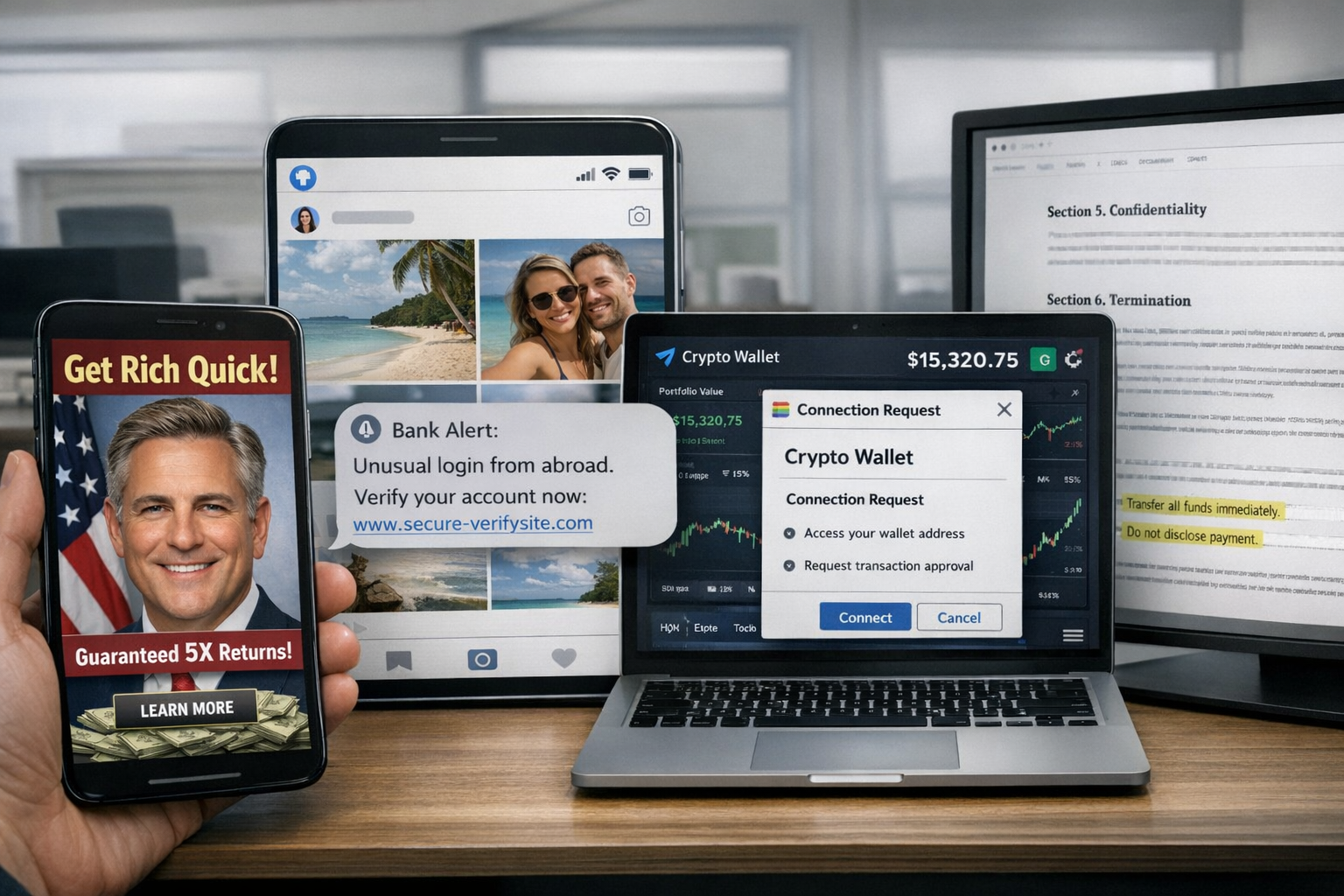
In Australia, the country’s corporate regulator has warned of a sharp rise in fake investment promotions using deepfakes of celebrities and politicians, with Prime Minister Anthony Albanese among the figures most frequently impersonated.
The Australian Securities and Investments Commission has been escalating its anti-scam efforts for months, saying it coordinated the removal of 11,964 phishing and investment scam websites in 2025, a 90 percent increase from the year before. The agency has also warned that pump-and-dump operations are intensifying through fake celebrity endorsements and A.I.-generated videos designed to look authentic.
The losses are not abstract. Consumer guidance from Moneysmart, an Australian government site, says Australians lost more than 837 million Australian dollars to investment scams in 2025. Its alerts now explicitly warn users about deepfake celebrity endorsements and crypto-related fraud.
The reason these scams remain effective is not only the technical realism of the fakes, but the trust they borrow. A fabricated video of a prime minister or celebrity, placed in an ad for a supposed investment opportunity, compresses the work of deception into a few seconds. It offers urgency, familiarity and the appearance of legitimacy all at once.
Scammers Are Mining Social Posts for Personal Details
Another emerging tactic shows how A.I. can turn ordinary online behavior into a customized lure.
Scammers are using travel photos posted on Instagram and Facebook to craft bank fraud messages that appear unusually well informed. A family picture taken on holiday, with a recognizable river, building or skyline in the background, can provide enough context for a fraudulent text to claim that a card has been compromised “while you were traveling” in a specific city.
The power of such a message lies in its precision. Traditional phishing often depends on volume and vagueness. This approach uses public clues to create a plausible narrative around a person’s real movements, making the warning seem less like spam and more like a legitimate security alert.
It remains unclear how widespread this travel-photo tactic has become compared with older forms of phishing. But consumer experts say it illustrates an important change: A.I. systems can rapidly analyze images, extract location cues and help generate convincing, individualized scripts at scale. Fraudsters no longer need extensive research on a target if a social feed can supply the raw material.
Crypto Scams Are Becoming Cheaper to Run
The same dynamic is reshaping online investment fraud, especially in cryptocurrency.
In one recent Australian case, a Queensland man was drawn into a fake crypto trading operation after clicking on an online advertisement. The setup looked professional: a sleek app, a browser extension and a dashboard showing apparent profits. As his confidence grew, so did his deposits. Then the money began to disappear.
Authorities and consumer advocates have warned that browser add-ons connected to crypto wallets can be especially dangerous, giving scammers access or visibility that victims may not fully understand. Moneysmart’s scam guidance specifically flags crypto schemes involving browser extensions and wallet-linked tools.
What has changed with A.I. is the administrative burden behind such operations. Fraud rings can now generate persuasive marketing copy, customer-service scripts, fake analyst commentary and responsive chat messages with far less labor. The front end looks cleaner, the follow-up sounds more professional and the scheme can be adjusted quickly for new audiences.
In practical terms, that means scams that once required a relatively organized operation can now be run with fewer people and more polish.
A Court Draws a Line on Prompt Injection
The spread of A.I. abuse is not limited to consumer-facing fraud.
In Connecticut, a judge sanctioned a self-represented litigant after hidden instructions were embedded in court filings in what appeared to be an attempt to influence any automated A.I. review system that might process the documents. The text was reportedly placed in tiny white font on a white background, making it invisible to ordinary readers.
The court said the state’s judicial branch does not use A.I. in its applications as defined by state law, meaning the tactic did not affect an actual A.I.-based filing review process. But the judge treated the attempt itself as serious misconduct, comparing it to secretly tampering with a jury. The litigant’s electronic filing privileges were revoked.
The case may be an early sign of a new procedural risk. Prompt injection — the practice of hiding instructions intended to steer an A.I. system’s output — has been discussed mainly in cybersecurity and software circles. Its appearance in court documents suggests that as legal offices, clerks, law firms and vendors experiment with automated tools, even the possibility of machine review can create incentives for manipulation.
Connecticut has already moved to tighten A.I.-related filing rules and verification requirements, underscoring a broader point: institutions are being forced to prepare not only for erroneous A.I. outputs, but also for adversarial attempts to game the systems around them.
The Broader Pattern
These episodes are different in method and setting, but they point in the same direction. A.I. is helping bad actors close the gap between crude fraud and credible simulation.
A fake endorsement can be rendered with a public figure’s face and voice. A holiday snapshot can become the basis for a personalized bank alert. A crypto scam can be wrapped in the design language of legitimate financial technology. A legal filing can carry hidden instructions meant for a machine reader rather than a human one.
In each case, the technology expands three things at once: scale, plausibility and speed.
That matters now because defenses are still catching up. Platforms, banks, regulators and courts are all confronting a version of the same problem: systems built for human signals of trust are being flooded with synthetic ones. The challenge is no longer just spotting a fake image or a suspicious email. It is deciding how to verify identity, authenticity and intent in environments where convincing deception has become cheap.
For consumers, that may mean greater skepticism toward celebrity-backed investment ads, urgent security texts and crypto tools that ask for wallet access. For institutions, it may mean stricter disclosure rules, stronger authentication and closer scrutiny of how A.I. is used in screening, moderation and administrative workflows.
The underlying warning is that A.I.-enabled abuse is no longer confined to spectacular hoaxes. It is settling into ordinary channels — ads, inboxes, apps and filings — where people are accustomed to acting quickly and asking questions later.
Sources
Further reading and reporting used to add context:
- https://www.tomshardware.com/tech-industry/artificial-intelligence/plaintiff-busted-trying-to-use-ai-prompt-injection-to-win-court-case-hides-text-instruction-in-filing-demands-ai-model-reviewing-the-text-should-side-with-him-rumbled-because-of-strange-white-spaces-in-text
- https://www.theguardian.com/money/2026/jun/29/holidaymakers-warned-over-social-media-scams-for-fake-accommodation
- https://www.asic.gov.au/about-asic/news-centre/find-a-media-release/2026-releases/26-157mr-asic-warning-pump-and-dump-scammers-intensify-use-of-fake-celebrity-endorsements/
- https://www.asic.gov.au/about-asic/news-centre/find-a-media-release/2025-releases/25-178mr-asic-s-moneysmart-urges-consumers-to-be-on-the-lookout-for-scams-after-25-per-cent-jump-in-fake-celebrity-finance-endorsements/
- https://www.theguardian.com/money/2026/jan/18/january-blues-longing-for-an-escape-to-the-sun-perfect-timing-for-criminals-to-cash-in
- https://www.reddit.com/r/GUARDIANauto/comments/1voa035/tech_a_queensland_man_enjoyed_soaring_profits/
- https://www.reddit.com/r/GUARDIANauto/comments/1voa2vu/world_a_queensland_man_enjoyed_soaring_profits/
- https://www.asic.gov.au/about-asic/asic-investigations-and-enforcement/enforcement-activities/first-guardian-master-fund/
- https://www.reddit.com/r/theguardian/comments/1vppf1x/we_detected_unusual_activity_the_scam_that_uses/
- https://docs.justia.com/cases/federal/district-courts/connecticut/ctdce/3%3A2023cv00512/154098/93
- https://docs.justia.com/cases/federal/district-courts/connecticut/ctdce/3%3A2024cv01496/161351/243
- https://www.reddit.com/r/pwnhub/comments/1vnkhg9/connecticut_court_sanctions_selfrepresented/
- https://www.theguardian.com/technology/hyperverse
- https://site.guard.io/blog/travel-and-delivery-scams-guide
- https://www.reddit.com/r/NowInTech/comments/1vq180d/deepfake_anthony_albanese_used_in_celebrity_scams/
- https://www.asic.gov.au/newsroom/
- https://www.law360.ca/pulse/daily-litigation/articles/2492883/connecticut-courts-require-verification-of-ai-output-in-filings
- https://www.ctd.uscourts.gov/sites/default/files/adminOrdersOCR/25-16_Amended-And-Restated-Order-Re-Arrests-in-Federal-Court-in-CT.pdf
- https://www.theguardian.com/australia-news/scams
- https://www.reddit.com/r/GUARDIANauto/comments/1vpy90i/tech_deepfake_anthony_albanese_used_in_celebrity/
- https://www.reddit.com/r/TheColorIsBlue/comments/1vpyx3w/deepfake_anthony_albanese_used_in_celebrity_scams/
- https://www.reddit.com/r/GUARDIANauto/comments/1vpy7ce/world_deepfake_anthony_albanese_used_in_celebrity/
- https://www.reddit.com/r/AutoNewspaper/comments/1vpy8xp/world_deepfake_anthony_albanese_used_in_celebrity/
- https://www.reddit.com/r/AutoNewspaper/comments/1vpyhhj/tech_deepfake_anthony_albanese_used_in_celebrity/
- https://www.reddit.com/r/law/comments/1vnjtml/person_hides_prompt_injection_in_legal_filing/
- https://docs.justia.com/cases/federal/district-courts/connecticut/ctdce/3%3A2023cv01669/157303/54
- https://app.midpage.ai/document/white-v-connecticut-judicial-branch-10098542
- https://cases.justia.com/federal/district-courts/connecticut/ctdce/3%3A2023cv01669/157303/54/0.pdf
- https://ecf.cofc.uscourts.gov/cgi-bin/show_public_doc?2025cv0949-104-0=
- https://app.midpage.ai/document/khan-v-yale-university-1000439301441
- https://www.mealeys.com/mealeys/articles/2426803/judge-strikes-briefs-of-pro-se-plaintiff-after-finding-ai-errors
- https://dockets.justia.com/docket/connecticut/ctdce/3%3A2025cv01648/167177
- https://www.govinfo.gov/content/pkg/USCOURTS-canb-1_10-bk-10494/pdf/USCOURTS-canb-1_10-bk-10494-0.pdf
- https://www.supremecourt.gov/DocketPDF/19/19-7135/127191/20200102120330017_20200102-115807-95749565-00000673.pdf
- https://cases.justia.com/federal/district-courts/new-york/nysdce/1%3A2025cv01705/637714/111/0.pdf
- https://www.supremecourt.gov/DocketPDF/23/23-6184/292486/20231207101808266_20231207-101428-95761117-00002367.pdf
- https://trellis.law/case/9003/hhd-cv-26-5093015-s/aiello-rick-et-al-v-ned-lamont-in-his-office-capacity-as-governor-et-al
- https://www.democracydocket.com/cases/connecticut-doj-voter-data-access-challenge/
- https://law.justia.com/cases/federal/district-courts/connecticut/ctdce/3%3A2020cv00736/139498/88/
- https://www.reddit.com/r/Lawyertalk/comments/1vnao0k/beware_the_prompt_injection/
- https://www.reddit.com/r/ChatGPT/comments/1o7m7fy/update_opposing_counsel_just_filed_a_chatgpt/
- https://www.stamfordhealth.org/locations/ct/fairfield/new-york-bariatric-group/11139709/
- https://bariatric.stopobesityforlife.com/fairfield/
- https://nybariatricportal.pattrax.com/
- https://trellis.law/doc/268668400/complaint
- https://www.healthgrades.com/group-directory/ct-connecticut/fairfield/new-york-bariatric-group-x7vj3c
- https://portal.ct.gov/-/media/OHS/ohca/Public-Hearings/12-7-21/21-32425-CON-Hearing-Transcripts.pdf
- https://www.trinityhealthofne.org/location/new-york-bariatric-group-4
- https://dockets.justia.com/docket/indiana/insdce/4%3A2021cv00072/192062
- https://www.nycourts.gov/courts/ad2/Handdowns/2020/Decisions/D64926.pdf
- https://www.greenwichhospital.org/-/media/Files/YNHHS/PDF/Billing-Fin-Asst/non-participating_2026.ashx
- https://www.govinfo.gov/content/pkg/USCOURTS-nyed-2_22-cv-05400/pdf/USCOURTS-nyed-2_22-cv-05400-0.pdf
- https://www.docketalarm.com/cases/Connecticut_State_Superior_Court/NWH-CV22-6006923-S/LD_PROPERTIES_LLC_v._PRITCHARD_BRIDGET_R._Et_Al/docs/184.00.pdf?download=true
- https://www.stamfordhealth.org/-/media/project/healthcare-websites/stamfordhealth/documents/decline-fap—3-31-2026.pdf?rev=4aebd90cc30a4f60821ed4b3535f154a
- https://uspto.report/TM/99200371/APP20250523173810/
- https://habeasdockets.org/dockets/docket/15772/
- https://www.bbb.org/us/ny/cortlandt/profile/weight-reduction-physician/new-york-bariatric-group-0121-173278/addressId/206473
- https://www.bestprosintown.com/ct/fairfield/new-york-bariatric-group-fairfield-/
- https://local.yahoo.com/info-224288836-new-york-bariatric-group-farmington-farmington
- https://www.404media.co/we-sued-ice-to-get-its-spyware-contract-the-agency-is-redacting-essentially-everything/
- https://www.404media.co/welcome-to-404-media/
- https://www.404media.co/content/files/2026/02/zinesmallfile.pdf
- https://www.404media.co/page/28/
- https://www.404media.co/content/files/2026/02/404ICEZINE.pdf
- https://www.404media.co/tags/
- https://www.404media.co/404-media-podcast-hackers-order-drugs-week-29/
- https://www.404media.co/author/matthew/
- https://www.404media.co/tag/fbi/
- https://www.404media.co/archive/page/11/
- https://www.404media.co/two-years-404-media-anniversary/
- https://www.404media.co/help-us-investigate-book-bans-and-educational-censorship-around-america/
- https://www.404media.co/404-media-and-freedom-of-the-press-foundation-sue-dhs/
- https://www.404media.co/tag/impact/
- https://www.404media.co/content/files/2024/03/apple-lawsuit.pdf
- https://www.404media.co/content/files/2024/06/050156457518.pdf
- https://www.asic.gov.au/regulatory-resources/scams/scams-impersonating-asic/
- https://moneysmart.gov.au/financial-scams/investment-scams
- https://asic.gov.au/about-asic/contact-us/scams/
- https://www.asic.gov.au/for-consumers/loans-and-credit-cards/
- https://www.reddit.com/r/theguardian/comments/1vpypjr/deepfake_anthony_albanese_used_in_celebrity_scams/
- https://moneysmart.gov.au/media-centre/scam-alert-scammers-impersonating-asic-s-moneysmart-website
- https://moneysmart.gov.au/investment-warnings/dont-get-burned-by-investment-hype
- https://moneysmart.gov.au/check-and-report-scams/what-to-do-if-youve-been-scammed
- https://moneysmart.gov.au/media-centre
- https://www.asic.gov.au/about-asic/news-centre/inside-asic-podcast/
- https://asic.gov.au/for-consumers/what-to-do-if-you-ve-been-scammed/
- https://www.asic.gov.au/about-asic/news-centre/find-a-media-release/2026-releases/26-063mr-asic-ramps-up-action-to-protect-consumers-from-ai-powered-online-investment-scams/
- https://www.reddit.com/r/australia/comments/1vq7mjg/ai_deepfake_scams_an_emergency_in_the_making_as/
- https://www.reddit.com/r/australian/comments/1n0gm0b
- https://www.aph.gov.au/-/media/02_Parliamentary_Business/24_Committees/243_Reps_Committees/Economics/46p/ASIC_2019/Review_of_ASIC_Annual_Report_2019.pdf
- https://www.reddit.com/r/Scams/comments/1nqcvnk
- https://www.reddit.com/r/AusPol/comments/1ms9m8o
- https://ppc.land/content/files/2025/12/recent-developments-in-artifical-intelligence.pdf
- https://www.aph.gov.au/DocumentStore.ashx?id=133c7725-1936-4e29-be1c-8f57a5d644d6&subId=756456
- https://www.aph.gov.au/DocumentStore.ashx?id=cf084f3f-bc56-4572-abec-35b990fb1095&subId=759953
- https://www.scstatehouse.gov/sess126_2025-2026/sj26/20260514.htm
- https://br.advfn.com/noticias/EDGAR2/2026/artigo/98927474
- https://www.thetedkarchive.com/library/dorian-lynskey-everything-must-go
- https://opencasebook.org/casebooks/9230-constitutional-law-institutional-powers-and-constraints/as-printable-html/5/
- https://tomhull.com/ocston/notebook/0707.php
- https://houstonnewmedia.org/tag-map/
- https://bondcasebriefs.com/author/jamie/page/142?print=print-page
- https://plechova-krytina-falcovana.com/
- https://patriotheadquarters.com/test/whatdoyouthink21/
- https://huggingface.co/nickmuchi/sec-bert-finetuned-finance-classification/blame/15cae24ba4089500a7e18f340e0286160b1daf14/vocab.txt
- https://studylib.net/doc/8213099/undergraduate-catalog
- https://www.jud.ct.gov/faq/artificial_intelligence.htm
- https://www.cga.ct.gov/Current/pub/chap_870.htm
- https://www.law360.com/articles/2492883?sidebar=true
- https://www.jud.ct.gov/faq/CTJBResponsibleAIPolicyFramework2.1.24.pdf
- https://www.cga.ct.gov/2026/JFR/S/PDF/2026SB-00435-R00LAB-JFR.PDF
- https://portal.ct.gov/governor/news/press-releases/2026/06-2026/governor-lamont-signs-legislation-establishing-youth-online-safety-protections
- https://portal.ct.gov/das/-/media/das-beta/pdf/legislative-testimony/presentation-and-reports/2023-state-of-connecticut-executive-branch-artificial-intelligence-inventory.pdf
- https://interagency.ct.gov/webforms/default.aspx?load_catg=Civil
- https://jud.ct.gov/
- https://www.cga.ct.gov/2026/act/Pa/pdf/2026PA-00092-R00SB-00475-PA.PDF
- https://www.jud.ct.gov/faq/represent.html
- https://portal.ct.gov/das/knowledge-base/articles/bits/considering-ai-for-your-agency-start-here
- https://www.jud.ct.gov/faq/courtrec.html
- https://www.jud.ct.gov/decisions.htm
- https://www.cga.ct.gov/asp/CGABillStatus/cgabillstatus.asp?bill_num=SB00005&selBillType=Bill&which_year=2026
- https://portal.ct.gov/ag/press-releases/2026-press-releases/attorney-general-tong-releases-memorandum-on-artificial-intelligence
- https://www.reddit.com/r/privacy/comments/1txsy68/looks_like_connecticut_just_signed_a_social_media/
- https://www.reddit.com/r/law/comments/1ttqw7h/new_connecticut_law_requires_businesses_to_tell/
- https://arxiv.org/abs/2606.21155
- https://www.reddit.com/r/biglaw/comments/1twy9cl/us_judiciary_asked_to_adopt_rule_to_curb_fake/
- https://www.reddit.com/r/recruitinghell/comments/1ttt7gs/connecticuts_lamont_signs_ai_law_with_employer/
- https://www.reddit.com/r/LawOffice/comments/1vpxrfz/a_litigant_tried_hiding_instructions_for_ai/
- https://www.asic.gov.au/about-asic/news-centre/news-items/scam-alert-scammers-luring-investors-onto-fake-crypto-asset-trading-platforms/
- https://blog.mozilla.org/addons/2025/05/30/crypto-wallet-scams-thwarting-a-new-threat/
- https://www.theguardian.com/technology/technology%2Bartificialintelligenceai
- https://moneysmart.gov.au/financial-scams/crypto-scams
- https://www.ic3.gov/CrimeInfo/Investment
- https://guarda.com/chrome-extension/
- https://www.theguardian.com/australia-news/2025/sep/09/dhanushi-lost-her-job-the-same-day-cba-rolled-out-an-ai-chatbot-it-may-just-be-the-beginning
- https://chromewebstore.google.com/detail/guardian-ai/edkofalobofkiaghdipjbdfdchchgdji
- https://support.token.im/hc/en-us/articles/33409839387033-Beware-of-Malicious-Chrome-Extensions-and-AI-Video-Scams-Security-Monthly-Report-27th-Issue
- https://www.asic.gov.au/about-asic/news-centre/find-a-media-release/2026-releases/26-008mr-bps-financial-to-pay-14-million-in-penalties-over-crypto-qoin-wallet/
- https://dfi.wa.gov/alerts/evolve-ai-innovations-inc-and-alleged-cryptocurrency-trading-platform-astrax-exchange-inc
- https://thehackernews.com/2026/06/silent-swap-crypto-clipper-uses-fake.html?m=1
- https://www.esma.europa.eu/sites/default/files/2026-01/Factsheet_on_crypto_fraud_and_scams_IE_EN.pdf
- https://www.reddit.com/r/web3dev/comments/1u4869s/built_an_aipowered_crypto_wallet_risk_scanner/
- https://www.bi.team/wp-content/uploads/2024/10/AI-and-Retail-Investing-Scams-and-Countermeasures-Final-Report-2024.09.23.pdf
- https://www.accc.gov.au/system/files/recent-developments-in-artifical-intelligence.pdf
- https://arxiv.org/abs/2607.28747
- https://21061676.fs1.hubspotusercontent-na2.net/hubfs/21061676/Annual%20Risk%20Report%202026.1.pdf
- https://icaie.com/wp-content/uploads/2026/03/ICAIE-Spring-2026-Policy-Brief-FINAL-1.pdf
- https://www.scamnet.wa.gov.au/scamnet/d/Resource_Library/Publications/E3YXZSAI96DO9P6L30ALARYXL6ME4E/EGA2I6WL6O9BCXV.pdf/2024-WA-ScamNet-Year-in-Review-2024_WEB.pdf
- https://www.reddit.com/r/Scams/comments/1uhdi7e/warning_crypto_ai_trading_investment_scheme/
- https://arxiv.org/abs/2504.11735
- https://www.reddit.com/r/CryptoScams/comments/1uqtmyq/niece_fell_for_crypto_scam_using_browser_on_my/
- 26-063MR ASIC ramps-up action to protect consumers from AI-powered online investment scams | ASIC
- Artificial Intelligence



Leave a Reply