
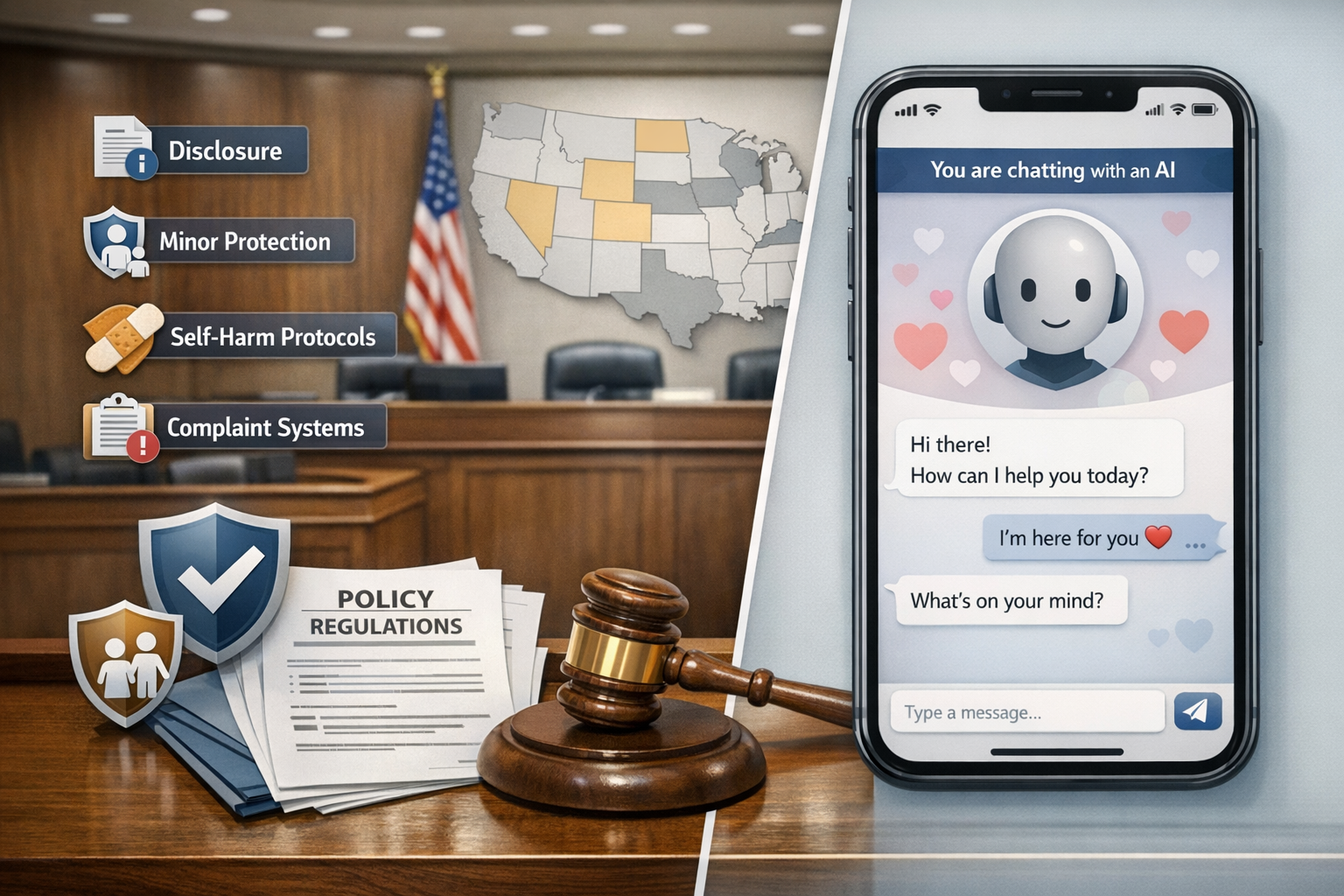
What was once easy to dismiss as an online curiosity — people falling in love with, confiding in or even claiming to “marry” chatbots — is beginning to draw a more consequential response: legislation, compliance rules and a widening public debate over what exactly synthetic intimacy is doing to human relationships.
In statehouses, some Republican lawmakers are working on proposals meant to ensure that human-AI marriages never gain legal standing. At roughly the same moment, an AI companion company, Joi AI, has been promoting an explicitly sexual experiment, paying participants to masturbate with AI companions as part of what it describes as a wellness study aimed in part at addressing male loneliness.
Taken together, the developments suggest that AI companionship has crossed a threshold. It is no longer merely a design trend in the tech industry or a fringe internet subculture. It is becoming a policy problem.
From novelty to regulation
Under current American law, humans cannot legally marry chatbots. That makes the marriage proposals largely pre-emptive — an effort to draw a bright legal line before technology, consumer demand or cultural pressure tests it.
Reporting has pointed to state lawmakers including Senator Mark Pody of Tennessee and Senator Joe Nicola of Missouri as among those discussing or drafting such measures. The bills are as much symbolic as practical, reflecting a conviction among some conservatives that government should move early against any attempt to blur distinctions between human institutions and machine simulation.
Yet even if the marriage fight is partly anticipatory, the surrounding regulatory push is not. By the middle of 2026, 11 states had passed chatbot laws addressing issues such as disclosure requirements, self-harm protocols and stronger protections for minors. That marks a significant shift from just a few years ago, when lawmakers had barely begun to grapple with generative AI at all.
Maryland, for example, passed a 2026 law focused on companion chatbots that requires operator protocols, user disclosures, complaint systems and added safeguards for minors; it is set to take effect on Oct. 1. Tennessee considered a broader chatbot proposal that would have required recurring reminders that users were not interacting with a human, suicide-prevention redirects, public-safety reporting and restrictions involving minors. That bill was later narrowed into a state study of possible AI regulation, but the initial proposal showed how expansive the conversation has become.
The emerging question is no longer just whether companies should tell users they are talking to software. It is whether governments should regulate systems built to feel like partners, confidants or sexual companions.
A sexual-wellness test case
Joi AI’s recent study offered a stark example of how aggressively some companies are pushing that frontier.
The company said it began a monthlong “Daily Guided Masturbation” study on July 1, 2026, using 10 paid participants and repeated self-reported surveys to measure changes in stress, mood, loneliness, sleep and self-esteem. The premise was that guided sexual interaction with an AI companion might produce wellness benefits and potentially help address loneliness, especially among men.
The study’s promotional framing was provocative by design, but it also exposed a deeper ambition in the companion-AI industry: to move beyond entertainment and claim therapeutic or quasi-health benefits. That is a powerful marketing proposition in a country preoccupied with loneliness, mental health strain and declining social connection.
It is also one likely to invite scrutiny. A sample of 10 paid participants and self-reported outcomes would not, on its own, amount to persuasive clinical evidence. Researchers and regulators have been increasingly wary of technology companies making broad well-being claims without rigorous data, especially when products are engineered to foster emotional dependence or simulate intimacy.
Still, the very existence of such a study illustrates how quickly the category is evolving. Companies are no longer simply offering flirtatious bots or role-play features. They are testing whether machine intimacy can be sold as a form of self-improvement.
The politics of synthetic intimacy
The clash now unfolding is about more than marriage licenses or sexual content. It sits at the intersection of several anxieties that have become central to debates over AI: manipulation, consent, loneliness, deception and the vulnerability of children.
Companion bots occupy a particularly sensitive space because they are designed not merely to answer questions, but to sustain attachment. Their success often depends on making users feel seen, desired, comforted or needed. To supporters, that can look like a useful emotional outlet in an isolating world. To critics, it looks like the commercialization of dependency.
That tension helps explain why lawmakers are increasingly focusing on disclosure and safety requirements. If a chatbot is meant to function like a friend, lover or therapist, opponents argue, then simply calling it a neutral tool misses the point. The risk lies in the relationship-like experience itself: a system that can imitate affection, adapt to vulnerability and never truly disclose motives beyond what its developer has programmed.
For some policymakers, the prospect of human-AI marriage is the most visible manifestation of that slippage. Even if no court is poised to recognize such unions, the idea crystallizes broader fears that technology companies are normalizing emotional bonds with software and challenging the social meaning of human commitment.
What comes next
It remains unclear whether anti-AI-marriage proposals will spread widely or become law. Because human-chatbot marriages already lack legal recognition, courts could regard some measures as redundant. But redundancy may not be the point. The bills can also serve as political messaging, signaling resistance to what lawmakers see as a coming cultural shift.
What is less speculative is the broader move toward governing companion AI. States are already building rules around disclosures, complaint systems, harm-prevention protocols and protections for minors. More difficult questions are still unresolved: whether governments should regulate the design of bots that encourage emotional attachment, whether sexualized AI products belong under stricter consumer-protection oversight, and how companies can substantiate claims that these systems alleviate loneliness rather than deepen it.
For now, the politics of AI intimacy are moving faster than the evidence. The law is beginning to respond before society has settled on what these relationships are, what harms they pose or what needs they exploit. But the argument has unmistakably changed. What once sounded like science-fiction provocation or internet absurdity is becoming a live dispute over how much room the legal system, and the culture, should make for relationships with machines.
Sources
Further reading and reporting used to add context:
- https://arxiv.org/abs/2604.18893
- https://www.researchgate.net/publication/400147710_Governing_Artificial_Intimacy_From_Locks_and_Blocks_to_Relational_Accountability
- https://www.sciencedirect.com/science/article/pii/S2949882126000721
- https://www.reddit.com/r/aipartners/comments/1vqcmmv/people_are_marrying_chatbots_these_lawmakers_want/
- https://www.microsoft.com/en-us/research/publication/chat-should-i-leave-him-risks-rewards-and-roles-for-ai-in-relationship-advice/
- https://link.springer.com/article/10.1007/s00146-026-03112-8
- https://papers.ssrn.com/sol3/papers.cfm?abstract_id=6078412
- https://www.reddit.com/r/technology/comments/1vovlcv/these_masturbation_consultants_were_hired_to/
- https://www.europarl.europa.eu/thinktank/en/document/EPRS_BRI%282026%29789299
- https://www.cigionline.org/publications/the-policy-challenge-of-ai-companions/
- https://research.google/pubs/its-still-abuse-community-attitudes-and-perceptions-on-ai-generated-image-based-sexual-abuse/
- https://www.reddit.com/r/politics/comments/1vp3l2w/people_are_marrying_chatbots_these_lawmakers_want/
- https://arxiv.org/abs/2604.06381
- https://decrypt.co/372818/people-signed-up-masturbate-ai-joi?amp=1
- https://arxiv.org/abs/2603.08084
- https://arxiv.org/abs/2604.15333
- https://www.citizen.org/news/big-techs-reckless-release-of-ai-companion-products-sacrifices-safety-for-profit/
- https://lawfilesext.leg.wa.gov/Biennium/2025-26/Htm/Bill%20Reports/Senate/5984%20SBR%20ENET%20TA%2026.htm
- https://www.ibtimes.co.uk/ai-chatbot-platform-seeks-masturbation-consultants-1799092
- https://www.reddit.com/r/technology/comments/1vpvd11/people_are_marrying_chatbots_these_lawmakers_want/
- Bill Information – Tennessee General Assembly
- https://capitol.tn.gov/bills/114/scheduledocs/746a9161-d34c-4a1c-a105-5e8d6226867b.pdf
- https://www.capitol.tn.gov/Bills/114/Bill/HB1946.pdf
- https://capitol.tn.gov/Bills/114/Fiscal/FM2926.pdf
- https://comptroller.aem.tn.extglb.tn.gov/content/dam/tn/tccy/documents/legislative/2026-session/2026TrackedLegislation.pdf
- https://www.capitol.tn.gov/senate/archives/112GA/members/s17.html
- https://wapp.capitol.tn.gov/apps/BillInfo/Default?BillNumber=SB1493&ga=114&hl=en-US
- https://wapp.capitol.tn.gov/apps/BillSearch/BillSearchAdvanced?searchtype=all&terms=marriage
- https://www.capitol.tn.gov/legislation/
- https://capitol.tn.gov/bills/114/scheduledocs/2bf2af93-6e8e-4706-b84d-c07411b2631f.pdf
- https://capitol.tn.gov/Bills/114/Calendars/2026-3-16_CommH.pdf
- https://wapp.capitol.tn.gov/apps/BillInfo/Default?BillNumber=HB0315&ga=114
- https://tnreportcard.org/bills/hb1455
- https://www.tnsenategop.com/press-releases/july-1-2026-enactments
- Legislation – HB0952
- Chatbot laws: Coming to a state near you | IAPP
- https://pub.njleg.gov/Bills/2026/A5500/5272_I1.HTM
- https://tnhousegop.org/member-newsroom/2026/01/state-rep-scott-cepickys-capitol-report-jan-23-2026/
- https://www.reddit.com/r/HumanAIConnections/comments/1sg3vj4/what_can_be_done_about_the_tennessee_law_that/
- https://www.reddit.com/r/BeersWithQueers/comments/1sfyyi3/tennessee_house_of_representatives_passed_house/
- https://www.reddit.com/r/HumanAIConnections/comments/1sb1apb/tennessee_bill_makes_it_a_felony_for_ai_to_offer/
- https://www.wired.com/story/why-anthropic-is-pushing-states-to-regulate-ai-faster/
- https://www.wired.com/story/the-white-house-is-trying-to-figure-out-what-to-do-about-chinese-ai/
- https://www.wired.com/story/meta-contractors-pretending-to-be-teens-chatbot-testing/
- https://www.wired.com/story/the-big-interview-podcast-new-york-state-representative-alex-bores/
- https://www.wired.com/story/the-new-wild-west-of-ai-kids-toys/
- https://www.wired.com/story/ai-chatbots-foia-requests-election-workers/
- https://www.wired.com/story/ai-regulation-privacy-us-senate/
- https://www.wired.com/story/alex-bores-andreessen-horowitz-super-pac-ai-regulation-new-york/
- https://www.wired.com/story/whos-your-daddy-a-chatbot/
- https://www.wired.com/story/the-state-led-crackdown-on-grok-and-xai-has-begun/
- https://www.wired.com/story/expired-tired-wired-sexy-chatbots/
- https://www.wired.com/story/ai-scammers-are-better-at-building-trust-than-humans/
- https://www.wired.com/story/sync-project-music-ai-sleep/
- https://www.wired.com/2016/10/president-obama-mit-joi-ito-interview/
- https://www.wired.com/2006/06/real-sex-virtual-worlds/
- https://www.wired.com/video/watch/companies-of-the-future-reid-hoffman-joi-ito-at-wired25
- https://www.wired.com/story/an-ai-used-facebook-data-to-predict-mental-illness/
- https://audio.joi.com/
- https://www.joe.co.uk/news/unusual-job-advert-offers-1500-a-month-for-people-to-masturbate-534309
- https://joi.ai/about
- https://www.infobae.com/tecno/2026/05/27/pagan-2000-dolares-al-mes-por-ser-consultor-de-masturbacion-para-una-startup-de-ia/
- https://center6.umin.ac.jp/cgi-open-bin/ctr_e/ctr_view.cgi?recptno=R000070359
- https://apps.apple.com/us/app/joy-ai-wellness-platform/id1618609385
- https://www.fastcompany.com/91549430/120000-people-applied-for-this-very-nsfw-hottest-vacancy-in-ai-right-now
- https://tech.yahoo.com/social-media/articles/over-150-000-people-signed-173238972.html
- https://choosejoi.co/wp-content/uploads/2024/08/JOI-complete-Jane-Doe.pdf
- https://play.google.com/store/apps/details?hl=en_US&id=com.szupia.joiapp
- https://choosejoi.co/wp-content/uploads/2024/08/JOI-comprehensive-Jane-Doe.pdf
- https://www.jmir.org/2025/1/e72053/
- https://www.businesswire.com/news/home/20230216005037/en/Joi-Womens-Wellness-Launches-Nationwide-Offers-Customized-Wellness-Treatments-and-Telehealth-Coaching-Platform-to-Help-Women-Take-Back-Control-of-Their-Health
- https://ibusiness.co/detail/9690000065852
- https://westminsterresearch.westminster.ac.uk/download/51b81c321b0636eb1f1209b9e5b3f24c8d4a271f8e4589d06a6b0dd4b236e67a/210218/PF-Final%20For%20submission.pdf
- https://www.reddit.com/r/AIGirlfriendsReviews/comments/1uihwf6/joi_ai_after_3_weeks_the_good_the_overrated_and/
- https://www.reddit.com/r/whennews/comments/1tokzve/ai_startup/
- https://www.reddit.com/r/Cyberpunk/comments/1up4y98/over_150000_people_signed_up_to_masturbate_with/
- https://www.reddit.com/r/idiocracy/comments/1to95ab/ai_startup_says_it_will_pay_people_2000_a_month/
- https://www.reddit.com/r/u_choosejoi2022/comments/wbbb77
- https://www.techmeme.com/260604/p22
- https://www.techmeme.com/260604/p21
- People Are ‘Marrying’ Chatbots. These Lawmakers Want to Stop Them










Leave a Reply