
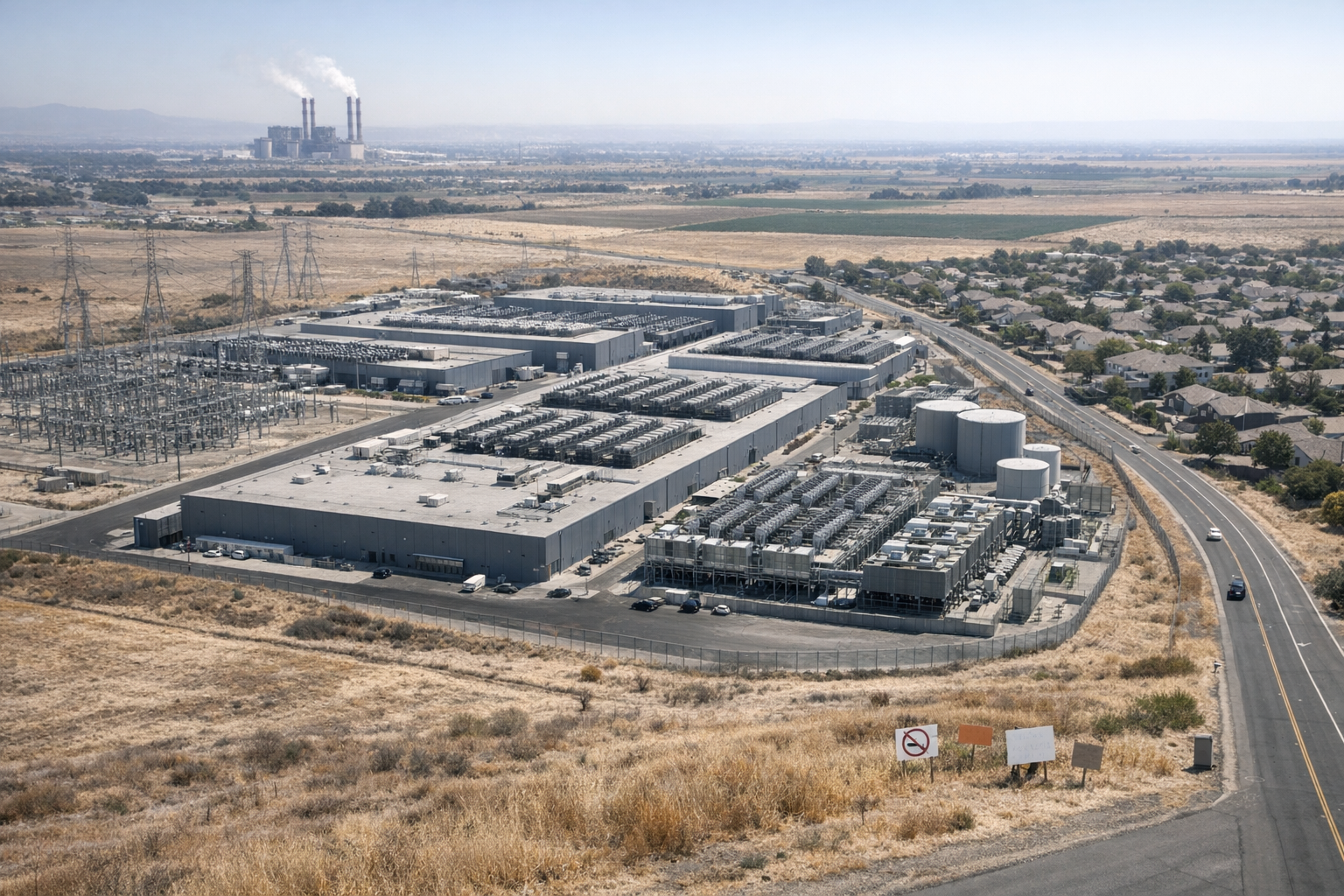
The race to build the physical backbone of artificial intelligence is colliding with an older reality: electricity grids, water systems and land are finite, and the communities that host data centers are increasingly resisting the trade-offs.
In Britain, the United States and Australia, a burst of reporting and policy moves in recent days has made clear that the politics of A.I. infrastructure are changing. What was once framed largely as a contest for technological leadership is becoming a more grounded argument over drought, emissions, transmission lines, tax incentives and who pays when hyperscale computing arrives.
The shift is especially striking because it is no longer confined to climate campaigners or local zoning boards. It now reaches national governments, rural landowners, suburban residents and utility regulators, all confronting a basic question: if A.I. requires vast new industrial capacity, who will bear the environmental and civic costs?
From abstract cloud to local burden
The backlash has been building for months, but it has sharpened as heat waves, drought concerns and new project proposals have made the industry’s footprint harder to ignore.
In Britain, debate has centered on Slough, west of London, where clusters of hulking data centers have turned an old commercial district into a symbol of Europe’s digital build-out. The British government has signaled that it wants to dramatically expand the country’s data-center base as part of a broader push for economic growth and A.I. capacity. But critics have increasingly linked that ambition to local infrastructure strain at a moment of climate stress, arguing that water and energy demands can no longer be treated as invisible side effects of the digital economy.
The politics are similar, if sharper, in Arkansas, where proposed hyperscale developments around Little Rock have prompted unusually broad opposition. Residents and critics have warned that the projects could consume huge amounts of power and water while reshaping nearby land for industrial use. Some opponents have cast the fight in civil-rights terms, arguing that rural Black landowners are being asked to absorb disproportionate burdens from development meant to serve distant tech ambitions.
Australia, meanwhile, is moving toward a more formal regulatory answer. The federal government has advanced national standards for large new data centers that would require operators to secure their own electricity, pay grid-connection costs, curb demand when the system is under strain and improve water efficiency. The approach reflects a growing recognition that governments may have to do more than cheer digital investment; they may also need to force developers to internalize costs that might otherwise be shifted onto households and existing ratepayers.
Texas becomes a test case
Nowhere is the scale of that tension more visible than in Texas, where the power demands of A.I. are beginning to reshape energy investment itself.
Nvidia is reportedly preparing to invest as much as $3 billion in Lancium, a power-infrastructure developer with major contracted capacity in the state. Amazon, for its part, is associated with a planned gas-fired power project in Pecos County with a capacity of 7.65 gigawatts — an enormous figure that underscores how closely the future of A.I. may be tied to new generation build-outs. Permits tied to the project allow for annual greenhouse-gas emissions of up to 33 million tons, a level that would make it one of the country’s largest single sources of climate pollution.
Those investments crystallize a central uncertainty surrounding the A.I. boom. Tech companies and policymakers often suggest that surging computing demand can be met alongside climate goals through cleaner power and better efficiency. But in practice, some of the fastest-moving responses to demand are coming from gas, not just renewables, especially in places where developers want dependable around-the-clock electricity for energy-intensive computing clusters.
That matters because the industry’s environmental debate is no longer only about the power used to answer a chatbot query or train a large model. It is increasingly about the entire supply chain of A.I.: substations, pipelines, backup generators, cooling systems, water rights and the industrial land needed to house them.
A broader pattern of resistance
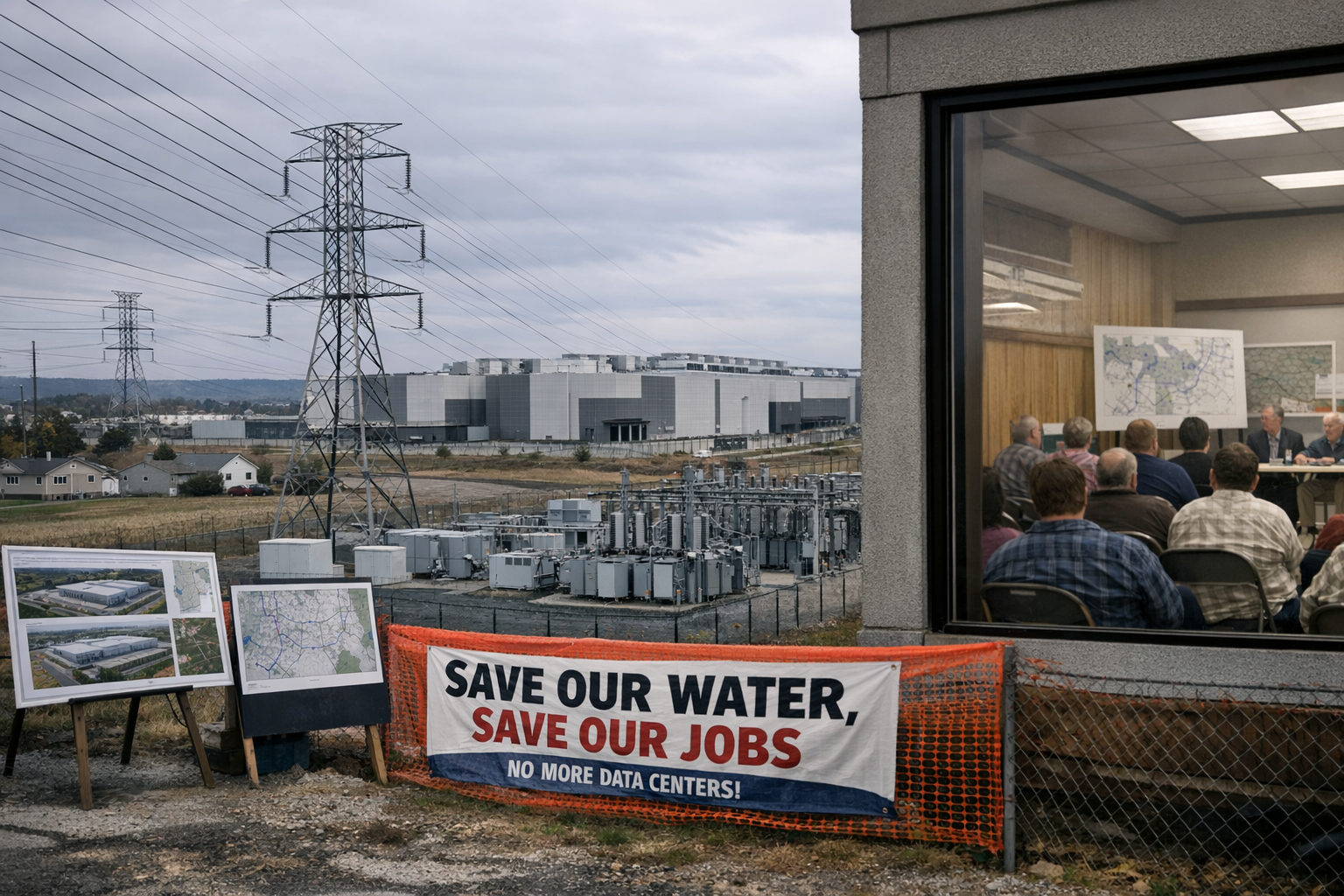
The emerging fights are not isolated disputes. Across the United States, resistance to data-center construction has spread through rural counties and fast-growing suburbs, often uniting groups that agree on little else politically. Residents have objected to fears of rising power bills, water withdrawals in already stressed regions, diesel pollution from backup systems, noise and the sense that local communities are losing control over land-use decisions to companies chasing tax breaks and cheap power.
Earlier reporting this year found that a large share of planned American A.I. data centers were slated for drought-stressed areas, intensifying concern that the industry’s cooling needs could collide with mounting water scarcity. That tension has become harder to dismiss as climate extremes worsen. In places facing hotter summers and tighter water supplies, the question can sound blunt: should scarce resources go first to homes and essential services, or to server farms powering ever larger A.I. systems?
In Europe, Slough has become an emblem of a related problem: concentration. The appeal of building near dense fiber networks and major urban markets has produced clusters of facilities whose cumulative effects — on heat, traffic, land values and utility systems — are increasingly visible to the people living nearby.
The policy question: who pays?
The next phase of the fight may hinge less on whether new data centers are built than on the terms under which they are approved.
Governments are only beginning to grapple with whether hyperscale operators should be made to pay the full system costs they create. That includes not only their direct electricity bills, but also new grid infrastructure, reserve power, water-management needs and environmental mitigation. Australia’s proposed rules point toward one possible model: require projects to bring more of their own power, shoulder connection costs and reduce consumption during grid stress.
But many open questions remain. Regulators still do not know how much of the coming A.I. load will ultimately be served by low-carbon sources rather than new fossil-fuel capacity. It is unclear whether tougher siting and environmental standards will meaningfully slow projects or merely push them into jurisdictions with weaker oversight. And while community opposition is growing louder, it is not yet clear how often it will alter the scale, location or design of major developments.
What is clear is that the old language of the cloud is giving way to something more physical and more politically fraught. A.I. may be sold as software, but its expansion depends on power plants, water systems and land. As that reality comes into focus, so does the backlash.
Sources
Further reading and reporting used to add context:
- https://www.theguardian.com/us-news/2026/jun/08/datacenter-ai-drought-water
- https://www.reddit.com/r/Arkansas/comments/1vibtuv/this_is_very_real_redlining_outrage_in_little/
- https://www.theguardian.com/environment/2026/jun/26/slough-is-like-an-experiment-europes-largest-datacentre-hub-leaves-town-sweltering
- https://www.minister.industry.gov.au/charlton/media/ai-australias-interests
- https://www.theguardian.com/us-news/2026/jan/13/datacenters-us-political-opposition
- https://www.theguardian.com/uk-news/datacentres
- https://www.theguardian.com/environment/2026/jun/04/how-the-insatiable-thirst-of-datacenters-is-leaving-communities-across-the-us-high-and-dry
- https://www.arkansasbusiness.com/article/arkansas-business-leaders-say-data-center-concerns-are-overblown/
- https://www.ualrpublicradio.org/local-regional-news/2026-05-19/they-own-it-a-split-screen-view-of-data-centers-comes-to-central-arkansas
- https://arstechnica.com/tech-policy/2026/06/we-pissed-off-a-lot-of-people-giant-data-center-plan-cut-50-amid-protests/
- https://minister.dcceew.gov.au/watt/media-releases/have-your-say-two-new-national-environmental-standards
- https://www.reddit.com/r/LittleRock/comments/1sh2qh9/data_center_request_for_public_comment/
- https://www.theguardian.com/p/x4favy
- https://arstechnica.com/tech-policy/2026/02/im-not-for-sale-farmers-refuse-to-take-millions-in-data-center-deals/
- https://www.industry.gov.au/sites/default/files/2026-03/26-029-300311.pdf
- https://www.reddit.com/r/Arkansas/comments/1vdr3p1/arkansas_county_rejects_data_center_pause_after/
- https://www.reddit.com/r/collapse/comments/1vk36uj/amazons_new_765gw_texas_ai_data_center_power/
- https://www.reddit.com/r/fuckamazon/comments/1vkdfro/amazons_new_765gw_texas_ai_data_center_power/
- https://www.tceq.texas.gov/
- https://lancium.com/
- https://evogov.s3.us-west-2.amazonaws.com/meetings/77/staff_reports/1459.pdf
- https://nvidianews.nvidia.com/news/nvidia-announces-strategic-partnership-with-lumentum-to-develop-state-of-the-art-optics-technology
- https://lancium.com/newsroom/
- https://www.texastribune.org/2026/02/02/texas-permian-basin-power-plant-project-data-centers/
- https://www.tceq.texas.gov/permitting/air/air_permits.html
- https://www.tceq.texas.gov/permitting/air/guidance/newsourcereview/ghg/ghg-permitting.html
- https://lancium.com/locations/
- https://www.tceq.com/permitting/air/rules
- https://statutes.capitol.texas.gov/GetStatute.aspx?Code=HS&Value=382.051
- https://www.tceq.net/permitting/air/newsourcereview/airpermits-pendingpermit-apps
- https://www.tceq.texas.gov/permitting/air/air_status_permits.html
- https://www.tceq.texas.gov/downloads/agency/decisions/agendas/backup/2023/2023-1474-air-info.pdf
- https://www.reddit.com/r/NvidiaStock/comments/1viz1f1/nvda_investment_trend_stargate_oriented/
- https://www.reddit.com/r/ai_talk_monitor_dev/comments/1vk60ls/ai_digest_8102026/
- https://www.reddit.com/r/ai_talk_monitor_dev/comments/1vk60lt/ai_digest_8102026/
- https://www.reddit.com/r/UnderReportedNews/comments/1vkasxj/amazons_new_765gw_texas_ai_data_center_power/
- https://www.reddit.com/r/JoeRogan/comments/1vk1eah/amazons_new_765gw_texas_ai_data_center_power/
- https://www.reddit.com/r/antiai/comments/1vk4dgw/amazons_new_765gw_texas_ai_data_center_power/
- https://capitol.texas.gov/tlodocs/83R/handouts/C2602014092913301/6a7a8c06-ec15-4ddd-85fc-d712c2b07631.PDF
- https://www.bloomberg.com/news/articles/2026-03-06/oracle-and-openai-end-plans-to-expand-flagship-data-center?itm_content=OpenAI_Partnership_Ends-1
- https://news.bloomberglaw.com/texas-brief/crusoe-lancium-to-build-1gw-ai-data-center-in-texas
- https://news.bloomberglaw.com/bloomberg-government-news/data-centers-ai-boom-tests-limits-on-power-trade-in-texas
- https://brp-prod-bcc.bloomberg.com/news/articles/2026-03-02/nvidia-to-invest-4-billion-in-data-center-optics-companies?srnd=homepage-americas
- https://bloomberg.com/latest/nvidia
- https://lancium.com/2026/07/15/crusoe-and-lancium-announce-1-0-gigawatt-ai-data-center-campus-in-childress-texas/
- https://sponsored.bloomberg.com/article/iren/how-iren-broke-through-the-ai-power-bottleneck
- https://www.bloomberglinea.com/negocios/chevron-abastecera-de-energia-a-centro-de-datos-de-microsoft-en-texas-bajo-acuerdo-de-20-anos/
- https://news.bloomberglaw.com/private-equity/blackstone-is-said-to-invest-500-million-in-lancium-ai-buildout
- https://www.reddit.com/r/technology/comments/1vjwpko/amazons_new_765gw_texas_ai_data_center_power/
- https://ca.finance.yahoo.com/news/amazon-cerebras-giant-chips-help-150000927.html/
- https://www.theinformation.com/features/exclusive?page=2
- https://www.energyconnects.com/news/gas-lng/2026/january/vistra-buying-us-gas-power-fleet-for-4-billion-to-deepen-ai-bet/
- https://www.reddit.com/r/NewsD/comments/1vjzmpu/amazons_new_765gw_texas_ai_data_center_power/
- https://www.reddit.com/r/Fauxmoi/comments/1vjz2i3/amazons_new_765gw_texas_ai_data_center_power/
- https://www.reddit.com/r/aiwars/comments/1vk2cmh/the_independent_aug_8_2026_amazon_data_center/
- https://www.reddit.com/r/technology/comments/1vj1sa7/new_amazon_data_center_stokes_worry_it_would_be/
- https://www.reddit.com/r/ArtificialInteligence/comments/1vjmz6d/planned_amazon_data_center_could_become_the/
- https://techxplore.com/news/2026-02-texas-heart-amazon-ai-states.pdf
- https://www.reddit.com/r/aiwars/comments/1vk9abj/why_overplay_your_case_when_you_already_have_a/
- https://www.reddit.com/r/fuckamazon/comments/1vjriti/planned_amazon_data_center_could_become_the/
- https://techcrunch.com/?p=3109180
- https://techcrunch.com/tag/amazon/
- https://techcrunch.com/2025/10/17/your-ai-tools-run-on-fracked-gas-and-bulldozed-texas-land/
- https://techcrunch.com/2026/01/16/epa-rules-that-xais-natural-gas-generators-were-illegally-used/
- https://www.texastribune.org/text/234878/
- https://www.reddit.com/r/NoFilterNews/comments/1viwgiz/new_amazon_data_center_is_set_to_have_the_most/
- https://www.reddit.com/r/antiai/comments/1vj1rvi/new_amazon_data_center_stokes_worry_it_would_be/
- https://www.tomshardware.com/tag/amazon
- https://www.tomshardware.com/tag/data-center
- https://www.reddit.com/r/environment2/comments/1viptlj/amazon_is_creating_the_biggest_pollution_source/
- https://www.theguardian.com/technology/2026/apr/02/google-ai-datacenter
- ‘Slough is like an experiment’: Europe’s largest datacentre hub leaves town sweltering | Extreme heat | The Guardian
- Crusoe and Lancium Announce 1.0 Gigawatt AI Data Center Campus in Childress, Texas – lancium
- Majority of US’s new AI datacenters to be built on drought-hit land | Datacenters | The Guardian
- AI in Australia's interests | The Hon Dr Andrew Charlton MP | Ministers for the Department of Industry, Science and Resources








Leave a Reply