

The Politics of AI’s Physical Footprint Are Getting Harder to Ignore
The race to build the infrastructure behind artificial intelligence is colliding with a widening set of local and political conflicts, as governments eager to attract investment confront accusations that they are understating environmental costs, relaxing scrutiny or allowing public officials and private developers to move too closely together.
In Louisiana, questions about ethics have been raised around a state senator’s role in helping secure what Meta has described as its largest data center campus to date. In Scotland, environmental critics say a government policy promoting “green datacentres” relies on assumptions made before the generative A.I. boom transformed the scale of power demand. And across the United States, community opposition to new data centers is becoming more organized and more visible, focused on water use, electricity demand, land use, noise and the industrialization of rural areas.
Taken together, the disputes suggest that the contest over A.I. is no longer confined to chips, models and corporate rivalry. It is increasingly being fought in planning boards, parish governments and environmental reviews — places where the basic question is not what A.I. can do, but what communities are willing to host in order to make it possible.
A Louisiana Project Draws Ethics Questions
The sharpest flashpoint has emerged in Richland Parish, La., where Meta is building a vast campus known as Hyperion. The company has said the development will cover roughly 4 million square feet, underscoring the extraordinary physical scale now required to support leading A.I. systems and cloud services.
According to a recent investigation by Floodlight, published by The Guardian, State Senator John “Jay” Morris spent more than two years helping advance the project and later sold nearby land, with business partners, for infrastructure related to the development. Ethics experts cited in the report said the sequence raised potential conflict-of-interest concerns. Mr. Morris has denied wrongdoing and disputed the suggestion that he violated ethics rules.
The controversy has resonated beyond questions of legal compliance because it touches a broader unease about how these projects are landed. In many fast-growing data-center corridors, local residents say the approvals can feel opaque, with major decisions on zoning, utilities and tax treatment occurring before the public fully understands the project’s size or resource demands.
That unease appears especially potent in rural communities, where data centers are often sold as engines of economic development but can arrive with years of heavy construction, new transmission or power infrastructure, and anxiety over whether the benefits will be broadly shared.
Scotland’s “Green” Label Meets the A.I. Era
In Scotland, the fight is less about land transactions than about how governments define sustainability when courting digital infrastructure.
Scottish policy has treated “green datacentres” as a priority for economic development, embedding them in National Planning Framework 4 as part of a broader effort to attract technology investment. Government analysis associated with that planning framework concluded that the relevant category of national development would have a “negligible” effect on emissions targets.
Critics now say that judgment looks increasingly outdated.
Action to Protect Rural Scotland, a charity that has examined the policy, argues that the framework was developed in 2022, before ChatGPT’s release ignited the present surge in generative A.I. and the hyperscale computing loads that come with it. What might once have looked like a manageable category of digital infrastructure, critics contend, now includes facilities whose electricity use and indirect emissions can be far larger than policymakers anticipated.
The dispute points to a methodological problem that extends well beyond Scotland: regulators still do not have settled, widely accepted ways to count the full climate burden of A.I. infrastructure. A data center may be marketed as “green” because it purchases renewable power, improves cooling efficiency or supports grid balancing. But if it adds a huge new load to a power system that still depends partly on fossil fuels, opponents argue, the climate impact can be obscured rather than eliminated.
That debate is becoming more urgent as European policymakers push for better disclosure of data centers’ ecological footprint and as countries compete to host the facilities seen as essential to economic growth and technological sovereignty.
Organized Resistance Moves Into the Mainstream
At the same time, resistance to data-center expansion is becoming less isolated and more networked.
In the United States, activists and local groups that once fought projects town by town are increasingly framing their cause as a national movement. Data Center Watch, an opposition group, has described resistance as a growing political force, and a coalition report released in April said membership in local opposition efforts had climbed sharply as communities focused on grid strain, water resources and land use.
The consumer advocate Erin Brockovich has added visibility to the issue by launching a public reporting map that invites residents to document complaints tied to data-center projects. Organizers say they have quickly received thousands of submissions, with water consumption emerging as the top concern, followed by electricity use, health effects and impacts on wildlife.
That kind of organizing matters because the main constraint on A.I. development increasingly may not be only better algorithms or more advanced chips, but whether companies can actually secure permits, power and public consent for the giant facilities they need.
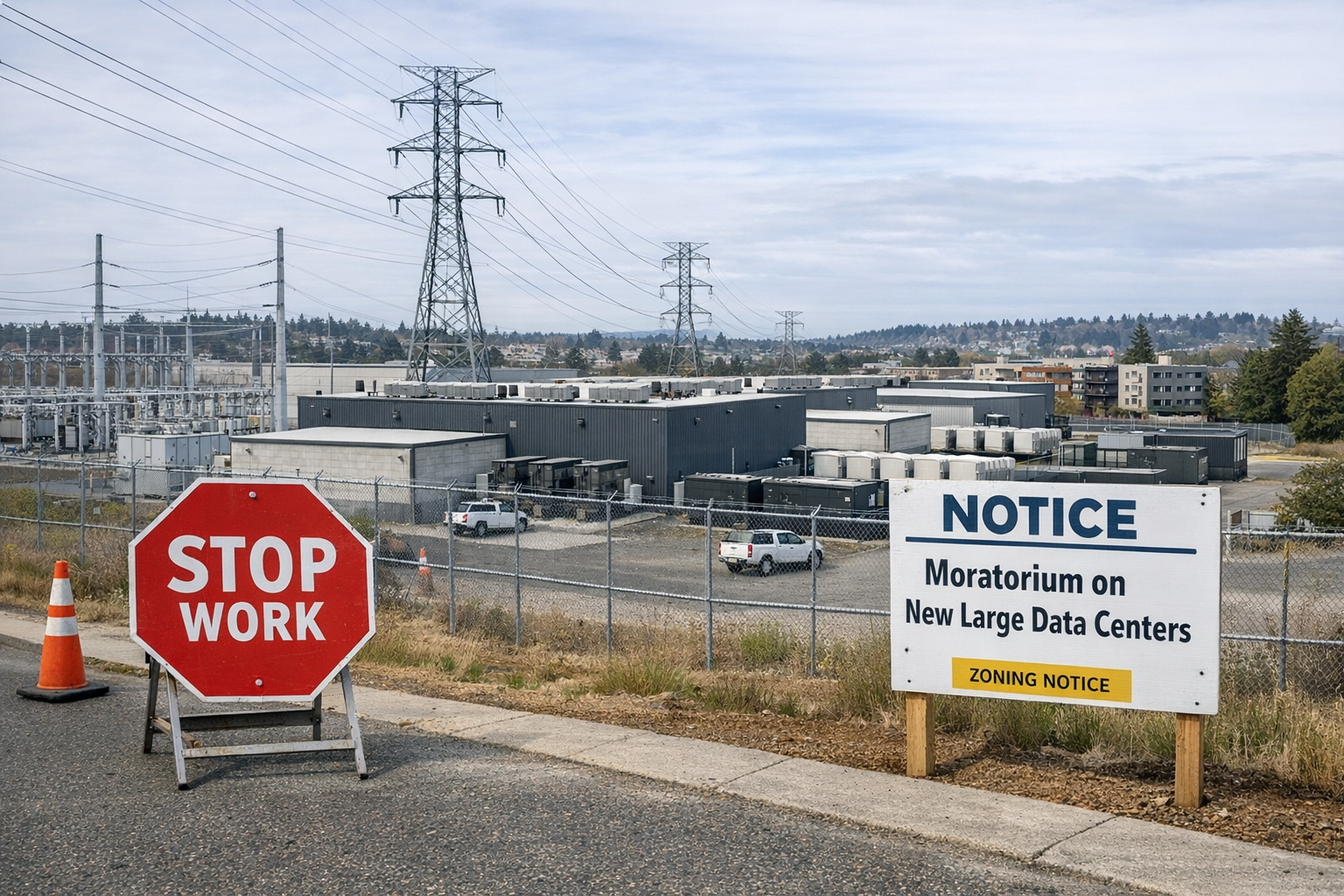
Across the country, local jurisdictions have already imposed restrictions, moratoriums or bans on data-center development in some form. The reasons vary, but the pattern is familiar: residents fear industrial noise, diesel backup generators, tax deals they do not fully understand, pressure on drinking-water supplies and rising utility burdens in exchange for projects that often promise fewer long-term jobs than factories or other traditional economic developments.
Why This Fight Is Intensifying Now
The timing is not accidental. The generative A.I. boom has transformed data centers from a relatively obscure layer of the internet economy into strategic assets. Governments want them because they signal investment, tax base, high-end infrastructure and participation in the next phase of computing. Companies want them because training and running advanced A.I. models demands extraordinary concentrations of power, land and networking capacity.
But the faster that demand rises, the harder it becomes to preserve the old political script in which data centers are treated as clean, technical and largely uncontroversial.
A.I.-era facilities are larger, more power-hungry and often more visible than their predecessors. They arrive in regions where grids are already strained, where renewable power is limited, or where drought and water stress have made industrial use newly contentious. They also tend to depend on a stack of public decisions — tax incentives, transmission approvals, planning waivers, road upgrades, utility commitments — that can turn what looks like a private investment into a referendum on public priorities.
That is why the disputes in Louisiana and Scotland carry significance beyond their immediate facts. The first raises the question of whether the scramble for investment is creating conditions in which ethics safeguards look too weak or too easy to test. The second asks whether environmental standards written just a few years ago are already obsolete in the face of A.I.’s escalating energy appetite.
Neither issue has been resolved. It remains unclear whether Louisiana authorities will pursue any formal ethics action tied to the Hyperion development, or whether Scotland will revise the way it evaluates the emissions profile of “green” data centers in an A.I.-heavy era.
What is clearer is that the politics of A.I. infrastructure have entered a new phase. For technology companies, the challenge is no longer simply to build bigger campuses faster. It is to convince communities and governments that the true costs — environmental, political and social — are being counted honestly, and that the rewards are not flowing only to a narrow circle of insiders.
Sources
Further reading and reporting used to add context:
- https://www.theguardian.com/uk-news/2026/may/25/scotland-policy-green-datacentres-emissions-impact-ai-analysis
- https://www.resultsense.com/news/2026-05-25-scotland-green-datacentres-ai-emissions/
- https://lailluminator.com/2026/05/21/morris-meta/
- https://gizmodo.com/erin-brockovich-targets-ai-industry-with-new-data-center-map-2000763638
- https://www.nysun.com/article/pge-nemesis-erin-brockovich-tilts-at-new-windmill-energy-intensive-ai-data-centers
- https://www.btcpolicy.org/articles/bitcoin-policy-institute-report-traces-foreign-influence-campaign-against-u-s-ai-infrastructure
- https://pjmedia.com/david-manney/2026/05/22/erin-brockovich-puts-ai-data-centers-on-the-map-n4953149
- https://thesoufancenter.org/intelbrief-2026-may-5/
- https://en.wikipedia.org/wiki/Opposition_to_AI_data_centers
- https://aprs.scot/news/update-on-data-centres-campaign/
- https://canada.constructconnect.com/joc/news/technology/2026/05/ai-rebellion-the-raging-backlash-against-data-centres
- https://civicintelligence.news/society/chinese-singham-network-data-center-campaigns
- https://www.techradar.com/pro/meta-to-receive-over-usd3-billion-in-tax-breaks-for-its-2-250-acre-louisiana-data-center-enough-to-fund-the-states-police-budget-for-seven-years
- https://www.theguardian.com/business/2026/may/18/uk-datacentres-plan-to-burn-gas-to-generate-electricity
- https://www.stopclimatechaos.scot/wp-content/uploads/2026/05/Hyperscale-AI-data-centres-Briefing-and-recommendations-from-Stop-Climate-Chaos-Scotland-1.pdf
- https://www.reddit.com/r/news/comments/1to4b2k/a_louisiana_state_senator_helped_secure_metas/
- https://www.reddit.com/r/LasCruces/comments/1tjv032/the_truth_about_data_centers/
- https://www.reddit.com/r/technology/comments/1toe7m2/erin_brockovich_launches_map_of_over_4200_data/
- https://datacenters.atmeta.com/2024/12/hello-louisiana/
- https://www.datacenterwatch.org/
- https://www.datacenterresponsibility.com/
- https://www.tomshardware.com/tech-industry/artificial-intelligence/meta-will-fund-seven-new-gas-plants-to-power-its-7gw-louisiana-data-center
- https://www.realclear.ai/case-studies/meta-richland-parish-hyperion
- https://www.dpr.com/projects/meta-richland-parish-data-center
- https://en.wikipedia.org/wiki/Hyperion_%28data_center%29
- https://www.axios.com/2024/11/19/meta-louisiana-data-center
- https://www.datacenterwatch.org/report
- https://powertracker.io/
- https://www.niemanlab.org/2026/05/erin-brockovich-made-a-map-to-track-data-centers-around-the-country/
- https://www.realclearenergy.org/2026/02/27/64_billion_of_data_center_projects_have_been_blocked_1166822.html
- https://www.axios.com/2026/02/24/ai-data-centers-energy-bills
- https://scrutica.com/facilities/fac-meta-richland-parish
- https://www.brockovich.com/
- https://cincodias.elpais.com/companias/2024-12-04/meta-elige-a-acs-para-levantar-su-mayor-campus-de-centros-de-datos-con-una-inversion-de-9500-millones.html
- https://www.lemonde.fr/en/economy/article/2026/05/10/in-virginia-the-world-s-data-center-capital-faces-mounting-opposition-from-local-residents_6753298_19.html
- https://en.wikipedia.org/wiki/Holly_Ridge%2C_Louisiana
- https://datacenters.atmeta.com/asset/richland-parish-data-center-info-sheet/
- https://www.reddit.com/r/TrueReddit/comments/1s49684/metas_27_billion_ai_data_center_is_causing_chaos/
- https://en.wikipedia.org/wiki/Data_center
- https://lpscpubvalence.lpsc.louisiana.gov/portal/PSC/ViewFile?fileId=tegXEb8UbKE%3D
- https://www.reddit.com/r/WayOfTheBern/comments/1toirsk/erin_brockovich_has_launched_a_new_interactive/
- https://www.reddit.com/r/techbeat/comments/1toj393/erin_brockovich_launches_website_mapping_ai_data/
- https://www.gov.scot/binaries/content/documents/govscot/publications/impact-assessment/2022/11/national-planning-framework-4-lifecycle-greenhouse-gas-emissions-npf4-proposed-national-developments-assessment-findings/documents/national-planning-framework-4-research-project-lifecycle-greenhouse-gas-emissions-npf4-proposed-national-developments-assessment-findings/national-planning-framework-4-research-project-lifecycle-greenhouse-gas-emissions-npf4-proposed-national-developments-assessment-findings/govscot%3Adocument/national-planning-framework-4-research-project-lifecycle-greenhouse-gas-emissions-npf4-proposed-national-developments-assessment-findings.pdf
- https://www.gov.scot/publications/national-planning-framework-4/pages/3/
- https://www.gov.scot/publications/national-planning-framework-4-lifecycle-greenhouse-gas-emissions-npf4-proposed-national-developments-assessment-findings/pages/2/
- https://www.gov.scot/binaries/content/documents/govscot/publications/advice-and-guidance/2022/11/national-planning-framework-4-revised-draft/documents/national-planning-framework-4-revised-draft/national-planning-framework-4-revised-draft/govscot%3Adocument/national-planning-framework-4-revised-draft.pdf
- https://www.gov.scot/publications/national-planning-framework-4-lifecycle-greenhouse-gas-emissions-npf4-proposed-national-developments-assessment-findings/pages/4/
- https://www.gov.scot/publications/national-planning-framework-4-revised-draft/pages/4/
- https://www.independent.co.uk/news/uk/home-news/scottish-government-hyperscale-ai-data-emissions-b2982766.html
- https://www.transport.gov.scot/publication/strategic-environmental-assessment-scoping-report-a96-corridor-review/legislative-and-policy-context/
- https://digitalpublications.parliament.scot/Committees/Report/LGHP/2022/3/30/06f7ad35-d92e-4558-ab1b-d94d9ef6c230-1
- https://www.gov.scot/binaries/content/documents/govscot/publications/strategy-plan/2023/01/draft-energy-strategy-transition-plan/documents/strategic-environmental-assessment-draft-energy-strategy-transition-plan-environmental-report/strategic-environmental-assessment-draft-energy-strategy-transition-plan-environmental-report/govscot%3Adocument/strategic-environmental-assessment-draft-energy-strategy-transition-plan-environmental-report.pdf
- https://www.westlothian.gov.uk/article/33796/National-Planning-Framework-4-NPF4
- https://www.gov.scot/publications/national-planning-framework-4/pages/5/
- https://data.gov.scot/environment/Outcome2.html
- https://prosper.scot/wp-content/uploads/2023/05/NPF4-Position-Statement.pdf
- https://www.scottishrenewables.com/assets/000/000/967/SR_NPF4_Supplementary_Position_Statement_-_CC_and_Deployment_Targets_FINAL_original.pdf?1588258453=
- https://www.westlothian.gov.uk/media/67012/National-Planning-Framework-4/pdf/national-planning-framework-4.pdf
- https://www.reddit.com/r/EnvironmentalNews/comments/1tms20w/scotlands_green_datacentres_policy_ignores/
- https://www.reddit.com/r/Edinburgh/comments/1qwiw4k/update_from_councillor_on_the_gyle_datacentre/
- https://www.reddit.com/r/Edinburgh/comments/1qvpa0j/green_data_centre_for_edinburgh_rejected_by/
- How Sen. Jay Morris mixed Meta's mega-deal with his own real estate business • Louisiana Illuminator
- Scotland’s ‘green datacentres’ policy ignores emissions impact of AI, analysis shows | Scotland | The Guardian
- Hello, Louisiana! – Meta Data Centers












Leave a Reply