
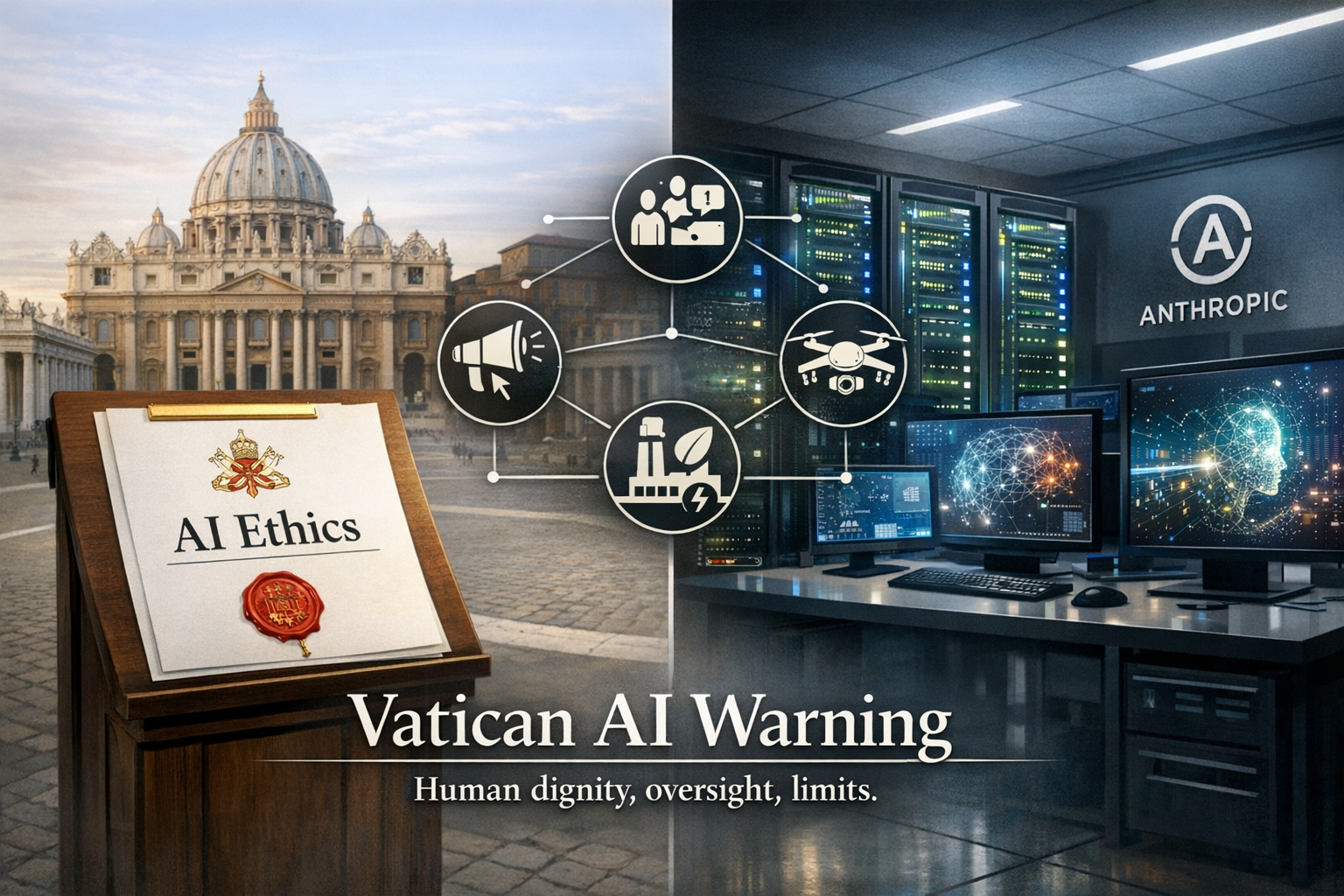
A Papal Warning Keeps Echoing in the AI Debate
A week after Pope Leo XIV issued a sweeping warning about artificial intelligence, the Vatican’s message is still ricocheting far beyond church circles — into Silicon Valley boardrooms, policy discussions and public anxieties about work, war and human dignity.
What began as a papal encyclical has quickly become something more politically and culturally potent: a moral framework that supporters say offers a rare language of restraint in an industry defined by speed, scale and competition. At the same time, the Vatican’s decision to place Anthropic co-founder Chris Olah prominently at the document’s rollout has stirred a sharp secondary debate over whether the church is exerting influence on the technology sector or lending it moral cover.
The result is an unusual moment in the global argument over AI, one in which a religious text is being treated by technologists, ethicists and ordinary readers as a serious intervention in governance.
Released by the Vatican on May 25 and signed 10 days earlier, the encyclical, *Magnifica Humanitas*, frames artificial intelligence not as a neutral tool but as a force capable of reshaping labor, warfare, truth and the distribution of power. Leo, the first American pope, argues that AI must remain subject to human moral judgment and warns against what he describes as a “culture of power” driving the technology’s rapid ascent.
In the document, he links today’s technological upheaval to the church’s long tradition of social teaching, explicitly invoking the legacy of Leo XIII’s 1891 encyclical *Rerum Novarum*, which addressed the dislocations of industrial capitalism. The parallel is deliberate: then, as now, the church is presenting itself as a critic of economic and technological systems that threaten to subordinate human beings to machinery and markets.
The Question of Anthropic
The most immediate controversy has centered on Anthropic, one of the companies at the forefront of generative AI. Olah’s appearance beside the pope during the Vatican event was striking precisely because Leo’s text reads as one of the most comprehensive moral critiques yet directed at the industry that companies like Anthropic are helping to build.
That juxtaposition has prompted skepticism from some outside observers, who argue that corporate engagement with the Vatican risks becoming what critics have called “Vatican-washing” — a way for AI firms to associate themselves with ethical seriousness without embracing more disruptive changes to their products or business practices.
The Vatican and its defenders see something else: evidence that the industry can no longer ignore external moral scrutiny. Even critics of Anthropic’s presence have acknowledged that the encyclical forced one of the leading AI companies to publicly engage with questions that the sector often treats as secondary to innovation.
The church’s engagement with technology companies did not begin with Leo. Under Pope Francis, the Vatican launched the Minerva Dialogues in 2016, bringing together church officials, scholars and tech leaders to discuss the ethical implications of emerging technologies. That longer effort helps explain why the current moment did not arise from nowhere. But it also sharpens the unanswered question now hanging over the Vatican’s outreach: whether access to companies will produce meaningful constraints, or merely symbols of goodwill.
Some reporting has indicated that Catholic ethicists offered comments on updates to Anthropic’s “constitution,” the set of principles used to guide its AI assistant Claude. Whether that kind of consultation leads to stronger safeguards on labor practices, environmental costs or the deployment of powerful systems remains unclear.
A Text Finding an Audience Beyond the Church
What has become harder to dismiss is the breadth of the response.
Commentators have treated *Magnifica Humanitas* as a template for “human-centered” AI governance, especially in its insistence that technology cannot be separated from the political and economic systems that shape it. Leo’s warning touches familiar fault lines in the current AI debate — job displacement, misinformation, surveillance, autonomous weapons and the concentration of wealth and decision-making in a few firms — but binds them together under a broader moral claim: that human beings must not be reduced to data points, productivity units or targets of manipulation.
That message appears to be resonating with people well beyond Catholic institutions. Public reaction in the United States has reflected many of the themes the pope emphasized, with readers and voters voicing worries that AI could erode privacy, replace workers, intensify environmental strain and put life-and-death decisions at greater remove from human accountability.
That wider reception may be one reason the encyclical has drawn so much attention. The AI debate is often dominated by executives, engineers and regulators. Leo’s intervention has helped move the discussion onto different ground, speaking in moral and social terms that are legible to people with little stake in the technical details but much at risk from the consequences.
Why It Matters Now
The timing is critical. AI companies are racing to embed generative systems into workplaces, schools, search engines, defense planning and consumer devices, even as governments struggle to write rules that can keep pace. Across the United States and Europe, policymakers have debated transparency requirements, safety testing and competition concerns, but regulation remains fragmented and uneven. Meanwhile, fears about military uses of AI and the environmental costs of data centers have grown alongside excitement about the technology’s economic promise.
In that landscape, the pope’s intervention matters less because it carries legal force than because it supplies a coherent moral vocabulary at a moment of regulatory uncertainty. Its central claim — that “technology is never neutral” — cuts against one of the industry’s most enduring habits of self-description: the idea that tools are inherently benign and only their misuse should be feared.
Leo’s language is also notable for resisting one of the era’s more seductive confusions, namely the tendency to talk about machine intelligence as if it were equivalent to human judgment. The encyclical warns against that equivalence and argues that no increase in computational power dissolves the need for conscience, responsibility and limits.
For advocates of stronger oversight, that makes the document useful as a public benchmark, even for those who do not share the church’s theology. For companies seeking dialogue with moral authorities, it presents both an opportunity and a test. Engagement with the Vatican may signal seriousness, but it also invites scrutiny over whether such seriousness extends to business decisions.
Symbol or Constraint?
That tension is likely to define the next phase of the story. The encyclical has already shifted the tone of debate, making it harder for AI companies to speak only in the language of progress and optimization. What remains uncertain is whether that rhetorical shift will harden into policy, product changes or stronger institutional limits.
Will lawmakers draw on the pope’s arguments as they consider labor protections, military restrictions or transparency rules? Will frontier AI labs accept external ethical critique when it collides with commercial incentives? Or will *Magnifica Humanitas* endure mainly as a moral touchstone — cited often, admired broadly and only selectively heeded?
For now, the Vatican has achieved something rarer than consensus: relevance. In an argument usually framed by engineers and investors, the church has managed to make dignity, power and the meaning of the human person central again. That alone has altered the conversation, even if the machinery of the AI boom keeps moving at full speed.
Sources
Further reading and reporting used to add context:
- https://www.theatlantic.com/ideas/2026/05/pope-leo-ai-encyclical-magnifica-humanitas/687294/?utm_source=apple_news
- https://www.axios.com/2026/05/25/pope-leo-xiv-ai-humanity-war-jobs-warning
- https://www.techradar.com/ai-platforms-assistants/the-pope-just-warned-ai-could-create-new-forms-of-dehumanization-and-his-message-feels-aimed-straight-at-big-tech
- https://theweek.com/religion/pope-tackles-ai-celebrate-humanity
- https://www.vaticannews.va/en/pope/news/2026-05/pope-leo-xiv-first-encyclical-magnifica-humanitas.html
- https://www.vatican.va/content/leo-xiv/en/encyclicals/documents/20260515-magnifica-humanitas.html
- Anthropic’s alliance with pope on AI harms: all in good faith or ‘Vatican-washing?’ | AI (artificial intelligence) | The Guardian
- https://www.theguardian.com/world/2026/may/25/pope-leo-encyclical-ai-artificial-intelligence-slavery
- https://www.humandevelopment.va/en/news/2026/intelligenza-artificiale-disarmata-papa-leone-magnifica-humanitas.html
- Presentation and promulgation of the Encyclical Letter “Magnifica humanitas” (25 May 2026)
- https://press.vatican.va/content/salastampa/en/bollettino/pubblico/2026/05/25/260525e.html
- https://www.usccb.org/news/2026/first-encyclical-pope-leo-urges-world-disarm-ai-amid-increased-reliance
- https://www.vatican.va/content/leo-xiv/it/encyclicals/documents/20260515-magnifica-humanitas.html
- https://www.vaticannews.va/es/papa/news/2026-05/la-enciclica-papa-leon-xiv-magnifica-humanitasla-inteligencia-ia.html
- https://www.usccb.org/news/2026/pope-urges-humanity-build-civilization-love-digital-world
- https://www.vatican.va/content/leo-xiv/es/encyclicals/documents/20260515-magnifica-humanitas.html
- https://www.reddit.com/r/ArtificialInteligence/comments/1tjfgug/pope_leo_xivs_first_encyclical_is_all_about_ai/
- https://www.academyforlife.va/content/pav/en/news/2026/pope-leo_s-_magnifica-humanitas–ai-must-serve-humanity-not-conc.pdf
- https://en.wikipedia.org/wiki/Pope_Leo_XIV
- https://press.vatican.va/content/salastampa/it/bollettino/pubblico/2026/05/25/0438.pdf
- The Vatican’s Man Inside Anthropic | WIRED
- https://www.iaasse.org/
- https://www.dbaman.com/
- https://eng.pressbee.net/show4709779.html?title=the-vatican-s-man-inside-anthropic
- https://www.follownews.com.br/en/a/the-vatican-s-man-inside-anthropic–cmpr4cr5q0xvmlm0x009roq4w
- https://www.aifearandgreed.com/
- https://www.wired.com/tag/religion/
- https://revere-ai.com/resources
- https://www.linkedin.com/posts/wired_the-vaticans-man-inside-anthropic-activity-7466157231143845890-eMgd
- https://www.shipit.news/
- https://aiflow.news/
- https://www.vibecodermarketplace.com/
- https://cdn.theatlantic.com/media/magazine/pdfs/202107.pdf
- https://cdn.theatlantic.com/media/magazine/pdfs/202502.pdf
- https://cdn.theatlantic.com/media/magazine/pdfs/202404.pdf
- https://cdn.theatlantic.com/media/magazine/pdfs/202401.pdf
- https://cdn.theatlantic.com/media/magazine/pdfs/202311.pdf
- https://www.pcgamer.com/software/ai/technology-is-never-neutral-pope-leo-xiv-criticises-culture-of-power-driving-ai-race-and-refuses-to-be-taken-in-by-consciousness-claims/
- Americans echo Pope Leo’s concerns about AI: ‘It threatens workers, privacy and human life’ | Pope Leo XIV | The Guardian
- https://www.theguardian.com/commentisfree/2026/may/29/pope-ai-encyclical
- https://www.theguardian.com/technology/artificialintelligenceai/2026/may/30/all
- https://www.theguardian.com/technology/2026/may/27/pope-leo-ai-comments-tell-us
- https://www.theguardian.com/world/2026/may/18/pope-leo-encyclical-human-dignity-ai-anthropic
- https://www.theguardian.com/world/pope-leo-xiv
- https://www.theguardian.com/technology/2026/may/30/all
- https://www.gmanetwork.com/news/topstories/world/988915/pope-ai-regulation-warns-weapons-now-beyond-human-control/story/
- Pope Leo’s ‘Magnifica humanitas’: AI must serve humanity not concentrate power – Vatican News
- https://www.reddit.com/r/technology/comments/1tsnn0h/americans_echo_pope_leos_concerns_about_ai_it/
- https://www.reddit.com/r/GUARDIANauto/comments/1trxhin/tech_americans_echo_pope_leos_concerns_about_ai/
- https://www.reddit.com/r/theguardian/comments/1ts8laf/americans_echo_pope_leos_concerns_about_ai_it/
- https://www.reddit.com/r/techbeat/comments/1tsv4yf/us_readers_echo_pope_leos_warnings_on_ais/
- Encyclical Letter of His Holiness Leo XIV Magnifica Humanitas (15 May 2026)
- 5 ways Pope Leo says AI could warp humanity











Leave a Reply