
Two New Disputes, One Emerging Fault Line
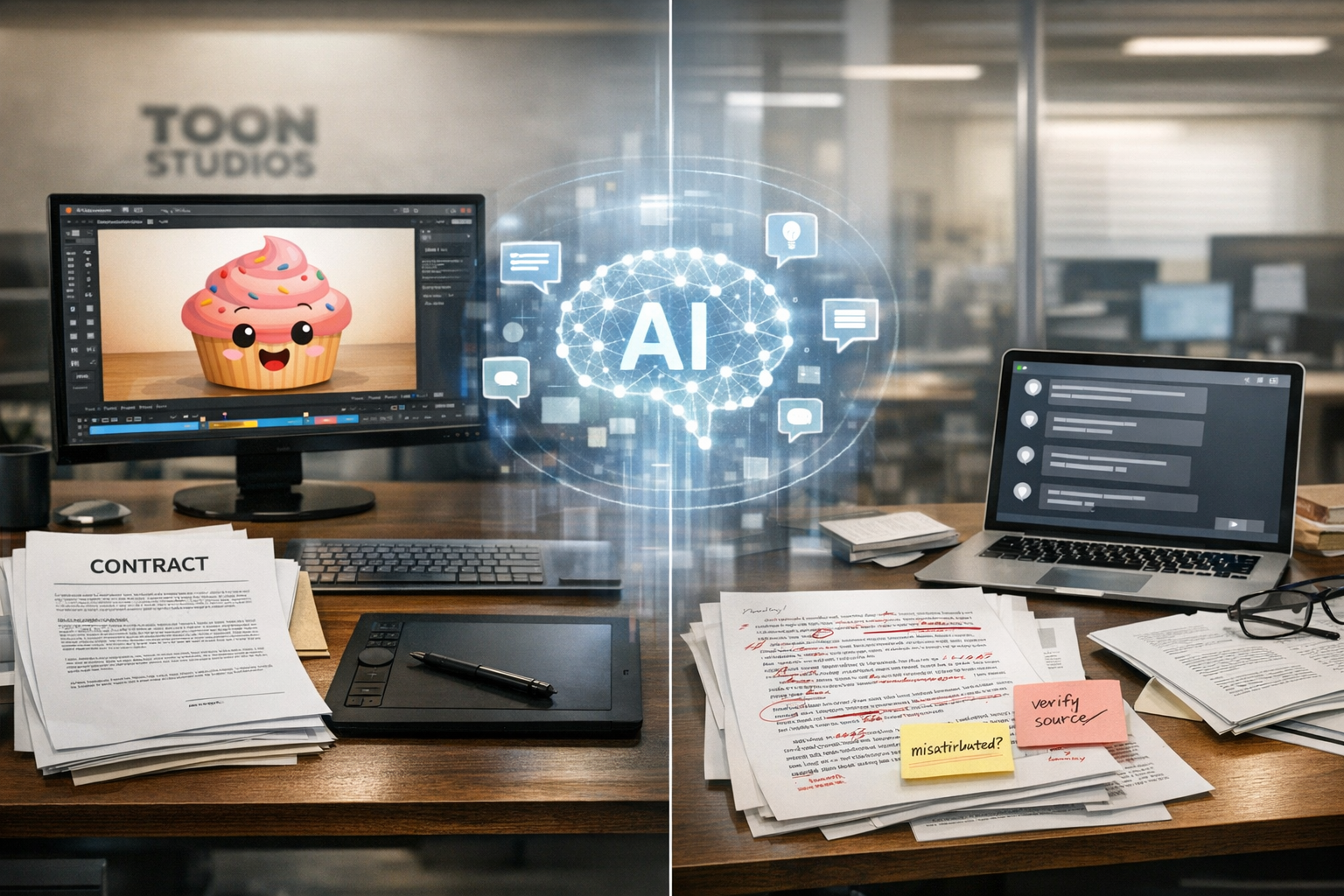
Two seemingly different controversies — one over a children’s animated series, the other over a nonfiction book about misinformation — are converging on the same unsettled question in media: when artificial intelligence enters the creative process, who gets credit, who gives permission and who is responsible when things go wrong?
That tension sharpened in recent days after Amazon MGM Studios and Amazon Web Services announced a new GenAI Creators’ Fund and greenlit three AI-assisted animated series, including “Cupcake & Friends,” based on *Good Advice Cupcake*, a character created years ago by the illustrator and writer Loryn Brantz while she worked at BuzzFeed. Brantz has objected publicly, saying BuzzFeed licensed the character for the new production without her consent and after she had understood that the project would not continue without her involvement.
At nearly the same time, Steven Rosenbaum, the author of “The Future of Truth,” faced scrutiny after reports that his book included more than a half-dozen fake or misattributed quotations. Rosenbaum acknowledged that the book contained “a handful” of “improperly attributed or synthetic” quotes and said A.I. tools had been used during research, writing and editing, raising broader questions about how deeply such systems had shaped a book devoted to the nature of reality and trust.
Taken together, the disputes illuminate how A.I. is no longer an abstract future concern for publishers and studios. It is moving into ordinary production workflows, where old contracts, professional norms and editorial safeguards are proving poorly matched to the technology now being used.
A Character’s Return, Without Its Creator
Brantz created *Good Advice Cupcake* in the 2010s at BuzzFeed, where the cheerful, bluntly encouraging character became popular enough to spawn books, merchandise and an eight-episode web series. Now it is set to reappear in an Amazon-backed adaptation being presented as part of a new wave of A.I.-assisted entertainment production.
Brantz has said she was not asked for permission and has argued that whatever rights BuzzFeed retained, the use of generative A.I. changes the nature of the project in ways not contemplated when the character was first created. She has also said she is exploring legal options.
BuzzFeed, for its part, has said it owns the intellectual property and has the right to develop it, including with A.I. tools. That response points to a hard reality underlying many emerging disputes in entertainment: creators often signed employment-era agreements long before generative A.I. existed as a practical production method. Those agreements may give companies broad legal control over characters and franchises, even as the people who made them feel that a new line has been crossed.
The legal merits of Brantz’s position remain unclear. Ownership documents and work-for-hire arrangements often heavily favor employers. But the controversy is not only legal. It is also moral and reputational, especially in a business that still depends on the public appeal of authorship and artistic identity.
Amazon and BuzzFeed have not publicly detailed exactly how A.I. will be used in “Cupcake & Friends,” or how much of the final work will be generated, assisted or guided by human artists. That ambiguity has become part of the problem. For many creators, “A.I.-assisted” can mean anything from harmless software support to a substantial replacement of human labor. Without clearer disclosures, suspicion tends to fill the gap.
A Book About Truth Collides With A.I.’s Habit of Invention
If the Cupcake dispute centers on consent, the Rosenbaum episode turns on credibility.
“The Future of Truth” arrived as part of a growing body of nonfiction attempting to explain how A.I. is reshaping information, trust and public understanding. But the book itself came under criticism after reports that several quotations appeared to be fabricated, synthetic or wrongly attributed. Rosenbaum later said A.I. had been used as part of the book’s research, writing and editing process, even while acknowledging that some of the output was, in his words, “staggeringly wrong.”
That admission has intensified concern well beyond one title. A fabricated quote in a novel may be an artistic choice. In nonfiction, it is a breach of the form’s basic promise. The Rosenbaum case has become an unusually vivid example of how A.I. systems can introduce falsehoods into work that still carries the authority of reported fact.
For publishers, the episode raises uncomfortable questions about process. How many passages were affected? What verification was performed before publication? Will future printings be corrected, and if so, how prominently? And should authors be required to disclose the use of A.I. not just in drafting prose but in gathering facts, checking quotations and building source material?
Those questions are becoming harder to avoid as A.I. tools become more deeply woven into editorial routines. The appeal is obvious: speed, convenience and the promise of assistance with research and organization. But the technology’s tendency to produce confident falsehoods — often called hallucinations — makes it especially dangerous in factual work, where mistakes can survive because they arrive neatly packaged in plausible language.
Old Rules, New Technology
The two controversies are unfolding in different corners of the media business, but they reflect the same transition. What began as experimentation is hardening into commercial practice.
In Hollywood, studios and tech companies are increasingly presenting generative A.I. as a legitimate production tool rather than a novelty. In publishing, authors and editors are testing it as a research aide, drafting assistant and workflow shortcut. Yet the institutions adopting these systems are still relying on rules built for earlier technologies.
In entertainment, that means contracts that settled ownership but said little or nothing about whether a creator’s work could someday be extended, remixed or visually reinterpreted through machine-generation tools. In nonfiction publishing, it means editorial standards built around human error and misconduct, not probabilistic systems that can invent details with fluency and no sense of consequence.
The result is a new class of conflict. In one form, a company may have the paperwork to proceed while still appearing to sideline the person most closely associated with the work. In another, a book may pass through ordinary editorial channels while containing inaccuracies introduced by tools that no one fully tracked.
Recent cultural flashpoints have only heightened the unease. Questions about A.I.-assisted writing have spilled into literary circles, prize judging and newsrooms, feeding a broader anxiety that machine-generated language is eroding the boundary between authentic expression and synthetic approximation. The concern is not merely that A.I. can imitate. It is that institutions may grow accustomed to using it before they have established durable rules for transparency and accountability.
Why This Matters Now
These episodes matter because they suggest that the central fights over A.I. in media are no longer theoretical. They are becoming fights about employment, licensing, editing and trust — the ordinary machinery of cultural production.
For creators, the Brantz dispute is a warning that intellectual property ownership may not settle the more personal question of artistic consent. A character can survive contractually while being severed from the person who gave it its voice. For authors and publishers, the Rosenbaum controversy shows how quickly A.I.-assisted workflow can become an editorial liability, especially when a tool used for convenience slips into the evidentiary chain of a nonfiction book.
Neither case has produced a definitive answer. It is not yet known whether Brantz has a viable legal path, or whether publishers will adopt stricter disclosure rules and fact-checking practices in response to the Rosenbaum episode. But together they make plain that the next phase of the A.I. debate will be less about what the technology can do than about what industries are willing to permit it to do — and what audiences will still trust once it does.
Sources
Further reading and reporting used to add context:
- https://www.creativebloq.com/ai/ai-art/kpop-demon-hunters-fans-are-fuming-over-amazons-ai-animation-mockbuster
- We Asked the ‘Future of Truth’ Author to Explain How He Used AI. It Didn’t Go Well | WIRED
- Amazon Is Making an AI-Animated ‘Good Advice Cupcake’ TV Show. Its Original Creator Is Furious | WIRED
- https://arstechnica.com/ai/2026/05/ai-put-synthetic-quotes-in-his-book-but-this-author-wants-to-keep-using-it/
- AI is devoid of meaning and humanity. That’s why its vapid voice suits this political moment | Nesrine Malik | The Guardian
- https://www.theguardian.com/technology/artificialintelligenceai
- Amazon Bolsters AI Production With 3 Animated Series Orders
- https://www.detectdeepfakes.com/examples/loryn-brantzthe-good-advice-cupcake-9f3vbv
- https://www.infobae.com/america/the-new-york-times/2026/05/19/escribio-un-libro-sobre-la-verdad-en-tiempos-de-la-ia-con-citas-inventadas-por-la-ia/
- https://kombi.id/read/2026/05/30/amazon-membuat-acara-tv-good-advice-cupcake-animasi-ai-pencipta-aslinya-sangat-marah/
- https://www.theatlantic.com/technology/2026/05/ai-writing-scandal-future-of-truth-book/687290/?utm_source=apple_news
- https://oecd.ai/en/incidents/2026-05-19-f57e
- https://megaton.ai/news/amazon-greenlights-three-ai-animated-series-using-proprietary
- https://www.thedailybeast.com/author-steven-rosenbaum-busted-using-fake-ai-generated-quotes-in-book-critiquing-ai/
- https://www.marsmag.com/2026/05/22/youre-not-writing-seth-rogen-torches-ai-slop/
- https://www.reddit.com/r/technology/comments/1tseqju/amazon_is_making_an_aianimated_good_advice/
- https://www.reddit.com/r/Fauxmoi/comments/1ts7b0w/amazon_is_making_an_aianimated_good_advice/
- https://www.reddit.com/r/aifails/comments/1tjjh8r/author_uses_ai_to_write_a_book_about_ai_ai_makes/
- https://www.reddit.com/r/u_andrewaltair/comments/1ticjdw/the_new_york_times_found_over_6_fake_quotes_in_a/
- https://www.reddit.com/r/antiai/comments/1thvouf/author_of_nonfiction_book_about_the_effects_of_ai/
- https://press.aboutamazon.com/2026/5/snowflake-expands-aws-collaboration-with-6b-commitment-to-accelerate-enterprise-agentic-ai-adoption
- https://press.aboutamazon.com/aws/2026/5/reactor-emerges-from-stealth-with-59m-to-build-the-platform-for-real-time-ai-worlds
- https://www.aboutamazon.com/news/operations/new-robots-amazon-fulfillment-agentic-ai
- https://press.aboutamazon.com/2026/5/wnba-and-aws-announce-multi-year-partnership-to-drive-fan-engagement-innovation-and-growth
- https://www.aboutamazon.com/news/entertainment/amazon-is-launching-a-fund-for-emerging-creators-on-its-live-radio-app-amp//
- https://www.aboutamazon.com/news/company-news/amazon-news-today-top-stories-company/
- https://press.aboutamazon.com/2026/2/openai-and-amazon-announce-strategic-partnership
- https://www.aboutamazon.com/news/AWS
- https://www.aboutamazon.com/news/aws/amazon-bedrock-openai-gpt-models-ai-agents
- https://www.aboutamazon.com/news/aws/bedrock-openai-models?refid=BC_UniversalKidsDay_ES
- https://www.aboutamazon.com/news/tag/artificial-intelligence//
- https://www.aboutamazon.com/news/aws/openai-amazon-partnership-explained
- https://trustworthyshopping.aboutamazon.com/eu-dsa-risk-assessment-report-amazon-2025
- https://ir.aboutamazon.com/files/doc_financials/2025/ar/2024-Shareholder-Letter-Final.pdf
- https://assets.aboutamazon.com/95/6e/58dd03ec468581d4d90d82864793/amazon-sustainable-bond-framework-bb-r5-option-b-copy.pdf
- https://assets.aboutamazon.com/e1/a0/17842ee148e8af9d55d10d75a213/aws-accelerating-ai-skills-us-en.pdf
- https://theweek.com/culture-life/books/ai-commonwealth-prize-jamir-nazir
- https://www.theguardian.com/books/2026/may/19/commonwealth-short-story-prize-winner-doubts-ai-artificial-intelligence
- https://www.theguardian.com/books/short-stories
- https://www.theguardian.com/culture/awards-and-prizes/2026/may/19/all
- https://www.wired.com/story/commonwealth-short-story-prize-ai-allegations/
- https://phys.org/news/2026-05-commonwealth-writers-prize-ai-allegations.html
- https://omni.se/tung-litteraturtidskrift-kan-ha-publicerat-ai-novell/a/43LdLo
- https://www.buzzfeed.com/lorynbrantz
- https://www.theatlantic.com/books/2026/05/granta-ai-fiction-book-scandal-changes-everything/687243/?utm_source=apple_news
- https://www.kirkusreviews.com/book-reviews/steven-rosenbaum/the-future-of-truth-2/
- https://apnews.com/article/9c7441de907664136a7ae0c8af0912ad
- https://www.imdb.com/news/ni65859440/
- https://commonwealthfoundation.com/cssp/
- https://en.wikipedia.org/wiki/Commonwealth_Short_Story_Prize
- https://agencelapautre.com/wp-content/uploads/2026/02/Aevitas-Creative-Management-London-2026-Rights-Guide-Nonfiction-Short.pdf
- https://www.reddit.com/r/RSbookclub/comments/1thpwwy/even_commonwealth_short_story_prizes_asian_region/
- https://www.reddit.com/r/RSbookclub/comments/1thab8t/pretty_sure_another_commonwealth_short_story/
- https://www.reddit.com/r/antiai/comments/1ti9xq0/commonwealth_short_story_prize_ai_allegations/
- https://en.wikipedia.org/wiki/International_Booker_Prize
- https://www.reddit.com/r/RSbookclub/comments/1tg726k/commonwealth_short_story_prize_awards_aigenerated/










Leave a Reply