
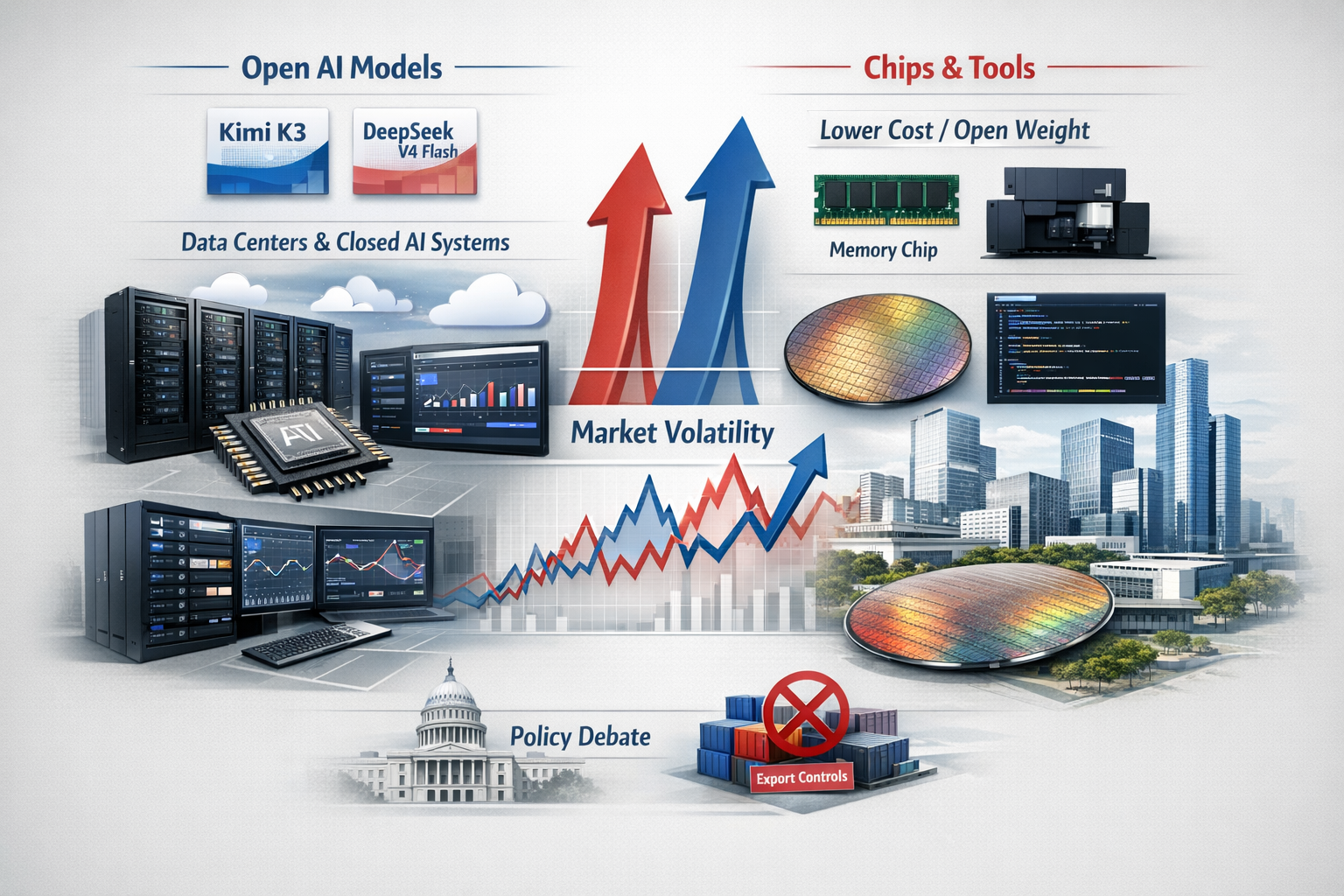
China’s A.I. Push Jolts Markets and Recasts the Industry’s Power Map
A rapid succession of Chinese advances in artificial intelligence and semiconductors has unsettled investors, intensified debate in Washington and Silicon Valley, and challenged a long-running assumption that the most important breakthroughs in the field would come chiefly from the United States.
In the span of just a few weeks, Chinese companies released increasingly competitive open A.I. models, a major domestic chipmaker soared in its market debut, and reports circulated that China had reached a new milestone in producing homegrown lithography tools. Together, the developments have fed a sense that China is no longer merely catching up in A.I., but beginning to shape the terms of competition — on price, on openness and on the hardware needed to sustain the technology’s expansion.
The shock has been felt far beyond research circles. Shares tied to the A.I. trade have swung sharply as investors try to gauge whether the latest Chinese entrants represent a temporary disruption or a more lasting threat to Western dominance in both software and chips.
A New Wave of Models
At the center of the latest attention are Chinese A.I. labs that have moved quickly to release models positioned as powerful and relatively inexpensive alternatives to American systems.
Moonshot AI’s Kimi K3, introduced in mid-July, drew notice as an open-weight model of enormous scale, with the company describing it as a 2.8 trillion-parameter system and touting a context window of one million tokens. Days later, DeepSeek published DeepSeek-V4-Flash-0731, the latest official release in its V4-Flash line, presenting it as a stronger, more capable version of an already closely watched model family.
Independent evaluators and developers quickly circulated comparisons suggesting that the DeepSeek release performed unusually well for its cost, adding to the pressure on American companies that have built their businesses around premium-priced access to top-tier models. The importance of that dynamic is hard to overstate: if Chinese labs can offer highly capable open or low-cost systems, they threaten not just prestige but the economics of the leading Western A.I. firms.
That is one reason the response has been so anxious. Open models can be downloaded, modified and integrated by developers around the world, making them especially difficult to contain once they gain traction. For U.S. companies such as OpenAI and Anthropic, the challenge is not simply that Chinese rivals may build good models. It is that they may distribute them in ways that spread influence quickly and undermine pricing power.
Beijing’s Hardware Ambitions Come Into View
At the same time, the software story has collided with fresh momentum in China’s semiconductor push.
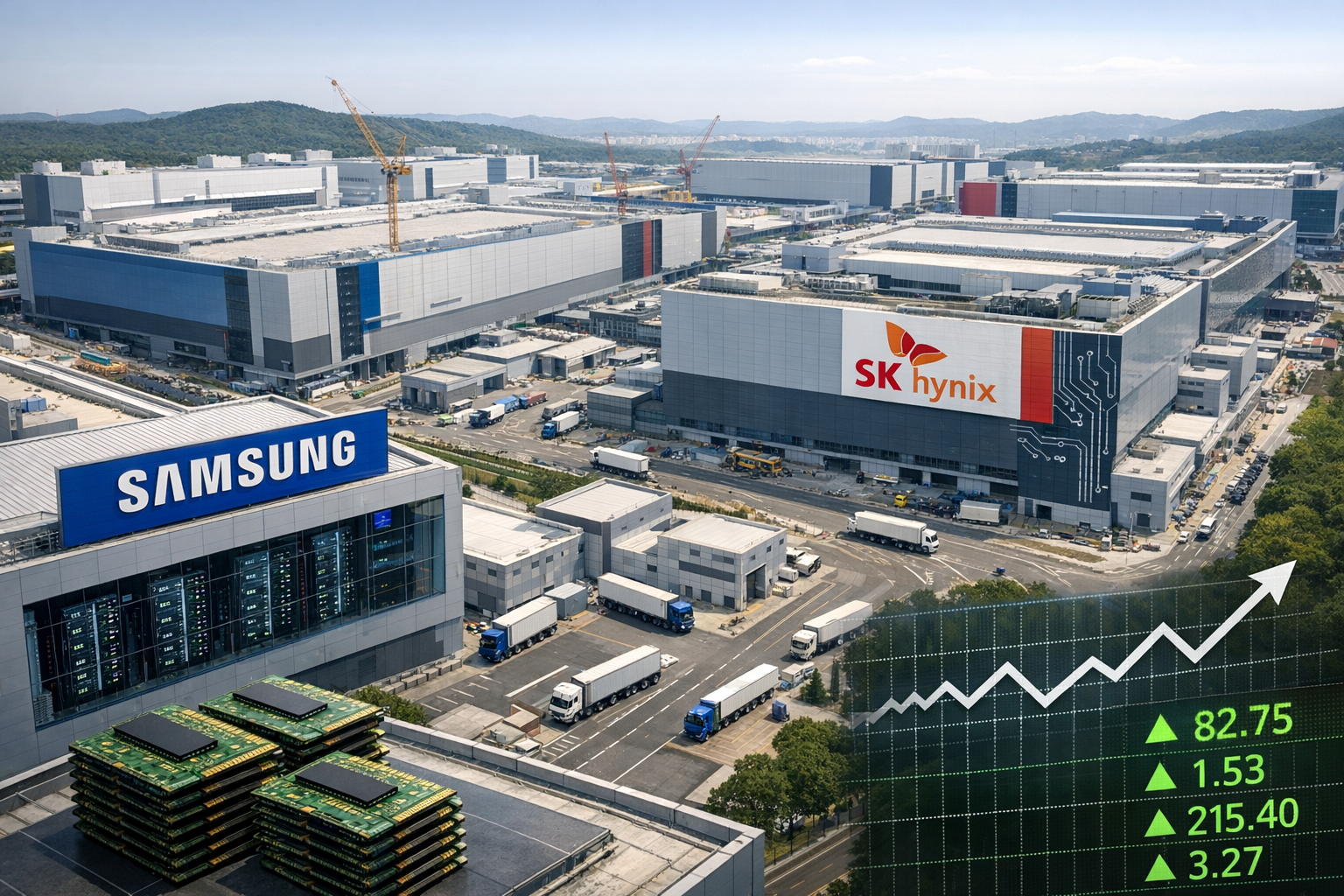
CXMT, a Chinese memory-chip company seen as central to Beijing’s effort to reduce dependence on foreign suppliers, surged 466 percent in its Shanghai debut on July 27, according to market reports. The extraordinary jump reflected not only speculative enthusiasm but also a broader conviction among Chinese investors that domestic chip champions may become increasingly valuable as geopolitical tensions harden and supply chains fragment.
Reports that China had also begun mass production of domestic immersion DUV lithography tools added another layer of significance. Such equipment does not erase China’s gap with the world’s most advanced chip-tool makers, and experts caution that mass production at less advanced nodes is not the same as matching the cutting edge. But the milestone matters because it suggests that China may be making progress in precisely the parts of the supply chain that support resilience: older but still highly useful manufacturing capabilities, domestic substitution and reduced exposure to export controls.
That combination — stronger models and a sturdier local hardware base — is what has made the latest developments so unsettling to Western companies and policymakers. The concern is no longer just that China can produce competitive applications. It is that it may gradually localize more of the underlying stack needed to train, deploy and scale them.
A Public-Facing Chinese Research Community
Another shift is playing out less on balance sheets than in public discourse.
As some employees at leading American A.I. firms have grown more guarded online, researchers affiliated with Chinese labs have become more visible on X, the social platform formerly known as Twitter. They have used it to explain technical papers, promote product launches, recruit talent and speak directly to a global developer audience.
That change may seem secondary to model benchmarks or chip production, but it reflects a broader maturation. Chinese A.I. researchers are no longer communicating mainly through product announcements and academic publications. Increasingly, they are participating in the same real-time, global conversation that helped American labs build influence and mindshare. In a field where perception can attract engineers, customers and investors, visibility has strategic value.
It also helps normalize Chinese firms as leading contributors rather than peripheral challengers. For years, much of the world’s A.I. narrative was shaped by companies in San Francisco and their networks of researchers, venture capitalists and influencers. The growing online presence of Chinese labs suggests that narrative terrain is becoming contested as well.
Why the Markets Are Reacting So Sharply
The recent volatility reflects more than ordinary hype. Investors have spent the past several years placing large bets on a relatively simple story: that the A.I. boom would chiefly enrich American model makers and, above all, the Western chip and equipment companies supplying them.
The latest Chinese developments complicate that thesis. If Chinese open models continue improving, they could cap the profits of top U.S. labs by making capable alternatives abundant and cheap. If Chinese chipmakers and toolmakers become more self-sufficient, that could weaken assumptions about the long-term dominance of foreign suppliers. And if China’s ecosystem advances despite U.S. restrictions, investors may be forced to reconsider how much those controls are really slowing the country’s progress.
That does not mean the balance of power has already shifted. American companies still lead in many of the most advanced semiconductors, cloud infrastructure and frontier-model deployments. And the recent Chinese claims, while impressive, will be tested by real-world adoption, developer trust and sustained performance over time.
But markets tend to react first to changes in narrative and only later to hard evidence. What changed over the past month was the sense of inevitability that had surrounded Western leadership.
Washington’s Dilemma
The developments have also sharpened a policy debate in the United States.
For years, export controls on advanced chips were meant to slow China’s A.I. progress by limiting access to crucial hardware. Yet recent model releases and chip-sector gains have raised a difficult question: if Chinese firms are still producing competitive systems and building out more domestic capacity, should Washington impose still tighter restrictions, or would doing so mostly accelerate China’s drive toward self-sufficiency?
A related debate is unfolding around Chinese open models themselves. Some U.S. officials and executives argue that such systems pose strategic and security risks and should be more aggressively restricted. Others warn that attempts to wall them off may prove ineffective while harming American developers, startups and researchers who are already drawn to lower-cost alternatives.
This tension has exposed divisions inside the U.S. tech industry. For some executives, China’s rise is proof that regulation at home should be kept light so American firms can move faster. For others, the emergence of cheap, capable Chinese models suggests that the business moats around proprietary A.I. may be thinner than promised.
A More Competitive Era
The deeper significance of the moment is that China’s progress appears to be arriving across several fronts at once.
This is not simply a story about one model, one stock-market debut or one manufacturing report. It is about a widening challenge to the assumption that the future of A.I. will be controlled by a small cluster of American labs and chip companies. Chinese firms are now competing not only by trying to match the West’s technical frontier, but also by changing the economic equation with open releases, aggressive pricing and a push for domestic supply resilience.
Whether that proves durable remains uncertain. Benchmark results do not always translate into broad adoption, and manufacturing milestones can obscure serious limitations. But for investors, policymakers and the tech industry, the message of the past few weeks has been unmistakable: China is no longer just part of the A.I. story. It is increasingly one of the forces writing it.
Sources
Further reading and reporting used to add context:
- https://huggingface.co/blog/deepseekv4
- https://api-docs.deepseek.com/news/news260424/
- https://www.nature.com/articles/d41586-026-02281-2
- https://huggingface.co/deepseek-ai/DeepSeek-V4-Flash
- https://www.reddit.com/r/DeepSeek/comments/1vbi0wk/deepseekv4flash_api_is_now_in_public_beta/
- https://www.theguardian.com/business/2026/jul/28/ai-sell-off-chip-stocks-sk-hynix-samsung
- https://huggingface.co/deepseek-ai/DeepSeek-V4-Flash/tree/refs%2Fpr%2F31
- https://www.reddit.com/r/DeepSeek/comments/1vbqrp8/httpshuggingfacecodeepseekaideepseekv4flash0731/
- https://github.com/huggingface/transformers/blob/main/docs/source/en/model_doc/deepseek_v4.md
- https://techcrunch.com/2026/05/27/china-is-increasingly-keeping-its-best-ai-talent-to-itself/
- https://www.reddit.com/r/DeepSeek/comments/1vbpknk/deepseek_v4_flash_0731_open_model_has_arrived/
- https://www.theguardian.com/technology/2026/may/11/trump-china-visit-ai-tech
- https://www.theguardian.com/technology/2026/mar/19/inside-chinas-robotics-revolution
- https://www.deepseek.com/en/transparency/
- https://api-docs.deepseek.com/updates/
- https://www.reddit.com/r/oMLX/comments/1vbpuls/new_deepseek_v4_flash_release/
- https://www.reddit.com/r/unsloth/comments/1vbw4q1/deepseek_v4_flash_0731_out_now/
- https://www.reddit.com/r/LocalLLaMA/comments/1vbp7kb/deepseekaideepseekv4flash0731_on_huggingface/
- https://www.reddit.com/r/DeepSeek/comments/1vbxz86/deepseekv4flash0731_is_currently_2_on_hugging/
- https://www.reddit.com/r/hermesagent/comments/1vc76pb/the_new_deepseekv4flash_is_incredible/
- https://www.reddit.com/r/DeepSeek/comments/1vc6ag5/ds_v4_flash_0731_agentic_performance_vs_code/
- https://www.reddit.com/r/DeepSeek/comments/1vbpi21/deepseekv4flash_official_version_is_here/
- https://www.reddit.com/r/DeepSeek/comments/1vc4ocr/deepseek_v4_flash_0731_real_experience_it_is/
- https://www.reddit.com/r/huggingface/comments/1vc4l6j/deepseek_v4_flash_0731_gguf_benchmark_tensorsharp/
- https://www.chinadailyasia.com/upload/main/pdf/2025/08/09/2551c70efeb1883f26fc61945a918081.pdf
- https://www.frontiersin.org/journals/computer-science/articles/10.3389/fcomp.2026.1780565/full
- https://www.nature.com/articles/d41586-026-01674-7
- https://www.sixthtone.com/news/1018753
- https://www.channelnewsasia.com/watch/chinas-ai-voice-clone-debate-when-real-voice-gets-flagged-6243826
- https://www.sciencedirect.com/science/article/pii/S0736585326000596
- https://pubmed.ncbi.nlm.nih.gov/42131519/
- https://www.jmir.org/2026/1/e80346
- https://journals.sagepub.com/doi/abs/10.1177/13678779261460051
- https://link.springer.com/article/10.1007/s00146-026-03079-6
- https://kompozy.io/news/chinese-voice-actor-prove-human-ai-clones
- https://officechai.com/ai/alibaba-qwens-tech-lead-junyang-lin-steps-down/
- https://restofworld.org/2026/chinese-ai-researchers-silicon-valley/
- https://www.reddit.com/r/Sino/comments/1ve5un4/oped_the_us_lead_over_china_in_ai_is_all_but_gone/
- https://www.reddit.com/r/Sino/comments/1vdi9df/removed/
- https://www.reddit.com/r/LocalLLaMA/comments/1uzpn33/removed/
- https://www.reddit.com/r/Sino/comments/1vc7ptf/first_it_was_openai_now_anthropic_also_admitted/
- https://www.reddit.com/r/MachineLearning/comments/1u0fv7u/stop_racist_posts_about_chinese_researchers_d/
- https://www.reddit.com/r/China/comments/1mfyoxw
- https://digitalpaper.stdaily.com/http_www.kjrb.com/ywtk/images/2024-08/10/03/ywtk2024081003.pdf
- https://en.wikipedia.org/wiki/MiniMax_Group
- https://www.reddit.com/r/Sino/comments/1uqoagq/lawmakers_probe_growing_use_of_chinese_ai_models/
- https://x.com/KanishkaNarayan/status/2027005522742800820
- https://x.com/Analyticsindiam/status/1949708712706453609
- https://x.com/ConversationUS/status/2039686313847165353
- https://x.com/BillionAireSon/status/2030754733825135028
- https://x.com/_imGQ/status/1952867792954507358
- https://partners.x.com/en
- https://x.com/ScaleAILabs/status/2035050785143497009
- https://x.com/DenverChannel/status/2023593249546338450
- https://x.com/FARLabsAI/status/2063622008064389343
- https://x.com/ChineseEmbinUS/status/1949603691939479720
- https://x.com/jasonaverbook/status/2038982900624859189
- https://x.com/zephyr_z9/status/1963250319879708800
- https://blog.x.com/content/dam/about-twitter/en/company/global-impact-2020.pdf
- https://about.x.com/content/dam/about-twitter/en/company/global-impact-2020.pdf
- https://business.x.com/content/dam/business-twitter/business-x/resources/downloadables/x-trends-2025/xtrends_india2025report.pdf
- https://marketing.x.com/content/dam/marketing-twitter/na/en/insights/twitter-trends-in-canada/conversation-trends-ca-feb2021.pdf
- https://transparency.x.com/content/dam/transparency-twitter/2025/x-global-transparency-report_h2_2024.pdf
- https://legal.x.com/content/dam/legal-twitter/twitter-purchaser-terms-of-service/x-purchaser-terms-2025-10-07/tr/x-purchaser-terms-2025-10-07.pdf
- https://laurence-wilse-samson.gitbook.io/textbooks/economic-coercion/part-ii-strategic-terrain/chapter_4
- https://www.techmeme.com/260102/h1635
- https://nextomoro.com/diaspora-map/
- https://www.linkedin.com/posts/bharathred_ai-geopolitics-activity-7432315455421435904-N9YH
- https://en.wikipedia.org/wiki/Artificial_intelligence_industry_in_China
- https://healthcarereimagined.net/2025/07/
- https://cmsrkv.rgukt.in/storage/notices/files/Hyderabad%2011–3%20%281%29_1773230804.pdf
- https://80000hours.org/career-reviews/china-related-ai-safety-governance/
- https://publichealth.jmir.org/2021/9/e27715
- https://groups.google.com/g/ai-brief/c/N4xwvITd2pk
- https://www.techmeme.com/250708/p19
- https://www.agenticbrew.ai/news/caeb8763-6733-4691-8e67-0befba510119/china-restricts-overseas-travel-for-top-private-sector-ai-researchers
- https://www.thecoli.com/threads/the-a-i-megathread-llm-gpt-development.960563/post-51639033
- https://vesperosint.substack.com/p/finger-on-the-button-the-people-and-b2d?triedRedirect=true
- https://oregonnews.uoregon.edu/lccn/sn97071110/1915-07-22/ed-1/seq-5.pdf
- https://formative.jmir.org/2023/1/e36401/PDF
- https://www.astrj.com/pdf-209579-131560?filename=A-hybrid-fuzzy-sentiment-.pdf
- https://upload.wikimedia.org/wikipedia/commons/4/43/Surrey_Rotunda_%28Sir_Ashton_Lever%27s_Museum_etc.%29_1784-1858_%28IA_b30458237%29.pdf
- https://www.axios.com/newsletters/axios-am-c28a0dcf-07c5-4caa-b46b-da0e202609d6
- https://www.tomshardware.com/tech-industry/cxmt-closes-up-466-percent-in-shanghai-debut-with-no-hbm-project-in-its-ipo-prospectus
- https://www.pcgamer.com/hardware/memory/memory-chipmaker-cxmt-sees-shares-surge-466-percent-becomes-one-of-chinas-most-valuable-listed-companies-right-below-tencent/
- https://www.tomsguide.com/ai/what-is-kimi-k3-everything-you-need-to-know-about-the-new-chatgpt-rival
- https://theweek.com/tech/kimi-k3-moonshot-chinese-ai-firm-anthropic-openai
- https://theweek.com/tech/ai-china-open-weight-models-might-be-the-future
- https://www.investing.com/news/stock-market-news/china-memory-chipmaker-cxmt-set-shanghai-debut-after-asias-biggest-ipo-4812927
- https://www.investing.com/news/stock-market-news/exclusivechina-starts-production-of-homegrown-immersion-duv-chipmaking-tools–source-4815671
- https://www.investing.com/news/stock-market-news/china-memory-chipmaker-cxmt-set-for-shanghai-debut-after-asias-biggest-ipo-4812927
- https://www.investing.com/news/stock-market-news/chinas-memory-chip-makers-ride-ai-boom-to-new-power–and-us-scrutiny-4810472
- https://efe.com/english/science-and-technology/2026-07-18/moonshot-ai-kimi-k3-open-source/
- https://www.theinformation.com/articles/china-starts-mass-producing-homegrown-duv-chipmaking-tools-advance-local-chip-industry
- https://www.investing.com/news/stock-market-news/eyeing-valuation-jump-investors-prep-bids-for-chip-giant-cxmts-86-billion-ipo-4792516
- https://www.investing.com/news/stock-market-news/chinas-moonshot-unveils-worlds-largest-open-ai-model-closing-in-on-us-rivals-4797347
- https://www.investing.com/news/stock-market-news/institutional-demand-for-cxmts-86-billion-shanghai-ipo-dented-by-chip-stock-selloff-4799712
- https://www.investing.com/news/economic-indicators/analysischipmaker-cxmt-debut-spotlights-chinas-statefunded-path-to-tech-power-4807822
- https://www.investing.com/news/stock-market-news/china-begins-making-homegrown-duv-chipmaking-tools-the-information-reports-4814529
- https://www.kimi.com/code/docs/en/kimi-code/whats-new.html
- https://www.kimi.com/resources/kimi-k3-pricing
- https://www.kimi.com/help/agent/agent-overview
- https://www.kimi.com/code/docs/kimi-code/whats-new.html
- https://www.kimi.com/vi/blog/kimi-k3
- https://www.kimi.com/en/blog/
- https://www.kimi.com/en-cn/help/agent/agent-overview
- https://www.kimi.com/resources/kimi-code-introduction
- https://www.kimi.com/code/docs/en/kimi-code-cli/release-notes/changelog.html
- https://www.kimi.com/fr-fr/resources/kimi-k3-pricing
- https://www.kimi.com/ru/help/agent/agent-overview
- https://www.kimi.com/ko/resources/kimi-k3-pricing
- https://statics.moonshot.cn/platform/%E4%B8%AD%E5%9B%BD%E4%BA%BA%E5%BD%A2%E6%9C%BA%E5%99%A8%E4%BA%BA%E8%A1%8C%E4%B8%9A_%E6%8A%A5%E5%91%8A_20250130.pdf
- What's New | Kimi Code Docs
- China’s tech advances are causing chaos from Silicon Valley to the White House | Technology | The Guardian
- deepseek-ai/DeepSeek-V4-Flash-0731 · Hugging Face








Leave a Reply