
As A.I. Talk Turns Into Pink Slips, the Fight Over Who Pays Is Moving Fast
The long-running argument over whether artificial intelligence will transform work gradually or jolt it all at once is becoming less theoretical by the week.
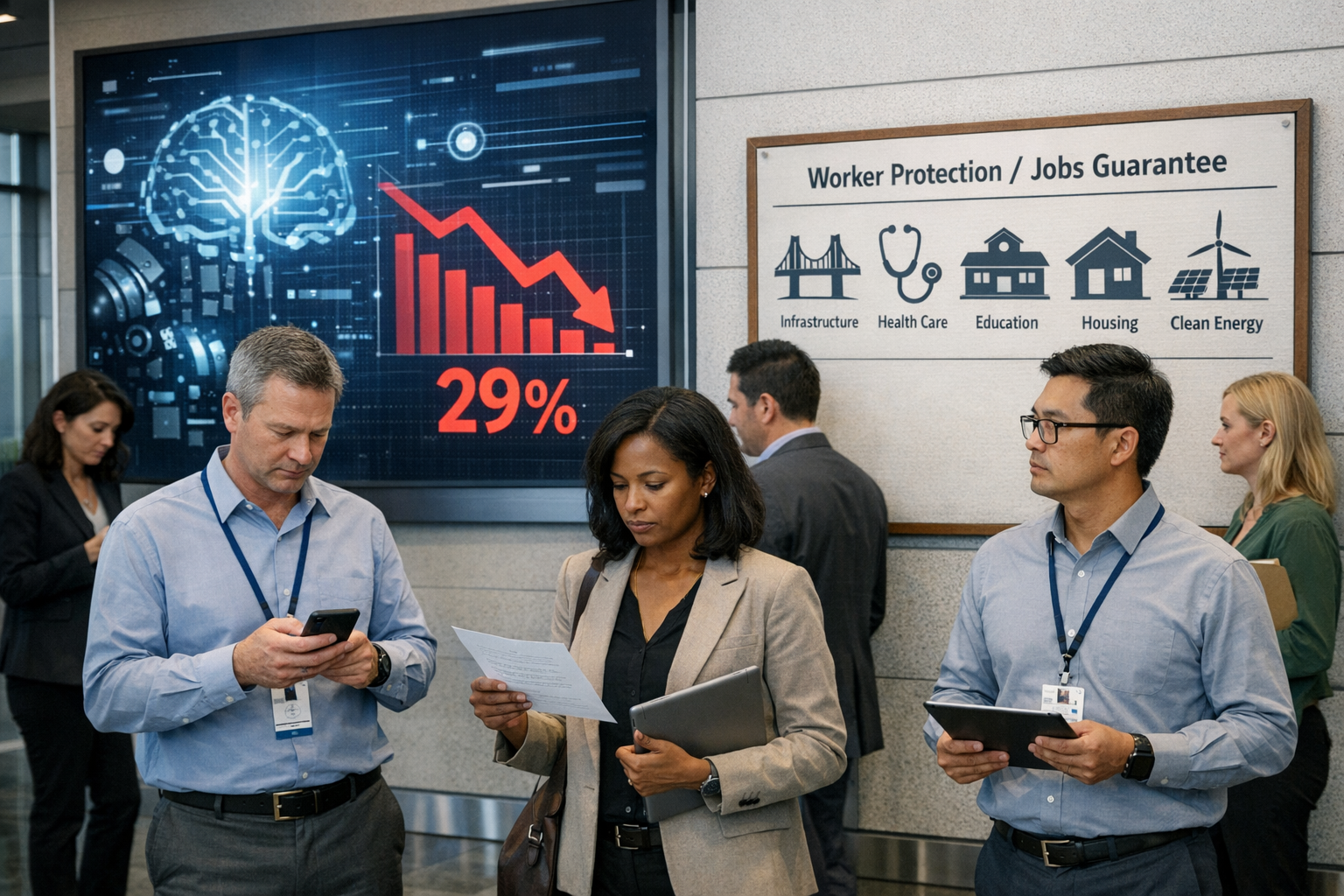
In California, Tom Steyer, the former presidential candidate now running for governor, has proposed an unusually direct response: a state-backed guarantee of “good-paying” jobs with benefits for workers displaced by A.I. In Australia, employees at WiseTech Global, a logistics software company, have spent months waiting to learn whether they will be among 2,000 workers the company has said it plans to cut, even as executives promote new A.I. systems as superior to human labor in some tasks.
Taken together, the developments suggest that the labor effects of A.I. are no longer confined to forecasts from economists or warnings from technologists. They are becoming a live political issue and a workplace reality, forcing a harder question into public view: If companies reap the gains from automation, who shoulders the human cost?
A Political Answer in California
Mr. Steyer’s proposal would create a jobs guarantee for people whose positions are eliminated by artificial intelligence, an idea that pushes well beyond the retraining programs and tax incentives that have typically defined state labor policy.
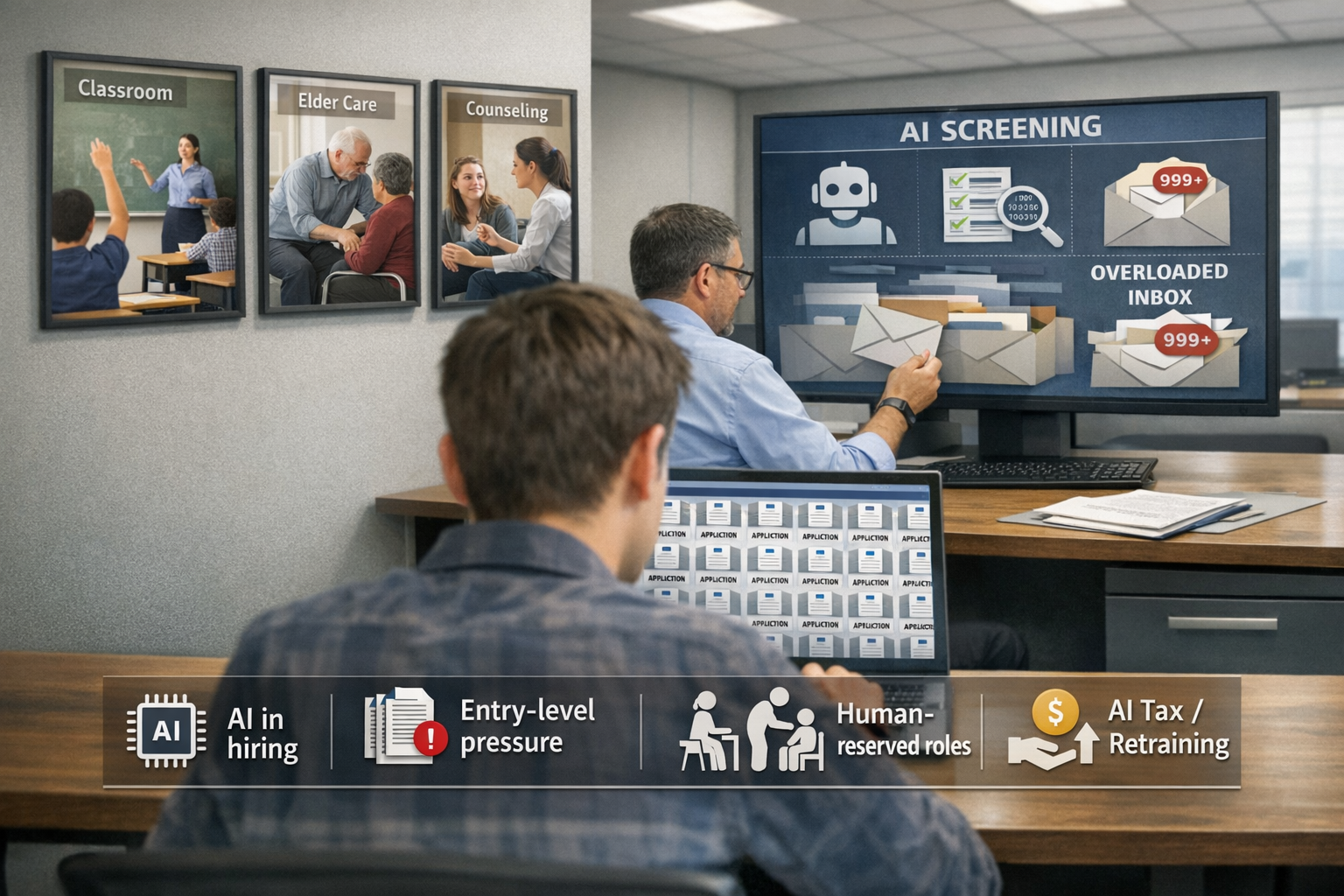
Under the plan, California would establish an A.I. Worker Protection Administration to help place displaced workers into new jobs, while also expanding unemployment insurance, apprenticeships and training. The proposal envisions public and publicly supported employment in areas that are less easily automated, including infrastructure, housing, clean energy, health care and education.
To help pay for it, Mr. Steyer has proposed what he calls a “token tax” on corporate use of A.I., betting that a state that has long helped create the modern technology economy could also become the first to build a large-scale social compact around its disruptions.
The idea faces steep obstacles. Mr. Steyer would first have to win office. California voters would most likely have to approve any major new tax mechanism. And even supporters of stronger labor protections acknowledge that a true jobs guarantee would be expensive, complex to administer and difficult to scale in an economy where the effects of A.I. are still uneven and hard to measure.
Still, the proposal stands out because it addresses A.I. displacement not as a side effect to be managed, but as a central policy challenge. It reflects a broader shift in the politics of automation: for years, leaders in both parties largely celebrated innovation while promising workers that new technologies would create more jobs than they destroyed. Now, at least some politicians are beginning to argue that the transition itself will require a far more muscular public response.
A Corporate Test Case in Australia
At WiseTech, the debate is playing out in more intimate and unsettling terms.
The company said in February that it would cut 2,000 jobs — about 29 percent of its work force — with reductions expected to unfold through the rest of fiscal 2026 and into fiscal 2027. But months later, many employees still had not been told whether their roles would disappear, leaving workers in a prolonged state of uncertainty.
The anxiety intensified after public remarks by the company’s founder suggesting that an A.I. agent could learn a human’s job in 15 minutes. WiseTech has also argued that the “era of manually writing code” is ending, casting the layoffs as part of a broader restructuring around A.I.-driven productivity.
For workers, that language has sharpened a sense that the threat is not abstract. It is personal, immediate and, in some cases, humiliating: not just the possibility of losing a job, but hearing the work itself described as obsolete before the final decisions have even been communicated.
WiseTech has become a closely watched example because relatively few large employers have tied layoffs this explicitly to A.I. Many companies have embraced automation rhetoric while describing workforce reductions in vaguer terms — restructuring, efficiency, strategic realignment. That ambiguity has made it hard to determine how much current job loss is truly being driven by new technology, and how much is simply conventional cost-cutting wrapped in the language of A.I.
The Unanswered Question: Replacement or Rebranding?
That uncertainty remains at the center of the broader labor debate.
Economists have long noted that automation does not always eliminate entire occupations; more often, it changes tasks, compresses teams or redistributes work. Generative A.I. appears especially likely to affect white-collar and technical jobs once assumed to be relatively insulated, including roles in coding, design, customer service, analysis and administrative support. But the speed and depth of that change are still contested.
Some executives have argued that A.I. will augment workers more than replace them, allowing employees to become more productive. Others have been blunter, saying fewer people will be needed. For governments trying to respond, that distinction matters enormously. It is one thing to help workers adapt to new tools; it is another to absorb large numbers of displaced workers into entirely new sectors.
That is why proposals like Mr. Steyer’s, however politically remote they may be, are drawing attention. They amount to an attempt to define a public obligation before displacement becomes more widespread. And cases like WiseTech’s are doing the opposite: offering an early picture of what it looks like when that obligation has not yet been clearly defined.
Why This Matters Now
The timing is significant. A.I. systems have improved quickly, and companies are under pressure from investors to show they can turn those advances into higher margins and faster growth. At the same time, workers are hearing increasingly direct claims that software can replicate skilled human work in minutes or seconds.
That collision — between investor expectations, executive ambition and worker insecurity — is beginning to reshape the politics of labor. The emerging argument is no longer only about whether A.I. will make the economy more productive. It is about whether the benefits of that productivity will be broadly shared, or whether the transition will leave workers to absorb the shock on their own.
California and WiseTech sit on opposite sides of that divide: one proposing a new public guarantee, the other offering a glimpse of how disruptive private-sector adoption can feel in practice. But both point to the same conclusion. The era when A.I.’s effect on jobs could be treated as a future problem is ending.
Sources
Further reading and reporting used to add context:
- https://www.theguardian.com/technology/2026/may/07/your-craft-is-obsolete-wisetech-staff-in-limbo-as-ai-touted-as-better-than-humans
- https://www.theguardian.com/technology/artificialintelligenceai
- https://www.abc.net.au/news/2026-02-25/wisetech-job-losses-losing-2000-over-next-two-years-coding-era/106387486
- There’s a Long-Shot Proposal to Protect California Workers From AI | WIRED
- https://www.tomsteyer.com/press/tom-steyer-unveils-a-jobs-guarantee-for-the-ai-era-plan
- https://www.machinebrief.com/news/wisetechs-ai-moves-leave-employees-in-uncertain-limbo-uu9a
- https://technewstube.com/wired/1830099/theres-long-shot-proposal-to-protect-california-workers-ai/
- https://www.computerworld.com/article/4137200/australias-wisetech-to-cut-2000-jobs-as-ai-renders-manual-coding-obsolete.html
- https://src.senate.ca.gov/sites/src.senate.ca.gov/files/Quick%20Summary%20of%20Governor%27s%20Budget%20Proposal%202026-2027.pdf
- https://podfollow.com/tech-news-today-2-min-news-the-daily-news-now/episode/9330b8ada499b145bceff76acfe38d38bd61299f/view
- https://www.reddit.com/r/AIDangers/comments/1t9fp1q/californias_tom_steyer_proposes_jobs_guarantee/
- https://sfist.com/2026/04/18/porter-steyer-and-becarra-push-for-single-payer-health-care-in-their-campaigns-for-governor/
- https://book.st-hakky.com/news/wisetech-creates-ai-agent-in-15-minutes
- https://www.theguardian.com/technology/2026/apr/06/tech-layoffs-ai-work
- https://www.reddit.com/r/economy/comments/1t91zf6/tom_steyer_of_california_proposes_a_guarantee_of/
- https://www.reddit.com/r/USNewsHub/comments/1t7dddh/theres_a_longshot_proposal_to_protect_california/
- https://www.reddit.com/r/AnythingGoesNews/comments/1t7cpc7/theres_a_longshot_proposal_to_protect_california/
- https://www.reddit.com/r/politics/comments/1t7ckaq/theres_a_longshot_proposal_to_protect_california/
- https://www.reddit.com/r/USNewsHub/comments/1t7cmtv/theres_a_longshot_proposal_to_protect_california/
- https://en.wikipedia.org/wiki/2026_California_gubernatorial_election
- https://abgt.assembly.ca.gov/system/files/2026-01/highlights-of-governor-s-proposed-2026-27-budget_1.pdf
- https://en.wikipedia.org/wiki/Tom_Steyer
- https://www.reddit.com/r/California/comments/1t80r9n/california_gov_hopeful_steyer_proposes_fund_to/
- https://www.wisetechglobal.com/fr-fr/news/1h26-results-briefing-presentation-ai-generated-avatars/
- https://www.bloombergtechnoz.com/detail-news/100706/coding-manual-yang-digantikan-ai-wisetech-phk-2-000-pekerjaan
- https://www.wisetechglobal.com/investors/welcome/
- https://tw.stock.yahoo.com/news/wisetech%E8%A8%88%E7%95%AB%E8%A3%81%E5%93%A12000%E4%BA%BA-ceo%E5%AE%A3%E7%A8%B1-%E6%89%8B%E5%8B%95%E7%B7%A8%E5%AF%AB%E4%BB%A3%E7%A2%BC%E6%99%82%E4%BB%A3%E5%B7%B2%E7%B6%93%E7%B5%90%E6%9D%9F-061643029.html
- https://quartr.com/companies/wisetech-global-limited_5832
- https://stockanalysis.com/quote/asx/WTC/transcripts/
- https://tickernews.co/wisetech-global-to-slash-2000-jobs-amid-ai-transformation/
- https://www.newsminimalist.com/articles/wisetech-global-plans-to-reduce-staff-by-up-to-2000-as-ai-drives-efficiency-1e975314
- https://www.wisetechglobal.com/investors/shareholder-services/
- https://layoffhedge.com/company/wisetech-global
- https://www.reddit.com/r/BetterOffline/comments/1rdyykt/wisetech_global_set_to_cut_up_to_2000_jobs_for_ai/
- https://www.reddit.com/r/auscorp/comments/1rdyg8i/another_company_using_ai_for_cutting_jobs_this/
- https://www.reddit.com/r/cscareerquestionsOCE/comments/1re1g8f/oof_wisetech_to_cut_2000_jobs_betting_big_on_ai/
- https://www.reddit.com/r/NowInTech/comments/1rebyvp/australias_wisetech_to_cut_2000_jobs_as_ai/
- https://www.reddit.com/r/u_b2idigital/comments/1r90f1a/capai_plc_to_present_at_ai_technology_virtual/
- https://www.reddit.com/r/AnythingGoesNews/comments/1t7ddln/theres_a_longshot_proposal_to_protect_california/
- https://www.reddit.com/r/sanfrancisco/comments/1t80yi4/california_gov_hopeful_steyer_proposes_fund_to/
- https://www.sos.ca.gov/elections/ballot-measures/initiative-and-referendum-status/eligible-statewide-initiative-measures
- https://legalclarity.org/aca-13-in-california-changing-the-ballot-initiative-process/
- https://www.sos.ca.gov/elections/ballot-measures
- https://www.cbsnews.com/amp/sanfrancisco/news/california-middle-class-homes-25b-bond-program-november-2026-ballot/
- https://law.justia.com/codes/california/code-gov/title-7-85/part-2/chapter-1/section-67732/
- https://quarexdata.org/measures/ca/
- https://www.ballotblog.com/post/california-2026-ballot-measures-voter-id-local-tax-threshold-initiatives-gain-momentum
- https://dof.ca.gov/budget/ballot-initiatives-and-propositions/
- https://www.treasurer.ca.gov/caeatfa/ste/
- https://www.sos.ca.gov/elections/ballot-measures/initiative-and-referendum-status/initiatives-referenda-cleared-circulation
- https://supreme.courts.ca.gov/sites/default/files/supremecourt/default/documents/8-430-s281977-rpi-hiltachk-written-return-122723_0.pdf
- https://en.wikipedia.org/wiki/2026_California_billionaire_tax_initiative
- https://en.wikipedia.org/wiki/2026_San_Francisco_Proposition_D
- https://en.wikipedia.org/wiki/2026_California_voter_ID_initiative
- https://en.wikipedia.org/wiki/2026_United_States_ballot_measures
- https://oag.ca.gov/system/files/initiatives/pdfs/25-0038%20%28Schools%20and%20Taxpayers%20Act%20%29.pdf
- Tom Steyer Unveils “A Jobs Guarantee for the AI Era” Plan






Leave a Reply