
Vatican Steps Forcefully Into the A.I. Age
Pope Leo XIV on Sunday placed the Roman Catholic Church squarely at the center of the global debate over artificial intelligence, issuing a sweeping first encyclical that warns against the concentration of technological power, condemns the delegation of life-and-death decisions to machines and calls for far tighter ethical and political oversight of the industry.
The document, *Magnifica Humanitas*, is not merely another statement of concern from a religious leader about a disruptive new technology. At more than 40,000 words, and issued in one of the highest forms of papal teaching, it represents the Vatican’s most ambitious attempt yet to shape how governments, companies and citizens think about A.I. — not as a narrow technical question, but as a moral test touching labor, democracy, war, inequality and truth itself.
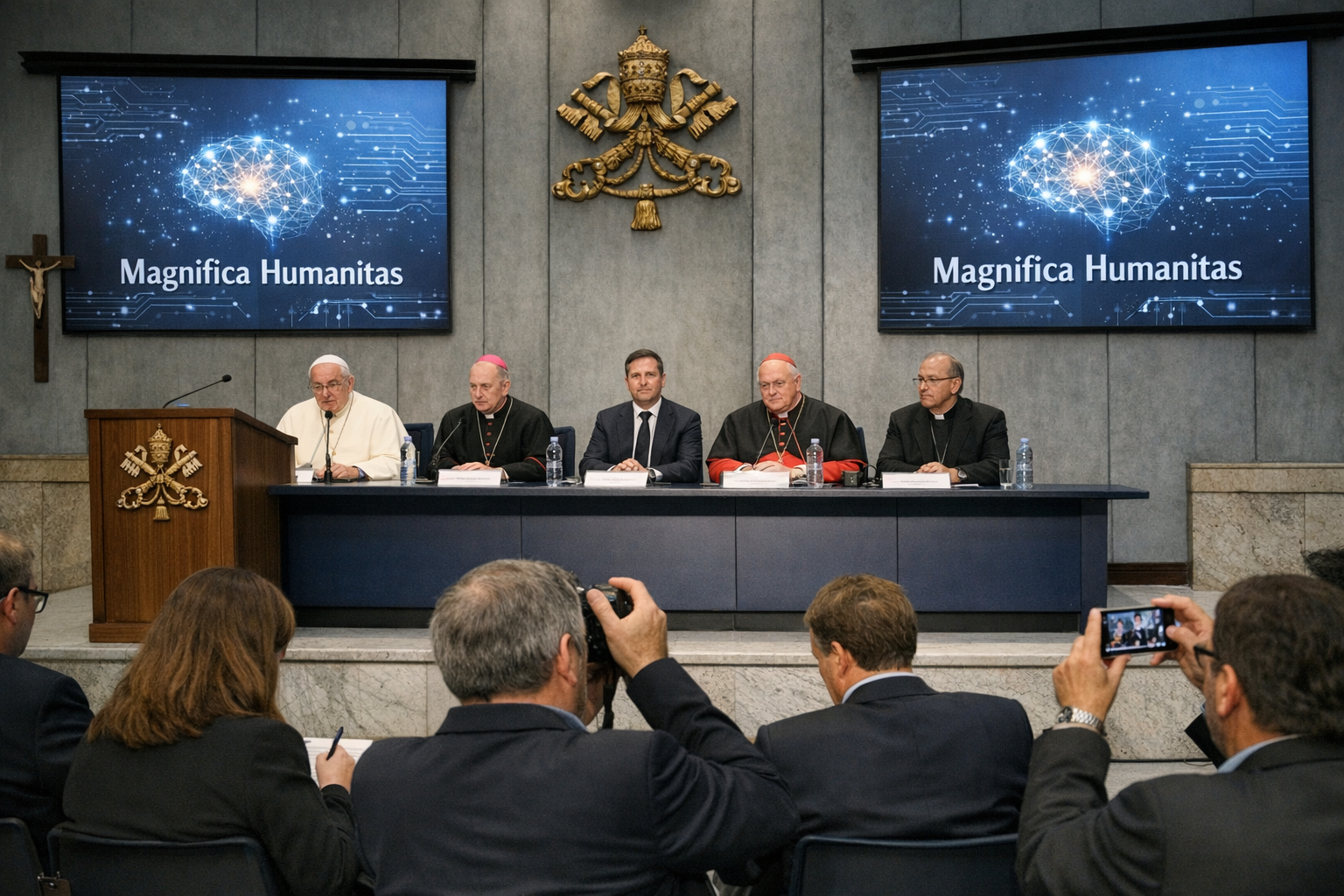
In an unusual sign of how seriously the Vatican is treating that effort, Leo personally joined the encyclical’s presentation, appearing alongside church officials, theologians and Christopher Olah, a co-founder of Anthropic, the artificial intelligence company behind the Claude chatbot. The appearance of a frontier-lab executive at such an event underscored both the Vatican’s desire to move beyond abstraction and the delicate optics of engaging directly with one of the companies helping drive the technology forward.
A New “Social Question”
Leo signed the encyclical on May 15, the 135th anniversary of *Rerum Novarum*, the landmark 1891 encyclical in which Pope Leo XIII addressed the upheavals of the Industrial Revolution and laid the groundwork for modern Catholic social teaching on labor and capital.
That anniversary was no accident. Since his election, Leo XIV has described artificial intelligence as the defining “social question” of the present age, suggesting that the digital revolution now poses the kind of civilizational challenge that industrialization once did. In *Magnifica Humanitas*, he explicitly places A.I. within the church’s long-running concerns about human dignity, the rights of workers, the common good, solidarity and the dangers of excessive economic power.
The encyclical argues that A.I. systems are being developed and deployed at a pace that has outstripped ethical control. It warns that the technology can deepen dependence, shift burdens onto the vulnerable and place entire societies in subordinate roles while wealth and influence accrue to a small number of powerful actors. “Ownership of data cannot be left solely in private hands,” the text says, casting data less as a commodity than as a collective good requiring public-minded governance.
That critique lands at a moment when a handful of American and Chinese firms dominate the race to build increasingly powerful models, and when policymakers on both sides of the Atlantic are struggling to keep up with questions of market concentration, labor disruption, national security and misinformation.
Human Dignity, Not Optimization
The encyclical’s language is often precise in ways that have impressed even secular technology observers. Leo writes that current A.I. systems are better understood as “cultivated” than “built,” because even their creators do not fully understand their internal workings. He warns that the apparent objectivity of machine-generated outputs can obscure the cultural assumptions and biases embedded in them, and that systems simulating empathy or companionship can create the illusion of relationship without the reality of human care.
Important decisions about employment, credit, public services and reputation, he says, should not be surrendered to systems incapable of compassion, mercy or forgiveness. And on warfare, the document is unequivocal: lethal decisions must not be delegated to autonomous machines.
The pope also links A.I. to environmental strain, pointing to the enormous energy, water and infrastructure demands of large-scale computing. And in one of the most discussed passages, he connects the digital economy to “new forms of slavery,” pairing that warning with an apology for the church’s own historical delay in condemning slavery — a striking gesture that folds institutional self-criticism into his broader warning about exploitation in the technological era.
An Unusual Opening to Silicon Valley
Yet if the encyclical is stern toward the technology industry, the Vatican’s handling of its release suggested that Leo does not intend to wage the debate from a distance.
The choice to invite Mr. Olah, and only one major tech representative, to the launch was closely watched. Anthropic has cultivated a reputation as one of the more safety-focused frontier labs, and its executives have at times argued for outside oversight of advanced A.I. systems. At the Vatican event, Mr. Olah said the field could not be left to technology companies alone and required scrutiny from governments, civil society and religious leaders.
That message aligned broadly with the encyclical’s call for accountability. But the pairing also raised questions. Critics in the technology world quickly wondered whether the Vatican risked lending moral legitimacy to a particular company, or to industry narratives about responsible self-restraint. Some pointed to the awkwardness of a papal document insisting that machines merely imitate aspects of human intelligence while a company executive at the launch spoke in more expansive terms about the interior capacities of advanced models.
For the Vatican, the challenge is likely to be maintaining enough proximity to influence the industry without becoming a prop in its image management.
Why This Matters Now
Religious statements on technology are not new. The Vatican has spent years convening discussions on digital ethics and endorsing principles for “human-centered” A.I. But this intervention is different in scale and timing.
It comes as A.I. systems are spreading rapidly through schools, workplaces, health care, government bureaucracies and military planning. It comes as public anxiety grows over job displacement, deepfakes, political manipulation and the concentration of data and compute in a few corporate hands. And it comes as governments remain divided over how hard to regulate a technology they also view as strategically and economically indispensable.
That gives the encyclical unusual relevance beyond the Catholic world. The church cannot write legislation, but it can frame moral categories that shape public debate, especially across parts of Latin America, Africa, Europe and the United States where Catholic institutions still wield political and social influence. By tying A.I. to wages, worker dignity, democratic accountability and peace, Leo is trying to widen the argument beyond the familiar talking points of innovation versus regulation.
The text also arrives with symbolic force. The Catholic Church, with 1.4 billion faithful worldwide, is one of the few institutions able to speak about A.I. in civilizational terms rather than commercial ones. In invoking Leo XIII, Pope Leo XIV is plainly arguing that this is not just another policy dispute but a historical turning point.
The Limits of Moral Authority
Whether that authority translates into concrete policy is another question.
The encyclical demands rigorous oversight, but it does not offer a detailed regulatory blueprint for governments deciding how to police training data, protect workers, curb monopoly power or ban military uses. Nor is it clear how far the Vatican’s relationship with Anthropic will go, or whether the church will engage other companies that are more deeply entwined with defense contracts, surveillance or mass-market consumer systems.
Still, the intervention changes the conversation. It signals that the Vatican no longer sees A.I. as a subject for occasional conference panels or general appeals to ethics. It is now treating the technology as a defining struggle over what kind of society is being built — and who gets to decide.
Near the end of the document, Leo quotes Tolkien on the duty “not to master all the tides of the world,” but to do what one can in one’s own time to uproot evil and leave “clean earth to till” for those who come after. For a debate often dominated by engineers, investors and government officials, it was a reminder that the battle over artificial intelligence is also becoming a contest over language, values and the meaning of human agency itself.
Sources
Further reading and reporting used to add context:
- https://www.axios.com/2026/05/25/pope-leo-xiv-ai-humanity-war-jobs-warning
- https://www.theatlantic.com/ideas/2026/05/pope-leo-ai-encyclical-magnifica-humanitas/687294/?utm_source=apple_news
- Pope Leo XIV urges AI regulation for the common good | AP News
- https://www.vaticannews.va/en/pope/news/2026-05/pope-leo-xiv-first-encyclical-magnifica-humanitas.html
- https://www.vatican.va/content/leo-xiv/en/encyclicals/documents/20260515-magnifica-humanitas.html
- https://www.vaticannews.va/be/vatykan/news/2026-05/pope-leo-xiv-anthropic-founder-ai-encyclical-presentation.html
- https://www.vaticannews.va/en/pope/news/2026-05/pope-leo-xiv-audience-vatican-artificial-intelligence-conference.html
- https://www.washingtonpost.com/business/2026/05/18/vatican-pope-anthropic-olah-encyclical-artificial-intelligence/2ed6f34a-52ae-11f1-9c40-7a0a12d9e745_story.html
- Encyclical Letter “Magnifica Humanitas” of Pope Leo XIV on safeguarding the human person in the time of Artificial Intelligence
- https://www.vatican.va/content/leo-xiv/es/encyclicals/documents/20260515-magnifica-humanitas.html
- https://www.vaticannews.va/en/pope/news/2026-01/pope-leo-xiv-messsage-world-day-social-communications-ai-human.html
- https://www.vatican.va/content/leo-xiv/pt/encyclicals/documents/20260515-magnifica-humanitas.html
- https://www.cbsnews.com/news/pope-leo-ai-encyclical-artificial-intelligence/
- https://www.vatican.va/content/leo-xiv/it/encyclicals/documents/20260515-magnifica-humanitas.html
- https://www.vatican.va/content/leo-xiv/fr/encyclicals/documents/20260515-magnifica-humanitas.html
- https://www.lemonde.fr/en/opinion/article/2026/05/26/ai-peace-and-humanity-the-pope-s-resounding-warning_6753832_23.html
- https://elpais.com/sociedad/2026-05-25/el-papa-leon-xiv-lanza-con-su-primera-enciclica-una-llamada-de-alarma-contra-el-tecnofascismo-quien-controla-la-ia-impondra-su-vision-moral.html
- https://evechenkc.org/wp-content/uploads/2026/05/Encyclical-Letter-of-His-Holiness-Leo-XIV-Magnifica-Humanitas-15-May-2026.pdf
- https://www.reddit.com/r/ArtificialInteligence/comments/1tjfgug/pope_leo_xivs_first_encyclical_is_all_about_ai/
- https://www.societyofmaryusa.org/content/uploads/2026/05/Pope-Leo-will-publish-first-encyclical-%E2%80%98Magnifica-Humanitas-on-preserving-humanity-in-the-A.I.-age-on-May-25-America-Magazine.pdf
- https://www.ncronline.org/print/pdf/node/331336
- https://www.ncronline.org/print/pdf/node/331541
- https://www.theguardian.com/world/2026/may/18/pope-leo-encyclical-human-dignity-ai-anthropic
- https://www.usccb.org/news/2026/first-encyclical-pope-leo-urges-world-disarm-ai-amid-increased-reliance
- https://www.theguardian.com/world/2026/may/25/pope-leo-encyclical-ai-artificial-intelligence-slavery
- https://www.forbes.com/sites/aliciapark/2026/05/25/anthropic-billionaire-cofounder-joins-pope-leo-warns-ai-job-losses-will-spark-moral-imperative-of-historic-proportions/
- https://www.reutersconnect.com/item/explainer-why-pope-leos-first-encyclical-is-focused-on-artificial-intelligence/dGFnOnJldXRlcnMuY29tLDIwMjY6bmV3c21sX1ZBMjEzNTIwMDUyMDI2UlAx/dGFnOnJldXRlcnMuY29tLDIwMjY6bmV3c21sX0xWQTAwOTIxMzUyMDA1MjAyNlJQMQ
- https://www.latimes.com/world-nation/story/2026-05-25/pope-calls-for-ai-regulation-using-technology-for-common-good-rather-than-profit
- https://whtc.com/2026/05/25/anthropics-olah-says-ai-must-be-guided-from-outside-big-tech/
- https://www.aljazeera.com/news/2026/5/26/what-has-pope-leo-warned-about-ai-and-why-thats-significant
- https://www.ncronline.org/vatican/vatican-news/pope-leo-anthropic-co-founder-call-church-tech-ethics-partnership-magnifica
- https://www.investing.com/news/world-news/pope-leo-urges-world-to-slow-down-on-ai-in-fervent-first-manifesto-4708413
- https://www.lemonde.fr/en/religions/article/2026/05/26/with-his-encyclical-leo-xiv-does-not-simply-proclaim-that-another-world-is-possible-he-calls-on-us-to-build-that-other-world_6753818_63.html
- Pope Leo XIV to unveil AI-focused encyclical with Anthropic co-founder | AP News












Leave a Reply