
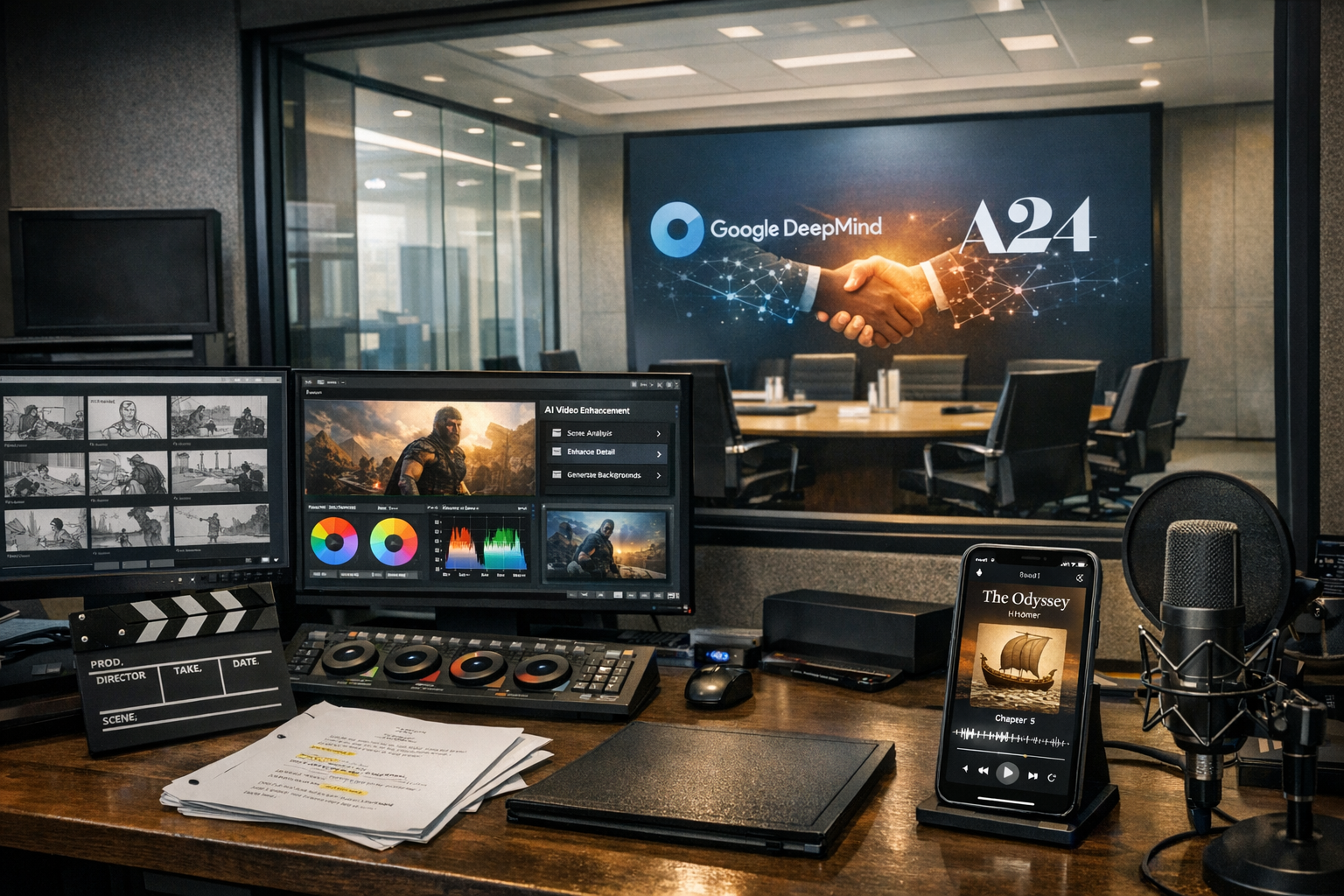
A New Phase of AI’s Advance Into Entertainment
Artificial intelligence’s long, uneasy courtship with the culture industry entered a more consequential phase this week, as two seemingly different announcements — one in Hollywood finance and production, the other in audiobook publishing — underscored how quickly the technology is moving from experimental tool to embedded business partner.
On one front, Google DeepMind and the independent film studio A24 said they were entering a research partnership to develop A.I.-assisted filmmaking workflows and techniques, with Google also taking a financial stake in the company that has become synonymous with prestige, filmmaker-driven cinema. On another, the voice technology company ElevenLabs released a new version of Homer’s “Odyssey” narrated by an officially licensed artificial replica of Michael Caine’s voice.
Taken together, the developments suggest that A.I. companies are no longer content to sell software to creative professionals from the sidelines. They are seeking influence at multiple points in the entertainment pipeline: financing studios, shaping production tools, and distributing commercial media built around synthetic performances that bear the formal approval of famous talent.
That breadth helps explain why the reaction has been so intense.
Backlash Around A24’s Deal
A24’s agreement with Google DeepMind, announced on June 22, was presented by the companies as a multi-project research-and-development collaboration meant to help filmmakers shape emerging tools rather than submit to them. Google confirmed it had also invested in A24; Reuters and other outlets reported the stake at roughly $75 million.
The companies have emphasized that the arrangement is not a deal for intellectual property or training data, and that filmmakers are intended to retain creative control. But for many online critics, those assurances did little to blunt the symbolism of the partnership.
A24 occupies a distinct place in the film business: a studio associated with auteurs, risk-taking and a certain indie credibility, even as it has grown into a major cultural brand. For some fans and filmmakers, the idea that such a company would align itself with a powerful A.I. lab felt less like a technical collaboration than a cultural turning point — evidence that the tools many artists have viewed with suspicion are being normalized at the heart of prestige filmmaking.
The concern is not simply that A.I. might help speed up editing, visual development or other production tasks. It is that technology companies are moving upstream, from offering software to helping shape what gets made and how. In Hollywood, where labor fights over automation and authorship have simmered for years, that distinction matters.
Google has already signaled ambitions in this direction. DeepMind previously pushed into A.I.-driven filmmaking experiments through collaborations including work with Darren Aronofsky’s Primordial Soup. The A24 partnership goes further in cultural resonance because it links one of the world’s most powerful A.I. developers with a studio whose reputation was built on artistic identity.
What remains unclear is what, exactly, the partnership will produce. Neither company has said in detail which tools or workflows they intend to build, how widely they might be deployed, or whether they would affect development, production or postproduction in tangible ways. It is also uncertain whether the backlash will remain largely a social-media phenomenon or evolve into a broader reputational challenge for A24 among filmmakers and audiences.
Michael Caine’s Voice, Recreated and Licensed
If the A24 deal points to A.I.’s growing role behind the camera, ElevenLabs’ latest release demonstrates how fully synthetic performance is already reaching consumers.
On June 23, the company released an “Odyssey” audiobook narrated by an A.I. replica of Michael Caine’s voice, available free on its ElevenReader platform. Unlike the unauthorized voice clones that have alarmed artists and agents in recent years, this one is officially licensed.
Caine joined ElevenLabs’ “Iconic Marketplace” in November 2025, part of the company’s effort to build a roster of approved celebrity and estate-backed voices that can be used commercially under negotiated terms. The new audiobook arrives at a moment when Homer’s epic has fresh cultural currency: Christopher Nolan’s film adaptation is due in theaters next month, and Caine has long been one of Nolan’s most recognizable collaborators.
The release is notable not merely because it uses a famous voice, but because it presents synthetic narration as a polished entertainment product rather than a novelty demo. That shift — from technological proof of concept to culturally marketed media — may prove more significant than the audiobook itself.
For years, debates over A.I. voice generation centered on abuse: impersonation, deepfakes, scams and the unauthorized mimicry of performers. Companies like ElevenLabs are now arguing for a different future, one based on consent, licensing and revenue-sharing. In that model, a synthetic voice is not theft but a managed asset.
Yet the ethical and artistic questions are hardly resolved. Even where consent is explicit, critics worry that licensed replicas could blur the line between performance and simulation, conditioning audiences to accept synthetic substitutes for human labor. Supporters counter that such tools may expand access, preserve legacies and create new forms of storytelling, especially when the talent involved has approved the use.
The Larger Cultural Stakes
What links the two announcements is not simply the presence of A.I., but the maturity of its business model.
For much of the past several years, generative A.I. in entertainment was framed as a disruptive technology looking for practical uses. Now it is increasingly becoming infrastructure: a source of capital, a production collaborator and a distribution mechanism for finished cultural products. In one case, an A.I. company is embedding itself near the beginning of the creative process. In the other, it is packaging a synthetic performance directly for audiences.
That progression matters because it shifts the debate. The question is no longer whether A.I. will touch media and culture; it already does. The more pressing questions are who gets to control it, who is compensated, what consent really means, and whether institutions that once defined themselves in opposition to corporate standardization can preserve their identities while partnering with technology giants.
The A24 and Michael Caine developments offer different answers to those questions, but they point in the same direction. Artificial intelligence is no longer hovering at the edges of entertainment. It is entering the room through the front door — with investment money, licensing agreements and, increasingly, the blessing of the industry itself.
Sources
Further reading and reporting used to add context:
- https://www.theguardian.com/film/2026/jun/23/youre-only-supposed-to-blow-the-bloody-hooves-off-ai-michael-caine-narrates-odyssey-audiobook
- https://techcrunch.com/2026/06/22/google-deepmind-bets-75m-on-ais-future-in-hollywood-with-a24-deal/
- https://www.salon.com/2026/06/23/a24-google-deepmind-ai-investement-sparks-fan-backlash/
- Google DeepMind signs AI research deal with film studio A24 By Reuters
- https://www.techrepublic.com/article/news-google-a24-ai-filmmaking-deepmind-investment/
- https://scroll.media/2026/06/23/google-deepmind-a24/
- https://parade.com/news/the-odyssey-new-audiobook-michael-caine-ai-voice
- https://thenextweb.com/news/google-75-million-a24-deepmind-ai-filmmaking-partnership
- https://lunch.publishersmarketplace.com/2026/06/elevenlabs-releases-showpiece-odyssey-audio/
- https://www.comingsoon.net/movies/features/2151862-a24s-divisive-new-deal-could-lose-movie-studio-its-identity-fans
- https://en.softonic.com/articles/google-deepmind-signs-a24-deal-a-reported-75-million-studio-bet
- https://www.uol.com.br/tilt/noticias/reuters/2026/06/22/google-deepmind-assina-acordo-de-pesquisa-em-ia-com-estudio-de-cinema-a24.htm
- https://www.techradar.com/ai-platforms-assistants/michael-caine-and-matthew-mcconaughey-have-licensed-their-voices-to-ai-but-not-every-iconic-voice-on-the-platform-can-consent
- https://as.com/meristation/libros/ya-es-oficial-el-primer-papel-de-michael-caine-con-voz-clonada-por-ia-sera-en-una-adaptacion-de-la-odisea-f202606-n/
- https://omni.se/hajpad-filmstudio-far-kritik-for-googlesamarbete/a/bOqj4k
- https://omni.se/google-investerar-720-miljoner-i-filmstudion-a24/a/L4W3wq
- https://www.reddit.com/r/AIGuild/comments/1ud1l71/google_invests_75_million_in_a24_to_build_new_ai/
- https://www.reddit.com/r/google/comments/1ucy7oi/google_invests_75m_in_a24_for_ai_film_partnership/
- https://www.reddit.com/r/technology/comments/1uegcx5/a24_fans_mourn_its_death_following_75_million/
- https://www.reddit.com/r/moviecritic/comments/1ueh3jg/a24_fans_mourn_its_death_following_75_million/
- https://www.reddit.com/r/GOOG_Stock/comments/1ucy8di/google_invests_75m_in_a24_for_ai_film_partnership/
- https://www.reddit.com/r/A24/comments/1udoqga/leaving_a24_because_of_deepmind_ai_partnership/
- https://www.reddit.com/r/movies/comments/1ucmmgc/google_invests_75_million_dollars_into_a24_the/
- Google DeepMind and A24 launch research partnership
- https://blog.google/technology/google-labs/deepmind-primordial-soup-collaboration/
- https://elevenreader.io/the-odyssey
- https://blog.google/innovation-and-ai/technology/ai/io-2026-google-ai/
- https://blog.google/innovation-and-ai/technology/ai/veo-3-1-ingredients-to-video/
- https://blog.google/technology/google-deepmind/ancestra-behind-the-scenes/
- https://blog.google/company-news/inside-google/googlers/ask-a-techspert/what-is-a-world-model-project-genie/
- https://elevenreader.io/audiobooks/starship-odyssey-audiobook/RrloksyjLYF8kNPFKpIP
- https://blog.google/products-and-platforms/devices/pixel/june-2026-pixel-drop/
- https://blog.google/company-news/outreach-and-initiatives/google-org/sundance-institute-ai-education/
- https://blog.google/innovation-and-ai/models-and-research/google-labs/flow-updates/
- https://blog.google/innovation-and-ai/products/notebooklm/generate-your-own-cinematic-video-overviews-in-notebooklm/
- https://blog.google/documents/37/How_Google_Fights_Disinformation.pdf
- https://blog.google/documents/83/information_quality_content_moderation_white_paper.pdf
- https://elevenlabs.io/blog
- https://elevenlabs.io/blog/announcing-partnership-with-sir-michael-caine-to-newly-launched-iconic-marketplace
- https://elevenlabs.io/iconic-voices
- https://elevenlabs.io/ja/blog/announcing-partnership-with-sir-michael-caine-to-newly-launched-iconic-marketplace/
- https://elevenlabs.io/pl/blog/announcing-partnership-with-sir-michael-caine-to-newly-launched-iconic-marketplace
- https://elevenlabs.io/sv/blog/announcing-partnership-with-sir-michael-caine-to-newly-launched-iconic-marketplace
- https://elevenlabs.io/es//blog/
- https://elevenlabs.io/es/iconic-voices/
- https://elevenlabs.io/es/blog/announcing-partnership-with-sir-michael-caine-to-newly-launched-iconic-marketplace/
- https://elevenlabs.io/fr/iconic-voices/
- https://elevenlabs.io/zh/iconic-voices
- https://elevenlabs.io/sv/iconic-voices/
- https://elevenlabs.io/assets/pdf/candidate-privacy-notice.pdf
- https://www.gamespot.com/articles/elden-ring-death-stranding-movie-studio-gets-75-million-from-google-for-ai-research-report-says/
- https://www.darkhorizons.com/a24-googles-ai-deal-raises-eyebrows/
- https://www.investing.com/news/stock-market-news/google-invests-75m-in-a24-studio-for-ai-partnership-93CH-4753120
- https://news.abplive.com/entertainment/google-deepmind-75-million-investment-a24-ai-hollywood-backlash-1852583
- https://www.thewrap.com/industry-news/tech/google-a24-investment-ai-research/
- https://www.reddit.com/r/A24/comments/1udi8r9/a24_and_google_ai_partnership_megathread/
- https://www.reddit.com/r/A24/comments/1ucpywl/new_logo_and_rebranding_after_their_partnership/
- https://en.wikipedia.org/wiki/A24
- https://www.reddit.com/r/A24/comments/1udqlmo/a24_google_deepmind_the_75m_deal_we_know_nothing/





Leave a Reply