
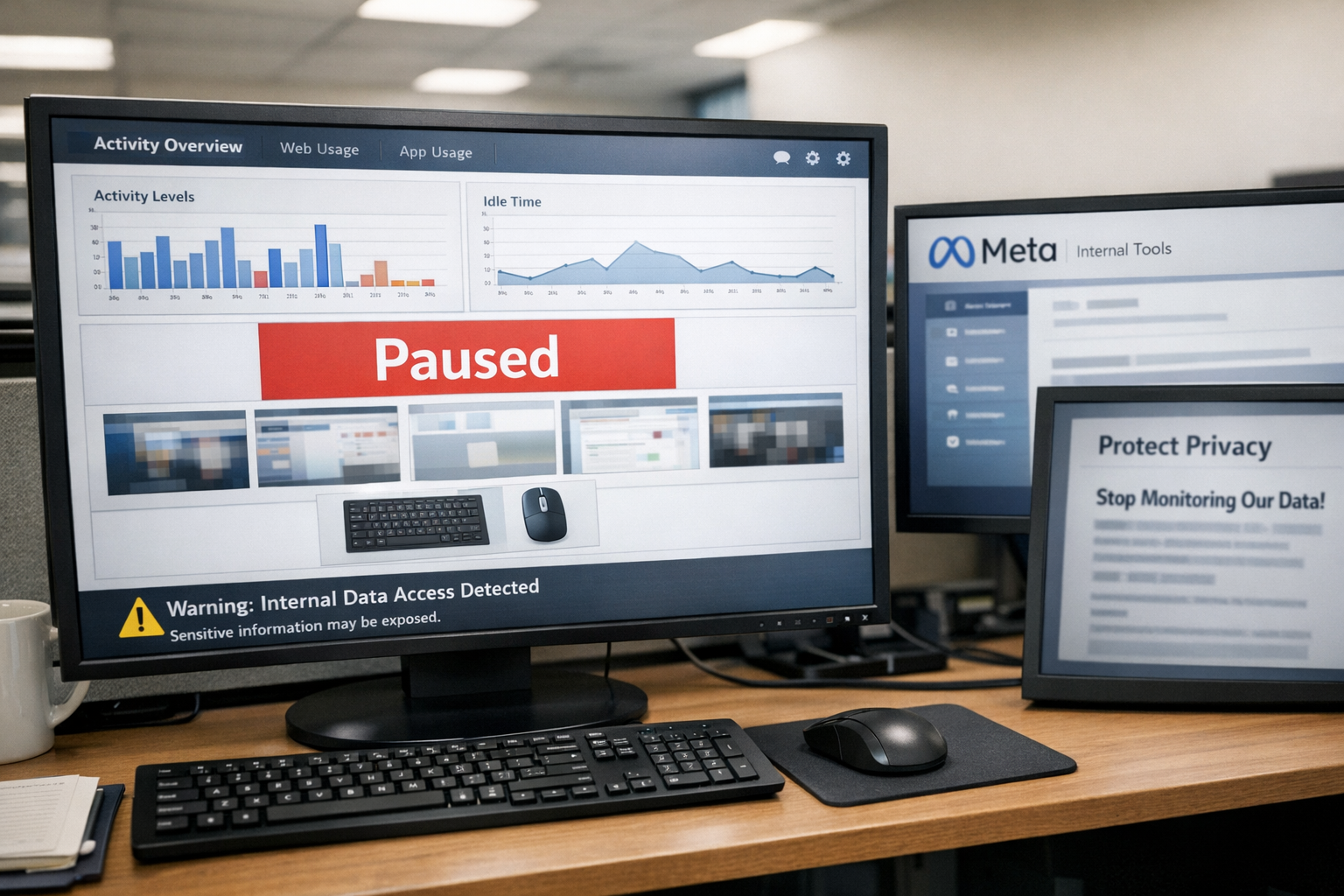
Meta has paused a contentious internal program that collected employees’ keystrokes, mouse clicks and screen activity to help train artificial intelligence systems, after the company disclosed that data gathered through the effort had been exposed more broadly inside the company than intended.
The decision, announced internally on June 22, halted a project known as the Model Capability Initiative, which had been rolled out in April to U.S.-based employees as part of Meta’s larger effort to build A.I. agents that can learn how people use software. According to the company, the pause followed a security issue involving the handling of the data. Meta said it was investigating and had found no indication at that point that employees had improperly accessed the information.
Still, the episode has intensified scrutiny of a practice that had already stirred unusual resistance inside one of the world’s most powerful A.I. companies: using workers’ everyday computer activity as raw material for machine learning.
A program that touched daily work
The initiative gathered mouse movements, clicks, keystrokes and some content visible on employees’ screens, according to people familiar with the program and internal accounts of it. The idea was to create a rich record of how humans navigate digital tasks — a valuable source of training data for A.I. systems designed to act more like assistants, or even autonomous agents, inside software environments.
But what looked to Meta like a strategic shortcut in the race to develop more capable A.I. appears to have looked to many employees like something closer to workplace surveillance.
Workers had raised concerns for weeks that the system could capture sensitive or private work material, and that the company’s framing of participation did not leave room for meaningful consent. Earlier this month, Meta had already scaled back parts of the effort after internal criticism, adding limited pause controls. Even that did little to settle objections. Roughly 1,600 employees signed a petition opposing the tool, according to reports of the internal backlash.
For critics inside the company, the latest disclosure appeared to confirm a central fear: that once a company starts collecting detailed behavioral data at scale, it may not be able to fully control where that data goes or who can see it.
Privacy, labor and A.I. collide
The controversy lands at a moment when tech companies are searching aggressively for new sources of data to improve A.I. systems. Public internet data has become more contested, publishers are striking licensing deals, and companies are increasingly looking inward — to proprietary information, customer interactions and workplace behavior — for material that can sharpen their models.
That shift is forcing questions that have not been fully answered by either corporate policy or regulation. Can employee behavior be treated as training data? What protections are required if the material may include screen content, internal documents or glimpses of sensitive communications? And how voluntary is participation when the collector is also the employer?
In Meta’s case, the concerns cut across both privacy and labor. The company has said it had no sign the exposed data was improperly accessed, but it remains unclear what categories of information were involved, how many employees were affected, or whether any particularly sensitive material was viewable internally. It is also not known whether the company plans to permanently abandon the initiative, redesign it with tighter safeguards or attempt to relaunch it in another form.
A broader test for the industry
The stakes extend beyond Meta. Across Silicon Valley, companies are racing to build systems that can observe and imitate how people perform computer-based tasks — opening programs, filling forms, navigating websites and making decisions across multiple applications. Those capabilities are widely seen as central to the next phase of generative A.I., in which chatbots evolve into agents that do work on users’ behalf.
But the data needed to train such systems can be unusually invasive. Unlike a database of text or images, records of human-computer interaction may reveal not just what workers produce, but how they think, where they click, what they hesitate over and what appears on their screens in the course of a day.
That makes the breakdown at Meta more than an internal embarrassment. It offers an early example of how the pursuit of better A.I. can run into the messy realities of workplace power, data governance and trust.
Whether the incident prompts regulators to take a closer look remains uncertain. But for now, Meta’s retreat suggests that even inside a company built on data collection, there are limits to what employees will accept — and risks to how that data is managed once it is gathered.
Sources
Further reading and reporting used to add context:
- https://www.techradar.com/pro/security/meta-investigates-security-concerns-of-internal-mouse-tracking-tech-used-to-track-employees-and-train-ai
- https://www.tomshardware.com/tech-industry/big-tech/meta-pauses-mandatory-ai-training-program-that-tracked-employee-keystrokes-after-internal-data-leak-exposed-sensitive-staff-information-company-wide-employees-express-frustration-over-poor-handling-of-data
- https://www.theguardian.com/technology/2026/jun/24/all
- https://agtechdata.uga.edu/meta-exposed-data-internally-from-its-controversial-employee-tracking-program/
- https://www.ndtv.com/feature/meta-to-stop-tracking-mouse-movements-keystrokes-of-employees-after-internal-data-leak-11673682
- https://www.theguardian.com/technology/2026/jun/24/meta-pauses-employee-tracker-for-ai-training-amid-privacy-concerns
- https://en.softonic.com/articles/meta-pauses-employee-tracking-program-45000-data-tables-exposed
- https://www.thedailystar.net/news/tech-startup/news/meta-scales-back-tracking-employee-keystrokes-after-backlash-4189656
- https://www.itechpost.com/articles/236424/20260623/meta-pauses-employee-tracking-program-after-internal-data-exposure-raises-workplace-surveillance.htm
- https://www.mixstackrr.com/meta/meta-pauses-employee-tracking-after-data-leak/
- https://www.theguardian.com/technology/artificialintelligenceai
- https://www.investing.com/news/stock-market-news/exclusivemeta-scales-backai-mouse-clicks-tool-citing-employee-concerns-4722827
- https://www.eweek.com/news/meta-employee-tracking-data-exposure/
- https://www.reddit.com/r/AnythingGoesNews/comments/1ucws16/meta_exposed_data_internally_from_its/
- https://www.reddit.com/r/technology/comments/1uczyyq/meta_pauses_employeetracking_program_following/
- https://www.techradar.com/pro/we-have-heard-your-concerns-meta-workers-can-request-pauses-in-computer-activity-tracking-but-only-in-temporary-half-hour-increments
- https://www.reddit.com/r/CorporateFacepalm/comments/1ue9dfu/meta_exposed_data_internally_from_its/
- https://www.reddit.com/r/facebook/comments/1ucwrwy/meta_exposed_data_internally_from_its/
- https://www.pcgamer.com/software/ai/would-you-quit-meta-will-put-keyloggers-on-employee-pcs-for-ai-training/
- https://www.reddit.com/r/BetterOffline/comments/1udj98l/meta_exposed_data_internally_from_its/
- https://www.reddit.com/r/USNewsHub/comments/1ucwsjh/meta_exposed_data_internally_from_its/
- https://www.itpro.com/business/leadership/internal-memo-suggests-meta-will-lay-off-10-percent-of-its-employees-with-a-further-10-percent-set-to-be-transferred-to-better-focus-on-ai
- https://www.svd.se/a/zOlP6K/meta-halts-ai-training-after-svd-gp-investigation
- https://cybernews.com/privacy/meta-pause-tracking-employees-keystrokes-leak/
- https://www.investing.com/news/stock-market-news/meta-to-pause-internal-mousetracking-tech-while-examining-data-security-issues-4754412
- https://es.wired.com/articulos/meta-vigila-las-computadoras-de-su-personal-para-entrenar-ia-una-falla-dejo-esos-datos-al-alcance-de-cualquier-empleado
- https://www.livemint.com/companies/news/meta-to-track-keystrokes-mouse-movements-for-ai-training-employees-push-back-11776826991953.html
- https://www.techradar.com/pro/meta-workers-revolt-against-mouse-tracking-technology-flyers-ask-if-they-want-to-work-at-the-employee-data-extraction-factory
- https://www.techradar.com/pro/simply-by-doing-their-daily-work-meta-tracks-staff-activity-to-teach-ai-how-to-replace-them
- Meta to pause internal mouse-tracking tech while examining data security issues By Reuters
- Meta Exposed Data Internally From Its Controversial Employee-Tracking Program – Agriculture Technology Data – University of Georgia
- Exclusive-Meta scales back plan for internal mouse-tracking tech, citing staff concerns By Reuters






Leave a Reply