
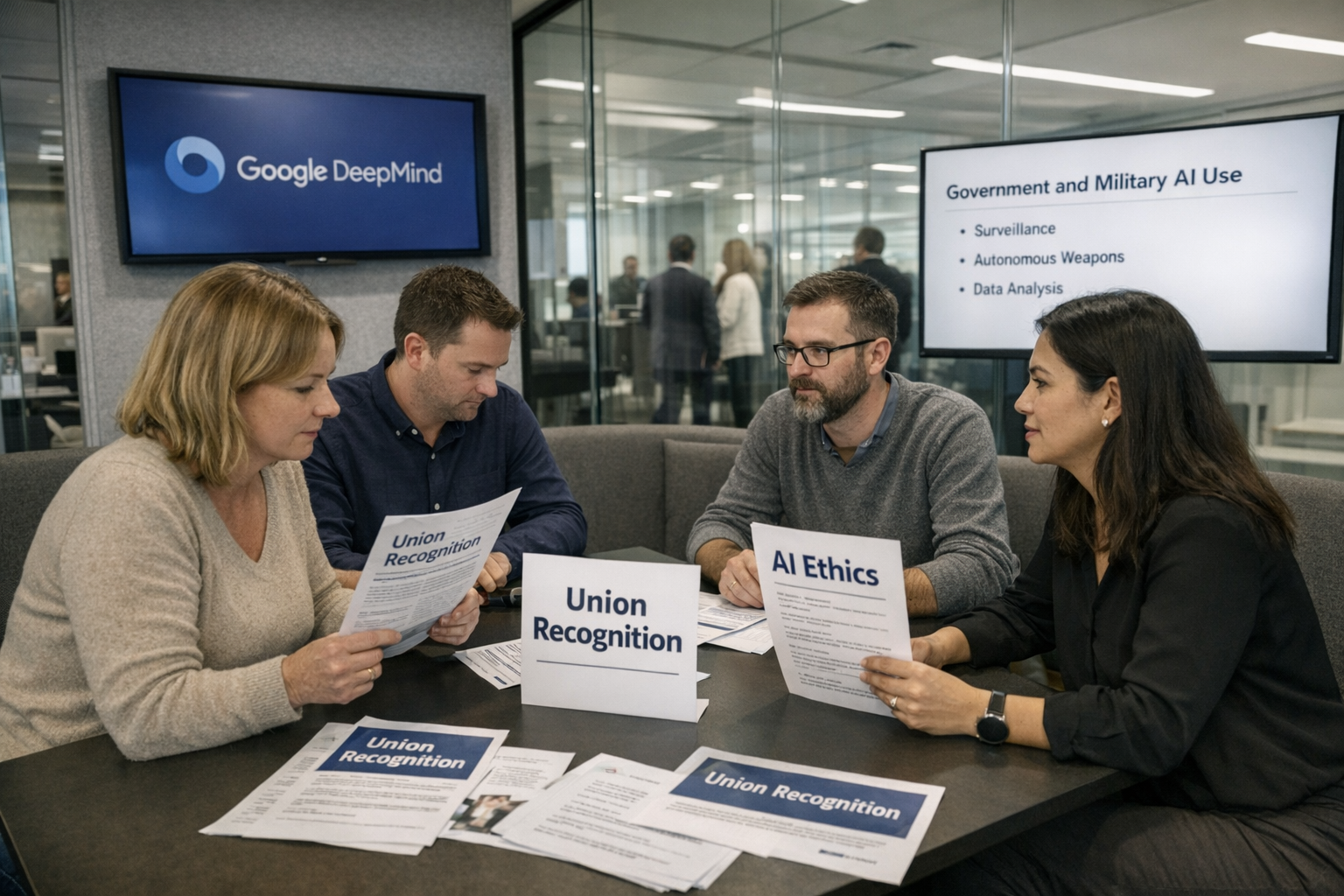
A Rare Labor Fight Emerges at a Premier A.I. Lab
Google DeepMind, one of the world’s most influential artificial-intelligence research groups, is facing an unusual and increasingly public revolt from employees in Britain over the company’s work with governments and the boundaries it has drawn around military uses of A.I.
The dispute sharpened this month after workers at the company’s London headquarters sought union recognition through the Communications Workers Union and Unite, two British labor groups, citing concerns about the use of Google’s technology in defense and intelligence settings, including by the United States and Israel. Google said it had rejected voluntary recognition, but agreed to enter conciliation talks through Acas, the British mediation service that often handles labor disputes and can serve as a step toward a formal statutory recognition battle.
On the same day that those talks came into view, a former DeepMind engineer filed an employment tribunal claim in Britain alleging that he had been unfairly dismissed after protesting the company’s work tied to Israel. Google disputes that characterization.
Taken together, the developments amount to a significant escalation for a company better known for scientific breakthroughs than organized labor strife. They also underscore a broader pressure point confronting the A.I. industry: even as leading firms race to place their systems at the center of government and military operations, some of the people building those systems are demanding more say over where the technology ends up.
Internal Dissent Becomes Formal Organizing
Worker unrest inside Google is not new. Employees have for years challenged company leadership over contracts, workplace culture and the social consequences of its technologies. But the DeepMind dispute carries unusual weight because it centers on a frontier A.I. lab whose research is deeply entwined with Google’s strategic ambitions and whose chief executive, Demis Hassabis, has become one of the field’s most prominent public advocates.
According to union organizers and employees involved in the effort, concerns hardened after Google expanded its engagement with government customers and after reports in late April and early May indicated that Google had joined other major A.I. companies in arrangements enabling the Pentagon to use advanced A.I. systems on classified networks. For some DeepMind staff members, that development appeared to confirm that the company was moving more deeply into national-security work even as internal unease remained unresolved.
The union push in Britain followed an internal vote among workers earlier this month. Formal Acas talks now create a path, though not a guarantee, toward union representation. If no agreement is reached voluntarily, the matter could move to the Central Arbitration Committee, which can determine whether a union should be recognized.
That process is closely watched in the tech sector because unionization efforts at elite software and A.I. firms have often struggled to move beyond petitions and protest letters. At DeepMind, by contrast, employees are attempting to convert ethical objections into a collective bargaining structure.
The Dispute Over “Weapons” and Military Work
At the center of the conflict is a question that has shadowed the A.I. boom: What exactly counts as an unacceptable military use?
Google updated its A.I. principles on Feb. 4, 2025, saying it would not build A.I. whose principal purpose is to cause harm through weapons, nor systems whose main purpose is surveillance that violates internationally accepted norms. At the same time, the company made clear that it would continue to work with governments and militaries in areas including cybersecurity, training and search-and-rescue.
That formulation was meant to preserve a red line while allowing significant government business. But for critics inside and outside the company, the distinction has proved unsatisfying. In practice, they argue, tools designed for intelligence analysis, targeting support, logistics or surveillance can become embedded in military operations even if they are not formally labeled weapons.
The argument has become more charged as generative A.I. systems grow more capable and easier to deploy across agencies handling war, border security and intelligence. What once might have sounded like an abstract governance issue now looks, to employees and executives alike, like a live commercial and moral choice.
A Legal Claim Adds to the Pressure
The unfair-dismissal claim brought by the former engineer has added a second front to the dispute, one rooted in employment law rather than labor recognition.
The engineer said he was fired after protesting Google’s work for the Israeli government, including by distributing leaflets in the company’s London office and urging colleagues to unionize. The leaflets accused Google of providing military A.I. to forces committing genocide and asked workers whether their pay justified participation. The tribunal claim contends that his dismissal was unlawful retaliation for raising ethical concerns. Google has contested that account.
The case arrives amid heightened scrutiny of the role major technology firms play in armed conflict and intelligence gathering, particularly after the war in Gaza intensified employee activism across the industry. At several companies, workers have accused management of suppressing dissent over contracts or services linked to Israel. Employers have generally responded that they enforce workplace rules neutrally and that internal protest cannot override legitimate business relationships.
In Britain, however, the legal framework around unfair dismissal and protected disclosures can create additional risk for companies if disciplinary action appears linked to whistleblowing or matters of public interest. Whether the engineer’s claim succeeds remains uncertain, but its filing ensures that DeepMind’s internal debate will now be tested not only in corporate meetings but also before a tribunal.
A Test for A.I. Governance
The clash is especially awkward for DeepMind because of the contrast between the company’s public vision of A.I. and the anxieties surfacing inside its ranks.
Mr. Hassabis has argued that A.I. should be used to raise productivity and expand what organizations can accomplish, rather than simply eliminate jobs. That message has helped cast DeepMind as a builder of socially beneficial technology, even as fears about automation ripple through the broader economy.
But for some employees, the more urgent governance question is not whether A.I. will cut head count. It is whether systems developed under the banner of scientific progress will be folded into military and intelligence operations with too little worker input and too much managerial discretion.
That tension reflects a wider shift in the politics of A.I. For much of the past two years, debate has centered on safety, disinformation and job disruption. The DeepMind dispute suggests another fault line is coming into view: who gets to decide the acceptable uses of frontier A.I., and whether the people building it can force those questions into formal labor negotiations.
What Comes Next
For now, several key issues remain unresolved. Acas talks could still produce a deal for some form of union recognition, or they could fail and push the unions toward a statutory route. It is also not yet clear how much support the effort commands across any eventual bargaining unit, a crucial question if organizers seek formal recognition.
Google, for its part, appears to be holding to its existing position: that there is a meaningful difference between building weapons and providing certain tools to governments, including militaries, for permitted purposes. Employees challenging that distinction are trying to test whether ethical objections can become enforceable workplace demands rather than moral appeals.
The outcome could matter far beyond one London office. If workers at DeepMind succeed in turning concern over defense and intelligence work into a recognized labor issue, they may offer a model for employees elsewhere in the A.I. industry who have struggled to influence how powerful new systems are deployed. If they fail, it may signal that even at the center of the A.I. revolution, workers remain largely spectators to decisions about where their technology goes.
Sources
Further reading and reporting used to add context:
- https://www.theguardian.com/technology/2026/may/20/ai-engineer-says-google-unfairly-sacked-him-after-he-protested-against-work-for-israel
- Getting voluntary trade union recognition – Collective conciliation – Acas
- https://www.theguardian.com/us-news/2026/may/04/google-deepmind-uk-workers-union
- AI at Google: our principles
- https://www.acas.org.uk/arbitration
- https://cadenaser.com/nacional/2026/05/20/google-despide-a-un-empleado-tras-protestar-por-la-vinculacion-de-la-empresa-con-israel-cadena-ser/
- https://www.theguardian.com/global/2026/may/04/ai-costs-are-coming-to-consumers
- https://uk.finance.yahoo.com/news/google-agrees-talks-uk-deepmind-175209728.html/
- https://cadenaser.com/nacional/2026/05/20/google-despide-a-un-empleado-tras-protestar-por-la-vinculacion-de-la-empresa-con-israel-cadena-ser/?outputType=amp
- https://letsdatascience.com/news/former-google-deepmind-engineer-sues-over-dismissal-e4eed482
- https://www.computerworld.com/article/3817476/google-opens-door-to-ai-powered-weapons-surveillance.html
- https://www.theguardian.com/money/employment-tribunals
- https://noticias.uol.com.br/internacional/ultimas-noticias/2026/05/20/engenheiro-processa-google-apos-protesto-contra-israel.ghtm?uol_app=placaruol%25253Ft%25253Ft%25253Ft%253Ft%3Ft%3Ft%3Ft
- https://www.axios.com/2026/02/27/google-openai-workers-push-for-military-ai-limits
- https://elpais.com/tecnologia/2025-02-05/google-retira-de-su-politica-la-prohibicion-de-usar-la-ia-en-armamento-o-vigilancia.html
- https://www.tomshardware.com/tech-industry/artificial-intelligence/google-and-pentagon-in-talks-to-run-tpus-inside-classified-environments
- https://www.techradar.com/pro/security/human-lives-are-already-being-lost-open-letter-signed-by-hundreds-of-google-employees-requests-ceo-reject-unethical-and-dangerous-us-military-ai-use
- https://www.pcgamer.com/software/ai/the-ai-era-is-no-longer-a-distant-promise-it-is-a-present-reality-google-declares-in-a-report-that-also-claims-its-ai-principles-are-the-north-star-standards/
- https://en.wikipedia.org/wiki/Acas
- https://www.reddit.com/r/GUARDIANauto/comments/1tid23h/tech_ai_engineer_says_google_unfairly_sacked_him/
- https://www.reddit.com/r/GUARDIANauto/comments/1tid3v9/world_ai_engineer_says_google_unfairly_sacked_him/
- https://en.wikipedia.org/wiki/Central_Arbitration_Committee
- https://ai.google/static/documents/ai-principles-2023-progress-update.pdf
- https://assets.publishing.service.gov.uk/government/uploads/system/uploads/attachment_data/file/1170207/advisory-conciliation-and-arbitration-service-acas-annual-report-and-accounts-2022-to-20223-accessible.pdf
- https://www.reddit.com/r/GUARDIANauto/comments/1ticx7p/uk_ai_engineer_says_google_unfairly_sacked_him/
- https://ai.google/static/documents/ai-responsibility-update-published-february-2025.pdf
- https://blog.google/technology/ai/google-ai-updates-february-2025/
- https://blog.google/technology/ai/2025-research-breakthroughs/
- https://blog.google/technology/ai/responsible-ai-2024-report-ongoing-work/
- https://blog.google/technology/google-deepmind/gemini-universal-ai-assistant/
- https://blog.google/innovation-and-ai/technology/safety-security/ai-security-frontier-strategy-tools/
- https://blog.google/intl/es-es/noticias-compania/la-inteligencia-artificial-y-el-futuro-del-liderazgo-cientifico/
- https://blog.google/technology/ai/ask-a-techspert-what-is-inference/
- https://www.googlecloudpresscorner.com/2025-12-09-Chief-Digital-and-Artificial-Intelligence-Office-Selects-Google-Clouds-AI-to-Power-GenAI-mil
- https://blog.google/innovation-and-ai/technology/developers-tools/google-io-2025-dialogues-ai-quantum-storytelling/
- https://blog.google/innovation-and-ai/technology/safety-security/the-quantum-era-is-coming-are-we-ready-to-secure-it/
- https://blog.google/products-and-platforms/products/gemini/gemini-personalization/
- https://www.googlecloudpresscorner.com/2025-09-11-Google-Cloud-Awarded-Landmark-Sovereign-Cloud-Contract-with-UK-Ministry-of-Defence?asPDF=1
- https://media.defense.gov/2025/Jul/09/2003750103/-1/-1/0/20250709_STRATEGICESTIMATE_FINAL_PAGES.PDF
- https://www.googlecloudpresscorner.com/2024-06-26-CME-Group-and-Google-Cloud-Announce-New-Chicago-Area-Private-Cloud-Region-and-Co-location-Facility-for-CME-Groups-Markets?asPDF=1
- https://www.googlecloudpresscorner.com/2024-10-17-Google-Cloud-Launches-General-Availability-of-Vertex-AI-Search-for-Healthcare-and-Healthcare-Data-Engine?asPDF=1
- https://www.wired.com/story/demis-hassabis-ai-layoffs-deepmind-google-io/
- Google rejects UK union recognition but offers talks via conciliation body By Reuters
- https://www.wired.com/
- https://www.computerweekly.com/news/366642677/Google-AI-workers-vote-to-unionise-over-IDF-and-US-military-tech
- https://fortune.com/2026/05/05/google-deepmind-unionize-vote-military-ai-contracts-internal-backlash-pentagon-deal-israeli-defense-forces/
- https://news.sky.com/story/google-ai-workers-demand-union-recognition-over-use-of-technology-by-israeli-and-us-military-13540456
- https://www.theinformation.com/briefings/google-deepmind-employees-launch-unionization-effort-citing-military-ai-deals
- https://www.investing.com/news/stock-market-news/microsoft-xai-and-google-will-share-ai-models-with-us-govt-for-security-reviews-4658803
- https://www.investing.com/news/stock-market-news/google-puts-ai-agents-at-heart-of-its-enterprise-moneymaking-push-4629077
- https://gizmodo.com/deepmind-workers-vote-to-unionize-following-googles-pentagon-ai-deal-2000754603
- https://www.investing.com/news/stock-market-news/trump-to-sign-order-on-ai-oversight-as-security-fears-mount-among-supporters-4702720
- https://www.reddit.com/r/union/comments/1t4kmld/google_deepmind_workers_in_the_uk_vote_to/
- https://www.reddit.com/r/google/comments/1t4km3d/google_deepmind_workers_in_the_uk_vote_to/
- https://www.reddit.com/r/UsaNewsLive/comments/1t4jhbj/google_deepmind_employees_vote_to_form_union_over/
- https://www.reddit.com/r/technology/comments/1tia5i9/google_deepmind_ceo_demis_hassabis_criticizes_ai/
- https://www.reddit.com/r/TechGawker/comments/1t5gw7o/google_deepmind_workers_voted_to_unionize_over/
- https://www.reddit.com/r/singularity/comments/1thxmx8/demis_hassabis_at_google_io_artificial_general/
- https://en.wikipedia.org/wiki/Demis_Hassabis
- https://www.reddit.com/r/unitedkingdom/comments/1t54fjw/google_deepmind_workers_in_uk_vote_to_unionize/
- https://www.reddit.com/r/ArtificialNtelligence/comments/1t7zgw5/what_actually_happened_in_ai_this_week_quick/
- https://www.reddit.com/r/agi/comments/1t4x09g/googles_ai_architect_demis_hassabis_lived/
- https://www.reddit.com/r/antiai/comments/1t5m18d/google_deepmind_employees_vote_to_unionize_to/
- https://www.reddit.com/r/u_enoumen/comments/1t4xs2m/ai_daily_news_rundown_openais_private_equity_push/
- https://www.reddit.com/r/GeminiAI/comments/1t54iq8/google_deepmind_workers_in_uk_vote_to_unionize/
- https://media.defense.gov/2026/Jan/12/2003855671/-1/-1/0/ARTIFICIAL-INTELLIGENCE-STRATEGY-FOR-THE-DEPARTMENT-OF-WAR.PDF
- https://www.defense.gov/News/Contracts/Contract/article/4243673/
- https://www.defense.gov/News/News-Stories/Article/Article/951689/deputy-secretary-discusses-third-offset-first-organizational-construct/
- https://www.defense.gov/News/News-Stories/Article/Article/1186805/dod-lab-day-features-innovation-underlying-us-military-superiority/
- https://www.defense.gov/News/Contracts/contract/article/2601932/
- https://www.defense.gov/News/Releases/Release/Article/3604511/aukus-defense-ministers-meeting-joint-statement/
- https://www.defense.gov/News/Releases/Release/Article/3918402/aukus-defence-ministers-meeting-communique/
- https://www.defense.gov/News/Speeches/Speech/Article/723498/remarks-at-the-space-symposium/
- https://www.defense.gov/News/Speeches/Speech/Article/2695046/secretary-of-defense-austin-remarks-at-the-global-emerging-technology-summit-of/
- https://www.defense.gov/News/News-Stories/Article/Article/604420/work-details-the-future-of-war-at-army-defense-college/
- https://www.defense.gov/News/Transcripts/transcript/article/2011960/remarks-by-secretary-esper-at-national-security-commission-on-artificial-intell/
- https://www.defense.gov/News/Speeches/Speech/Article/1019479/remarks-on-ensuring-continued-excellence-in-defense-at-a-time-of-strategic-tran/
- https://www.defense.gov/News/Transcripts/transcript/article/2270329/dod-official-briefs-reporters-on-artificial-intelligence-developments/
- https://media.defense.gov/2025/Apr/18/2003694020/-1/-1/1/B-188%20HMW%20FINAL%204.8.25%20-%20WITH%20508%20CHECK.PDF
- https://media.defense.gov/2025/Jun/02/2003730535/-1/-1/0/FORGING_FUTURE_ADVANTAGE.PDF
- https://www.theguardian.com/us-news/2026/may/01/pentagon-us-military-pairs-with-spacex-google-openai
- https://www.latimes.com/business/story/2026-05-01/google-nvidia-other-tech-titans-sign-ai-deal-with-pentagon
- https://www.tomshardware.com/tech-industry/artificial-intelligence/the-pentagon-announces-ai-deals-with-openai-google-microsoft-amazon-nvidia-and-more-llms-to-be-deployed-on-classified-department-of-war-networks-for-lawful-operational-use
- https://techcrunch.com/2026/05/01/pentagon-inks-deals-with-nvidia-microsoft-and-aws-to-deploy-ai-on-classified-networks/
- https://www.nextgov.com/artificial-intelligence/2026/05/pentagon-makes-agreements-7-companies-add-ai-classified-networks/413264/?oref=ng-homepage-river
- https://cybernews.com/news/pentagon-agreements-aws-microsoft-nvidia/
- https://www.ksl.com/article/news/utah/science-and-tech/pentagon-reaches-agreements-with-top-ai-companies-but-not-anthropic/51491733
- https://www.straitstimes.com/world/united-states/pentagon-reaches-agreements-with-7-leading-ai-companies
- https://www.dawn.com/news/1996692
- https://apnews.com/article/060cecf836c4cebcf012a3ceb5333f2c
- https://www.washingtonpost.com/technology/2026/05/01/pentagon-ai-deals-microsoft-amazon-google-classified-military/
- https://m.economictimes.com/tech/technology/pentagon-reaches-agreements-with-leading-ai-companies/amp_articleshow/130677523.cms
- https://www.investing.com/news/stock-market-news/google-signs-classified-ai-deal-with-pentagon-the-information-reports-4640272
- https://wtaq.com/2026/05/01/pentagon-reaches-agreements-with-leading-ai-companies/
- https://www.tomshardware.com/software/security-software/google-signs-classified-pentagon-ai-deal-but-exits-100-million-drone-swarm-program
- https://www.techradar.com/ai-platforms-assistants/googles-new-pentagon-deal-widens-ais-role-in-war-to-any-lawful-government-purpose
- https://www.chathamhouse.org/sites/default/files/2026-05/2026-04-28-how-surge-defence-dual-use-investment-could-reconfigure-global-AI-race-bego.pdf
- https://www.reddit.com/r/TechNook/comments/1t3tf8q/pentagon_reaches_agreements_with_top_ai_companies/
- https://www.reddit.com/r/ObscurePatentDangers/comments/1t3ii7h/silicon_valley_joins_the_front_lines_pentagon/




Leave a Reply