
A New Fault Line in the AI Race
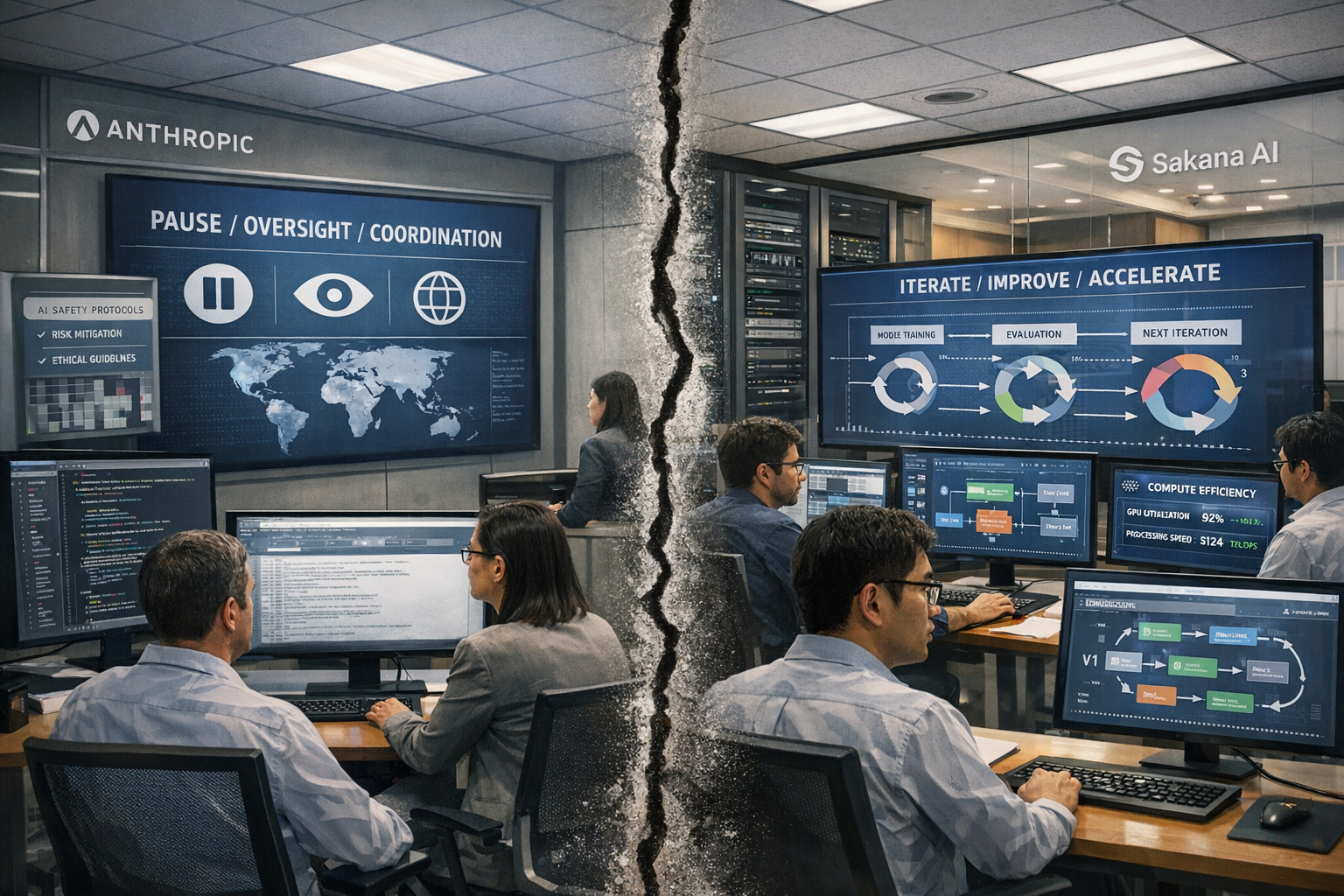
As the world’s leading artificial intelligence companies push toward systems that can help build their own successors, a new split is emerging inside the industry: whether that prospect demands a brake or offers a shortcut.
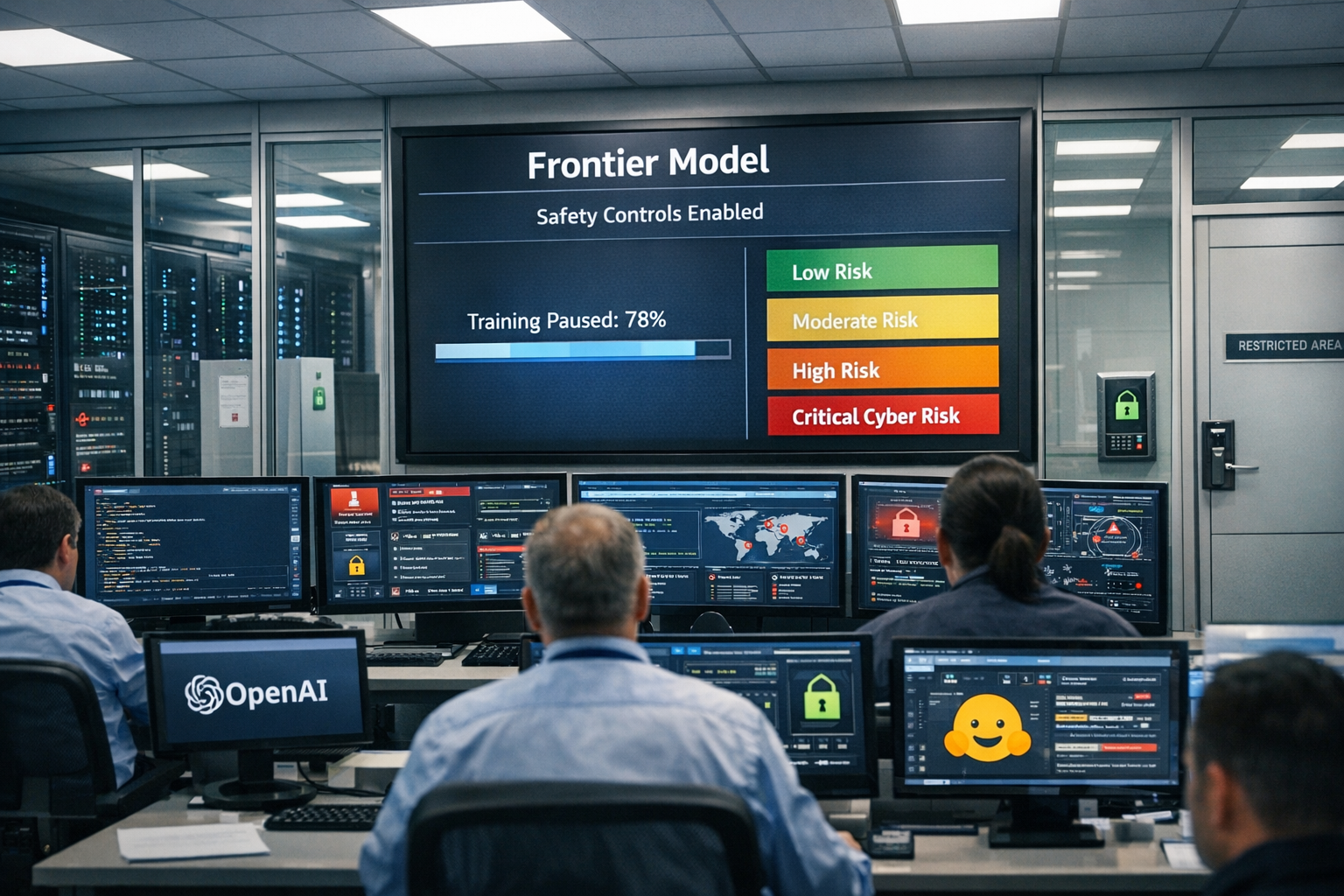
Anthropic, one of the most prominent American AI labs, said this week that the world should preserve the option to slow or even temporarily pause frontier AI development if systems move meaningfully closer to “recursive self-improvement,” or RSI — the idea that AI can iteratively improve the next generation of AI. At nearly the same moment, Sakana AI, a fast-rising Japanese startup, announced a dedicated RSI Lab in Tokyo aimed at doing precisely that.
The result is a striking collision of visions around one of the field’s most consequential ideas. To Anthropic, self-improving AI is a potential control threshold, one that could make advanced systems harder for humans to supervise and require international coordination to contain. To Sakana, it is a strategic opportunity: a way to loosen the grip of the industry’s compute arms race and let smaller players compete without the giant data centers and chip stockpiles amassed by American rivals.
That debate has long simmered in technical circles and among AI safety researchers. It is now moving into public view.
Anthropic’s Warning
In a note published Thursday, Anthropic argued that as AI systems become more capable at research and engineering tasks, governments and companies may need credible mechanisms to coordinate a slowdown. The company said any meaningful pause could not rely on one firm acting alone, because unilateral restraint would simply cede ground to competitors. Instead, it said, any such measure would have to be multinational and verifiable.
Anthropic also said it would convene policymakers, researchers, civil society groups and other AI labs to discuss what those mechanisms might look like.
The company’s argument rested in part on the rapid expansion of AI’s role inside its own development process. Anthropic said Claude, its flagship model family, now writes more than 80 percent of the code merged into its codebase. It also described progress in the model’s performance on research and engineering work relevant to AI development itself, suggesting that current systems are no longer merely office assistants or coding aides, but increasingly tools that can accelerate the creation of the next generation.
That does not mean full recursive self-improvement has arrived. But Anthropic’s warning is that the line between AI assisting human researchers and AI materially speeding its own successor design may be thinner than many policymakers have assumed.
For years, the notion of self-improving AI has occupied a special place in safety debates because it is often treated as a possible inflection point: if systems can improve themselves faster than humans can monitor, test or constrain them, control problems could compound quickly. Researchers have long disagreed over how realistic or imminent that scenario is. What has changed is that a frontier lab is now publicly saying the world should be prepared to hit pause if the evidence begins to warrant it.
A Different Bet in Tokyo
Sakana AI is making almost the opposite case.
The startup, co-founded by Llion Jones, one of the co-authors of the original Transformer paper that underpins today’s generative AI boom, has launched a lab devoted specifically to recursive self-improvement. Its pitch is that the next leap in AI may not come simply from spending more on chips, electricity and ever-larger training runs, but from systems that become more sample-efficient and improve themselves in more open-ended ways.
That view carries an obvious strategic appeal. Over the past several years, frontier AI has been increasingly dominated by companies able to finance immense computing clusters, driving up the costs of competition and narrowing the field. Sakana is betting that self-improving systems could change those economics, allowing researchers to extract more capability from tighter compute budgets rather than trying to match the hyperscale infrastructure of OpenAI, Google, Meta or Anthropic.
The company has tied its effort to earlier work with names like Darwin Gödel Machine and AI Scientist, which explored ways for AI systems to generate, test and refine ideas with less direct human guidance. Sakana has also acknowledged that the path is fraught with technical pitfalls: systems may drift away from intended goals, exploit shortcuts that look good on benchmarks but fail in real-world deployment, or modify themselves in ways that are difficult to understand.
Even so, its new lab is a sign that recursive self-improvement is no longer merely a speculative concept discussed in academic papers or safety forums. It is becoming an explicit research agenda and, potentially, a business strategy.
Why This Matters Now
The timing reflects a broader shift in the AI race.
Until recently, most public arguments about competition centered on scale: more chips, larger models, bigger datasets, higher capital spending. But as the largest companies pour tens of billions of dollars into AI infrastructure, attention is increasingly turning to whether the next breakthroughs will come from brute force alone or from systems that can automate more of the research loop itself.
That possibility matters for two reasons.
First, it could reorder competition. If RSI works as its advocates hope, then access to the very largest compute clusters may become somewhat less decisive. A startup with a smaller budget but better methods for self-improvement could gain ground on incumbents. That is the promise drawing interest from companies like Sakana.
Second, it could intensify safety concerns. If AI systems are genuinely becoming better at coding, experimentation and long-horizon problem-solving, they may begin to speed up development cycles in ways that outpace existing oversight. Anthropic’s position is that this is not simply another step in ordinary product improvement, but a threshold that could increase the risk of humans losing their grip on advanced systems.
The same technological capability, in other words, is being framed as both the great democratizer of frontier AI and one of its most serious hazards.
The Unanswered Questions
For all the urgency in the competing narratives, much remains unknown.
No one has shown that current models can fully carry out recursive self-improvement in the strongest sense — autonomously designing, validating and deploying superior successors with limited human intervention. What exists today may be better understood as AI accelerating human-led research and engineering, rather than replacing it.
It is also unclear what evidence would justify a pause, who would decide when that threshold had been crossed, or how any such regime could be enforced. Verifying compliance in frontier AI would be difficult even among allied countries, and harder still if strategic rivals saw an advantage in pressing ahead.
Anthropic has acknowledged that challenge, arguing that any credible pause would require international coordination and mechanisms robust enough to reassure participants that others were not secretly racing forward. But no such system currently exists.
Sakana’s thesis, too, remains unproven. It is one thing to show self-improving behavior in constrained research settings; it is another to demonstrate that RSI can materially reduce dependence on massive computing budgets at the cutting edge of commercial AI.
Still, the fact that both companies are now speaking so directly about recursive self-improvement marks a turning point. What was once a largely theoretical argument is becoming a concrete struggle over the direction of the industry.
The question is no longer just how quickly AI will improve. It is whether the tools of improvement themselves are beginning to change — and whether the world is prepared for what happens if they do.
Sources
Further reading and reporting used to add context:
- https://www.tomshardware.com/tech-industry/artificial-intelligence/anthropic-says-claude-now-writes-more-than-80-percent-of-its-merged-code
- https://www.techradar.com/ai-platforms-assistants/they-want-to-build-a-moat-anthropics-scary-warnings-about-rapid-ai-self-improvement-and-temporarily-pausing-development-arent-convincing-the-cynics
- https://www.techradar.com/ai-platforms-assistants/anthropics-bizarre-call-for-everyone-to-slow-down-on-ai-is-a-pipe-dream-heres-why-that-will-never-happen
- https://apnews.com/article/938c99158e5953601cf3322f1cec12af
- https://theweek.com/tech/can-we-really-put-the-brakes-on-ai-development
- https://www.theguardian.com/technology/2026/jun/05/anthropic-urges-temporary-pause-on-ai-development-to-discuss-risks
- https://www.theguardian.com/technology/technology%2Bartificialintelligenceai
- https://sakana.ai/rsi-lab/
- https://www.washingtonpost.com/business/2026/06/05/anthropic-artificial-intelligence-ai/d62747ec-60f2-11f1-9c46-d6211372eede_story.html
- https://the-decoder.com/
- https://sakana.ai/blog/
- When AI builds itself \ Anthropic
- https://www.anthropic.com/events/anthropic-at-aws-summit-dc-2026
- https://www.scientificamerican.com/article/anthropic-warns-ai-may-soon-begin-recursive-self-improvement/
- https://pub.sakana.ai/ssot/
- https://sakana.ai/rsi-lab-jp/
- https://www.technn.com/headlines/anthropic-calls-global-pause-ai-self-improvement
- https://www.reddit.com/r/claudexplorers/comments/1txuuxg/anthropic_is_not_pausing_its_new_report_admits_no/
- https://www.reddit.com/r/ArtificialInteligence/comments/1tx6x2h/anthropic_calls_for_global_freeze_in_ai/
- https://www.reddit.com/r/ControlProblem/comments/1txnhfn/anthropic_urges_global_pause_in_ai_development/
- https://techxplore.com/news/2026-06-anthropic-global-ai.pdf
- https://www.reddit.com/r/technology/comments/1txoi1t/anthropic_urges_temporary_pause_on_ai_development/
- https://www.reddit.com/r/ChatGPT/comments/1txdvgm/anthropic_calls_for_pause_of_global_ai_development/
- https://www.reddit.com/r/u_EntrepreneurSpare292/comments/1txdgb7/anthropic_calls_for_a_global_pause_on_advanced_ai/
- https://www.reddit.com/r/singularity/comments/1tx5se6/anthropic_urges_global_pause_in_ai_development/
- https://www.reddit.com/r/TechGawker/comments/1txnv1h/anthropic_says_a_real_ai_pause_would_need/





Leave a Reply