
Google Turns Search Into a Task Engine and Gemini Into a Cloud Assistant
Google used its I/O developer conference this week to do more than unveil another round of artificial-intelligence features. It recast two of its most important products — Search and Gemini — around a new premise: that users will increasingly want software that does not simply answer questions, but keeps working on their behalf.
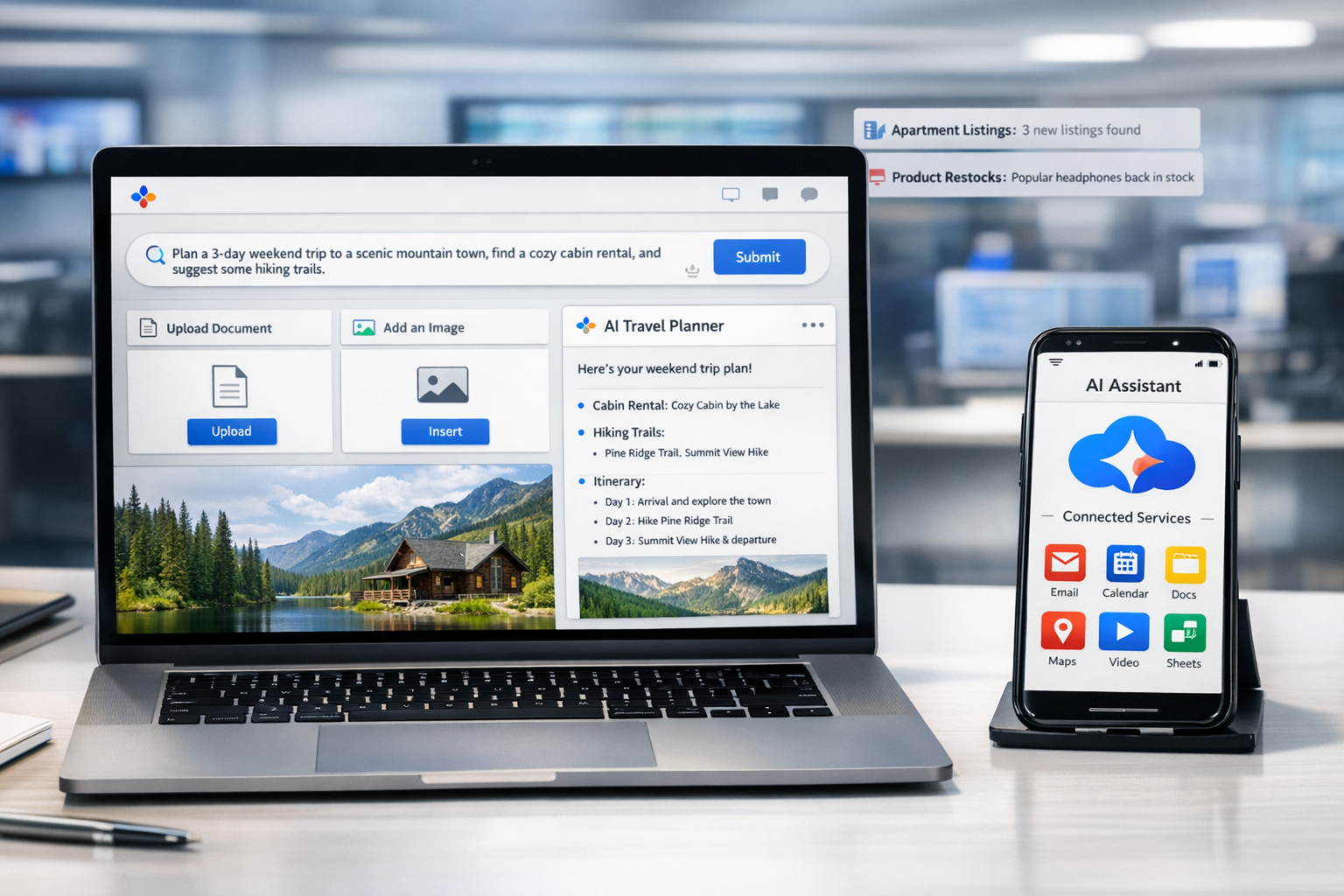
The company’s announcements on May 19 amounted to a broad push toward what Google executives described as an “agentic” future. In Search, Google is folding its AI Mode more deeply into the main product, redesigning the search box to accept longer and more varied inputs, and introducing background agents that can monitor the web for users. In the Gemini app, Google introduced Gemini Spark, a persistent cloud-based assistant meant to remain active around the clock and take actions across Google services with user permission.
For developers, Google tied the strategy together with Antigravity, its increasingly central platform for building AI agents and applications. The same tooling and model family now sit beneath consumer search, the Gemini app, AI Studio and the Gemini API, giving the company a more unified story as it tries to turn its enormous reach into an advantage in the next phase of the AI race.
What emerged from the event was not just a showcase of new products, but a reorganization of Google’s software around continuous delegation: less “search and click,” more “ask, assign and let the system keep going.”
Search’s Biggest Shift in Years
The most visible change came in Search, where Google said Gemini 3.5 Flash is now the default model for AI Mode globally. The company is also blurring the boundary between AI Overviews and AI Mode, allowing users to move directly from a standard search result into an ongoing AI conversation rather than choosing between separate experiences.
The search box itself is being redesigned to better accommodate the kind of longer, more conversational prompts that AI systems favor. It can now take multimodal inputs, including files and other media, a sign that Google no longer sees its core product primarily as a place for short keyword queries.
That matters because the search box is not just an interface element; it is one of the most familiar habits on the internet. For decades, Google trained users to reduce their curiosity into a few words. Now it is encouraging them to hand over full questions, documents, images and follow-up tasks.
Google also said Search will begin offering “generative UI” — interactive visuals and mini-app-like experiences created on the fly — and new Search agents that can monitor the web in the background. A user, for example, could ask Google to keep watching for a specific apartment listing, product restock or market change and receive updates when conditions are met.
The shift is backed by scale. Google says AI Mode has surpassed 1 billion monthly users a year after launch, a figure the company is using to justify moving the experience from the margins of Search toward the center.
Gemini’s New Role: Always On
If Search is becoming a task layer, Gemini is being repositioned as something closer to a standing digital assistant.
Google’s new Gemini Spark is designed as a 24/7 personal AI agent that runs in the cloud rather than only responding when a user opens an app. The company says it can connect with Google products including Gmail, Calendar, Drive, Docs, Sheets, Slides, YouTube and Maps, and act across them under user direction.
That could mean handling scheduling, sending emails, gathering information or carrying out multistep tasks while a user is away. Google has said Spark is beginning with trusted testers and is expected to enter beta next week for U.S. subscribers to its new AI Ultra plan.
The launch puts Google more directly into the emerging competition over persistent personal agents — software that does not just chat, but remembers context, works asynchronously and can spend compute, and in some cases money, on a user’s behalf.
But it also raises immediate questions about safety. Outside researchers and developers have pointed to unresolved risks around prompt injection, data exposure and the broader problem of giving agents access to sensitive personal services. Google has said Spark will run in a managed Google Cloud environment with isolated sessions and protected credentials, but many of the details that would determine how secure that system is in practice remain difficult to verify publicly.
That uncertainty is especially notable because the product’s appeal depends on trust. A chatbot can make an error and be annoying; an always-on agent with access to email, calendars and files can make a much larger one.
A More Expensive AI Stack
The strategy is also being paired with a more explicit monetization push.
Google introduced a new AI subscription structure, including an AI Ultra tier priced at $100 a month, and tied some of its most ambitious agent features to higher-end paid plans. The move reflects a wider industry shift away from simple message caps and toward more consumption-based pricing, as AI systems grow more compute-intensive.
At the center of much of Google’s lineup is Gemini 3.5 Flash, the model now powering AI Mode, parts of the Gemini app and developer offerings. Google is positioning it as a fast, action-oriented workhorse suitable for large-scale deployment. But independent observers have noted that the model is substantially more expensive than previous Flash versions, even as Google is pushing it into products used by hundreds of millions or billions of people.
That points to a larger bet: that agentic AI will not just increase usage, but create enough new value to support higher pricing for developers and more compelling subscription tiers for consumers.
It is a familiar pressure across the industry. As major AI companies pour enormous sums into infrastructure, they are searching for products that can justify those costs. An always-on assistant and a more self-contained, action-oriented Search product offer Google a clearer route to charging for convenience, persistence and automation — not just access to a smarter model.
Google’s Consumer and Developer Worlds Converge
One of the most consequential parts of the announcement may be the least visible to ordinary users. Google is increasingly aligning its consumer products and developer tools around the same architecture.
The company expanded Antigravity as what it calls an “agent-first” platform, added managed agents to the Gemini API, and pushed Google AI Studio further into application generation. Among the new features: the ability to generate a native Android app from a prompt, test it in a browser emulator and publish it to a Play test track.
That blurs the line between using Google’s AI and building on top of it. Search can create lightweight interactive experiences, Gemini can act across apps, and developers can use the same underlying systems to build their own agents and software. The result is a tighter ecosystem in which Google’s models, tools, subscriptions and platforms reinforce one another.
For Google, the appeal is obvious. For years, the company’s AI efforts often appeared fragmented across research, cloud, Android, Workspace and Search. This week’s announcements suggested a more coherent plan: one model family, one agent platform, many surfaces.
Why the Shift Matters Now
The timing reflects both opportunity and pressure.
Google is making this move from a position of unusual reach. It says the Gemini app now has more than 900 million monthly users, and Search remains one of the most important gateways to the web. If the company can convert even a fraction of those users from occasional prompts to ongoing delegated tasks, it could reshape how people use its products — and how Google makes money from them.
At the same time, the company faces intensifying competition from rivals that are trying to define the next dominant interface in computing. The risk for Google has never been simply that another chatbot would answer questions better. It is that users might begin forming new habits somewhere else.
By turning Search into a place where agents can keep watch and generate interfaces, and Gemini into a cloud assistant that remains active between sessions, Google is trying to ensure that the next habit forms inside its own ecosystem.
Still, much of what Google described remains early. Spark is just beginning limited testing. Several Search agent features are slated for this summer or later. And some of the company’s grandest ideas are easier to demo than to deploy reliably at scale.
That gap between vision and availability is important. So are the unresolved consequences. A more self-contained Search experience could further strain publishers that depend on referral traffic. A task-oriented search model could force advertisers and search marketers to rethink how visibility works. And a future built around always-on agents may prove far more vulnerable to security failures than today’s simpler chatbots.
What Google showed this week, then, was not a finished product so much as a direction of travel. Its message was clear enough: the era of typing a query and receiving a page of links is not disappearing overnight, but Google no longer sees that as the center of its future.
Sources
Further reading and reporting used to add context:
- Google Search’s I/O 2026 updates: AI agents and more
- Google AI subscription updates from Google I/O 2026
- https://blog.google/products-and-platforms/products/search/ai-mode-ai-overviews-updates
- 100 things we announced at Google I/O 2026
- https://blog.google/products-and-platforms/products/search/personal-intelligence-ai-mode-search/
- The Gemini app becomes more agentic, delivering proactive, 24/7 help
- https://blog.google/innovation-and-ai/products/gemini-app/personal-intelligence/
- https://blog.google/products-and-platforms/products/workspace/gemini-workspace-updates-march-2026/
- https://blog.google/intl/pl-pl/nowosci-produktowe/io-2026/
- https://blog.google/intl/zh-tw/products/explore-get-answers/search-io-2026/
- https://blog.google/intl/es-419/google-io-2026/
- https://blog.google/intl/id-id/company-news/technology/io-2026-selamat-datang-di-era-agentic-gemini/
- https://blog.google/documents/37/How_Google_Fights_Disinformation.pdf
- https://static.simonwillison.net/static/cors-allow/2025/rimu_kakapo_breeding_brief.pdf
- I/O 2026 developer highlights: Antigravity, Gemini API, AI Studio
- https://blog.google/intl/ja-jp/company-news/technology/google-io-2026-developer-highlights/
- https://blog.google/intl/de-de/produkte/suchen-entdecken/google-io-2026-developer-highlights/
- https://blog.google/intl/pl-pl/nowosci-produktowe/google-io-2026-developer-highlights/
- https://blog.google/intl/es-419/actualizaciones-de-producto/gemini-3-5/
- https://blog.google/intl/fr-fr/nouvelles-de-lentreprise/io-2026-annonces-cles-dveloppeurs/
- https://blog.google/innovation-and-ai/technology/developers-tools/full-stack-vibe-coding-google-ai-studio/
- https://blog.google/intl/zh-tw/products/explore-get-answers/gemini-3-5/
- https://blog.google/intl/ja-jp/company-news/technology/google-ai-studio-io-2026/
- https://blog.google/innovation-and-ai/technology/developers-tools/io-save-the-date-2026-gemini/
- https://developers.googleblog.com/en/all-the-news-from-the-google-io-2026-developer-keynote/
- https://blog.google/documents/159/MBG_Podcast_S2E5_Android_Security.pdf
- https://feeds.simonwillison.net/2026/May/19/gemini-35-flash/
- https://simonwillison.net/?_bhlid=c7dc84246bbe34d49a53c0ce9dacbf4c5e1acf84
- https://simonwillison.net/2026/May/20/google-io/
- https://simonwillison.net/2026/Mar/3/gemini-31-flash-lite/
- https://simonwillison.net/2025/Dec/17/gemini-3-flash/
- https://simonwillison.net/2026/May/
- https://simonwillison.net/2026/Apr/8/muse-spark/
- https://simonwillison.net/tags/google/
- https://simonwillison.net/2024/May/17/understand-errors-and-warnings-better-with-gemini/
- https://simonwillison.net/tags/llm-pricing/
- https://simonwillison.net/2024/May/14/llm-gemini-01a4/
- https://simonwillison.net/tags/prompt-injection/
- https://static.simonwillison.net/static/2024/chrome-headless-page.pdf
- https://static.simonwillison.net/static/cors-allow/2025/attention-all-you-need.pdf
- https://www.androidcentral.com/apps-software/google-is-giving-search-its-biggest-overhaul-in-25-years
- https://www.techradar.com/ai-platforms-assistants/this-new-search-box-does-not-mean-that-youll-only-get-ai-responses-googles-search-makeover-incorporates-yet-more-ai-but-google-promises-to-leave-room-for-classic-results
- https://www.techradar.com/computing/websites-apps/google-search-is-getting-its-biggest-upgrade-in-decades-here-are-the-5-best-new-features
- https://www.techradar.com/ai-platforms-assistants/google-i-o-2026-made-one-thing-clear-gemini-is-becoming-impossible-to-avoid
- https://www.tomsguide.com/ai/google-gemini/google-search-box-just-got-the-biggest-makeover-in-nearly-30-years
- https://venturebeat.com/technology/google-just-redesigned-the-search-box-for-the-first-time-in-25-years-heres-why-it-matters-more-than-you-think
- https://venturebeat.com/
- https://timesofindia.indiatimes.com/technology/tech-news/google-search-gets-its-biggest-upgrade-in-25-years-heres-whats-actually-changing/amp_articleshow/131210762.cms
- https://www.techcityng.com/google-search-ai-upgrade-io-2026/
- https://gadgets.beebom.com/news/google-unveils-ai-first-intelligent-search-box-and-search-agents-at-google-io-2026
- https://techcrunch.com/2026/05/19/google-search-as-you-know-it-is-over/
- https://www.searchengineworld.com/google-search-is-moving-from-links-to-ai-tasks
- https://www.campaignlive.com/article/google-rolls-biggest-upgrade-search-25-years/1958854
- https://www.techmeme.com/260519/p37
- https://rankeo.io/news/google-io-2026-ai-mode-1-billion-users-information-agents
- https://www.worthview.com/google-just-rebuilt-its-search-box-for-the-ai-age-heres-everything-that-changed/
- https://arstechnica.com/google/2026/05/buckle-up-google-is-set-to-remake-search-with-agentic-ai-in-2026/
- https://www.reddit.com/r/grAIve/comments/1til04l/googles_first_search_redesign_in_25_years_an_ai/
- https://www.reddit.com/r/technology/comments/1ti7cer/google_changes_its_search_box_for_the_first_time/
- https://www.reddit.com/r/google/comments/1ti7dgd/google_changes_its_search_box_for_the_first_time/
- https://www.reddit.com/r/SiliconValleyBayArea/comments/1thuyed/google_just_redesigned_the_search_box_for_the/
- https://www.reddit.com/r/ResultFirst_/comments/1tig9ph/google_introduces_new_intelligent_search_box/
- https://blog.google/intl/en-africa/products/explore-get-answers/gemini-3-5/
- https://blog.google/innovation-and-ai/models-and-research/
- https://blog.google/intl/pl-pl/nowosci-produktowe/gemini-3-5/
- https://blog.google/innovation-and-ai/models-and-research/gemini-models/gemini-3-deep-think/
- https://blog.google/products-and-platforms/products/gemini/gemini-3/
- https://blog.google/intl/ja-jp/company-news/technology/gemini-3-5/
- https://blog.google/innovation-and-ai/technology/ai/google-gemini-ai/
- https://blog.google/innovation-and-ai/technology/ai/gemini-collection/
- https://blog.google/documents/83/information_quality_content_moderation_white_paper.pdf
- https://blog.google/documents/77/Googles_submission_to_EC_AI_consultation_1.pdf
- https://blog.google/documents/213/AI_Sprinters_Report.pdf








Leave a Reply