
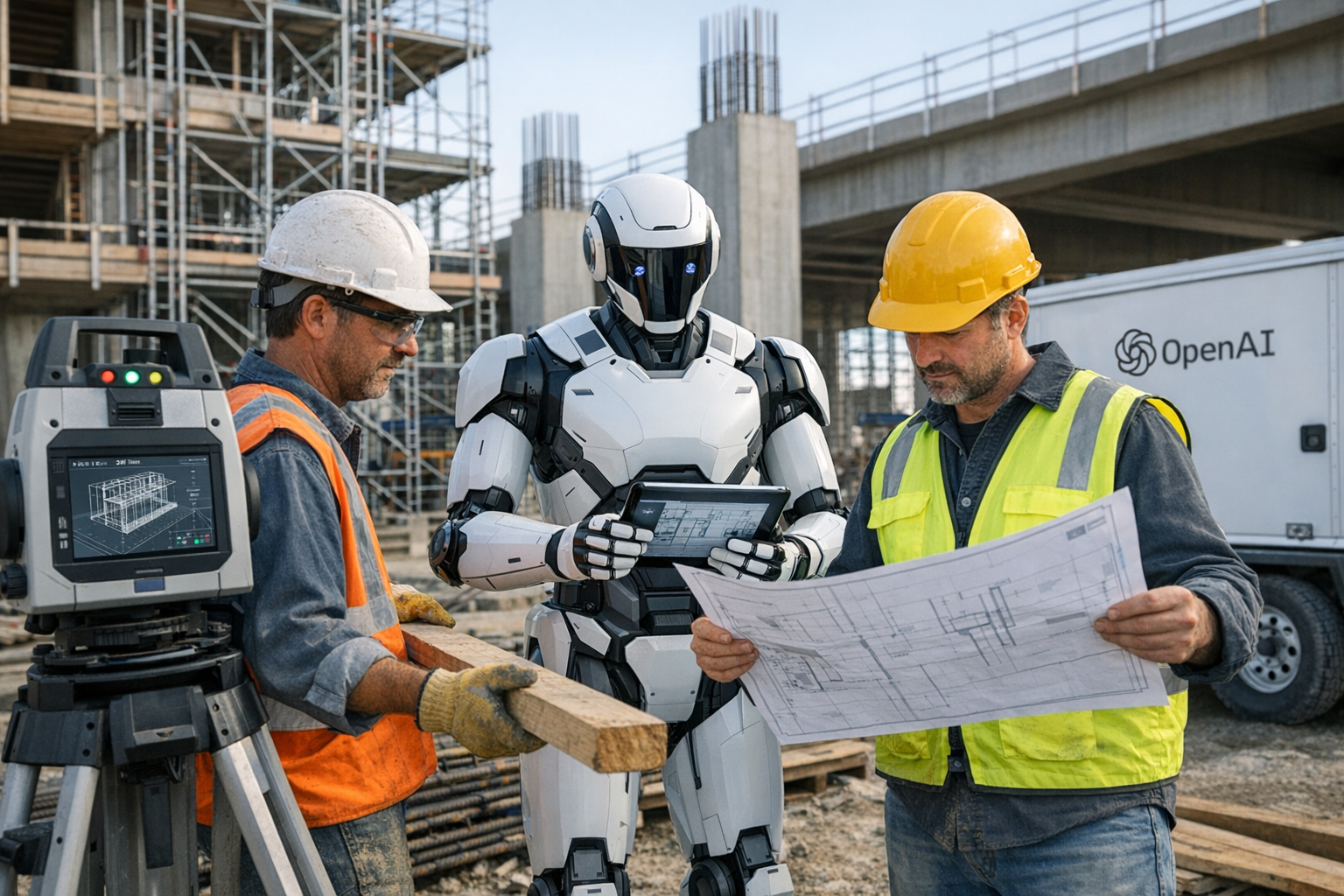
OpenAI Re-enters Robotics, Starting With the Machines That Build
OpenAI, the company whose software has become synonymous with the generative A.I. boom, is moving back into robotics — this time with an ambition that stretches from construction sites to the home.
In a public announcement over the weekend, Sam Altman, OpenAI’s chief executive, said the company had formed a dedicated robotics division out of its world-simulation research efforts. The near-term goal, he said, is to build robots that can assist skilled workers constructing infrastructure. The longer-term aspiration is more expansive: “everyone having a personal robot doing anything they need.”
The announcement marks a consequential shift for one of the world’s leading A.I. labs, signaling that OpenAI increasingly sees the next frontier not only in software agents that can reason and converse, but in machines that can act in the physical world.
Job postings from the company suggest that this is more than a conceptual exercise. OpenAI is recruiting hardware, machine learning, systems and operations engineers for what it describes as a general-purpose robotics effort, with roles spanning simulation realism, data infrastructure and hardware-software integration. The emphasis points to a strategy rooted less in unveiling a consumer gadget anytime soon than in building the technical foundation needed to make robots reliable outside the lab.
That “infrastructure-first” approach reflects a central reality of robotics: moving atoms is harder than generating text.
From World Models to Real-World Machines
The new robotics push appears to have grown directly out of OpenAI’s work on world simulation — research aimed at building systems that can model how the physical world behaves. Those efforts have been seen by many researchers as a critical steppingstone toward embodied A.I., because robots must do more than interpret language or images; they must predict motion, understand cause and effect, and act safely in messy, changing environments.
For OpenAI, the move revives an area it once abandoned. The company shut down its earlier robotics team in 2020, after concluding that progress was being constrained by the difficulty of collecting enough high-quality training data from the physical world. In recent years, however, advances in simulation, multimodal models and compute have changed the calculus. Reporting in 2024 indicated that OpenAI had resumed robotics work, and its latest hiring confirms that the effort has now become formalized.
The shift also aligns with the company’s broader push into infrastructure and hardware. OpenAI has been investing heavily in the computing and systems needed to support ever-larger A.I. models, including major infrastructure initiatives tied to data centers and chips. Robotics, in that sense, fits a broader thesis: that the next wave of A.I. will require not just better models, but an integrated stack of simulation, training systems, sensors, actuators and deployment operations.
Why Infrastructure Comes First
OpenAI’s decision to focus first on robots that support infrastructure work is telling. Construction, industrial projects and related trades offer environments where the value of automation can be high and labor shortages can be acute. They also present tasks that are economically meaningful even if a robot can perform only a narrow set of functions well.
That may be a more realistic entry point than the all-purpose household robot long imagined in science fiction. In homes, robots must cope with almost endless variability: clutter, pets, children, stairs, fragile objects and human expectations of near-perfect performance. On industrial and infrastructure sites, tasks can still be enormously difficult, but they are often more structured and easier to constrain.
In practical terms, that means OpenAI may be targeting systems that augment workers rather than replace them outright — machines that carry materials, perform repetitive handling, inspect sites or assist with specific kinds of physical labor. Mr. Altman’s phrasing, centered on helping skilled workers, suggests an attempt to frame the technology as complementary, at least initially.
Still, the implications for labor could be significant. If major A.I. companies succeed in making robots dependable in real-world work settings, the effects could extend across construction, logistics, warehousing, manufacturing and maintenance. For years, much of the public debate around A.I. focused on office work and digital tasks. Embodied A.I. broadens that debate to the physical economy.
A Crowded and Risky Race
OpenAI is not entering an empty field. A growing roster of robotics and A.I. companies — from humanoid start-ups to industrial automation firms and big technology companies — is pursuing the idea that recent breakthroughs in foundation models can help robots become more adaptable. Investors have poured money into the sector on the belief that general-purpose robotics may finally be moving from aspiration to industry.
What distinguishes OpenAI’s move is the weight of its computing resources, its access to top machine learning talent and its willingness to link robotics directly to frontier model development. That raises the stakes for competitors and adds momentum to the broader industry shift toward embodied A.I.
But there are also substantial unanswered questions. OpenAI has not said what kinds of robots it intends to build, whether it plans to manufacture full systems itself or provide the software “brains” for partner hardware, or when any product might reach real-world deployment. The company has also not publicly detailed its approach to safety governance for physical autonomy — a more complex matter than moderating a chatbot.
Those questions carry particular force because robots can make mistakes with immediate physical consequences. A software model that hallucinates can mislead a user; a robot that misjudges its surroundings can injure someone, damage property or fail in hazardous conditions. Reliability, oversight and clear limits on autonomy are likely to become central issues as OpenAI’s plans develop.
The Timing, and the Tension
The announcement arrives at a moment when enthusiasm around A.I. is being tempered by growing scrutiny of how quickly the technology is being deployed and what priorities companies are setting. Even as many researchers and investors greeted OpenAI’s robotics return as a natural next step, some online responses reflected frustration from users who say the company should focus on improving its existing models before expanding into new domains.
That tension is likely to persist. For OpenAI, robotics offers a compelling narrative about long-term impact: A.I. that does not merely answer questions or write code, but materially helps build roads, energy systems, factories and, eventually, perhaps household life itself. For critics, it raises an old concern in a new form — that companies racing toward transformative futures may be moving faster than their ability to manage the consequences.
For now, OpenAI’s message is less about a robot on the market than about a direction of travel. The company is betting that the path from digital intelligence to physical usefulness runs through simulation, infrastructure and full-stack engineering. If that bet pays off, the arrival of capable A.I. may be measured not only in what appears on screens, but in what begins to move through the world.
Sources
Further reading and reporting used to add context:
- https://the-decoder.com/openai-starts-with-infrastructure-robots-but-aims-for-everyone-having-a-personal-robot-doing-anything-they-need/
- https://digg.com/ai/jhms4h0l
- https://www.winzheng.com/en/article/openai-robotics-hiring-physical-ai-push
- https://www.infobae.com/tecno/2026/01/17/openai-va-en-serio-con-el-desarrollo-de-robots-y-dispositivos-de-ia-ahora-busca-fabricantes-para-lograrlo/
- https://www.axios.com/2026/01/19/openai-device-2026-lehane-jony-ive
- https://www.techradar.com/ai-platforms-assistants/openai/openais-head-of-robotics-resigns-over-pentagon-deal-warning-about-surveillance-and-lethal-autonomy
- https://www.barnacle.ai/intel/briefing
- https://m.economictimes.com/tech/artificial-intelligence/sam-altman-sets-out-openais-three-key-focus-areas-for-next-phase-of-growth/amp_articleshow/130717262.cms
- https://openai.com/index/building-the-compute-infrastructure-for-the-intelligence-age/
- https://www.techradar.com/ai-platforms-assistants/chatgpt/2026-could-be-the-year-we-move-beyond-smartphones-led-by-a-sam-altman-and-jony-ive-designed-ai-device
- https://www.bloomberg.com/news/articles/2025-06-12/video-sam-altman-says-2026-may-be-a-big-year-for-ai
- https://longbridge.com/en/news/285139223
- https://openai.com/index/openai-launches-the-deployment-company/
- https://winbuzzer.com/2026/01/16/openais-hardware-transformation-rfp-signals-shift-from-software-company-to-vertically-integrated-ai-manufacturer-xcxwbn/
- https://www.cityam.com/openai-listing-plans-hit-as-altman-scraps-robotics-spin-off-idea/
- https://en.wikipedia.org/wiki/OpenAI
- https://www.reddit.com/r/IndiaTech/comments/1ttgdug/move_over_chatgpt_sam_altman_is_building_personal/
- https://www.reddit.com/r/DeepSeek/comments/1tt1oln/they_promise_to_bring_robots_to_everyone/
- https://en.wikipedia.org/wiki/Stargate_LLC
- https://openai.com/careers/
- https://openai.com/careers/simulation-realism-engineer-san-francisco/
- https://openai.com/careers/search
- https://openai.com/careers/simulation-applications-engineer-san-francisco/
- https://openai.com/careers/software-engineer-distributed-data-systems-robotics-san-francisco/
- https://openai.com/careers/software-engineer-ml-systems-and-training-architecture-san-francisco/
- https://openai.com/careers/ml-research-engineer-hardware-codesign-san-francisco/
- https://openai.com/careers/research-engineer-frontier-evals-and-environments-san-francisco/
- https://openai.com/careers/datacenter-hardware-operations-technician-ai-compute-infrastructure-stargate/
- https://openai.com/careers/search/?q=Engineer
- https://openai.com/careers/electrical-engineer-robotics-san-francisco/
- https://openai.com/residency
- https://cdn.openai.com/pdf/openai-ostp-accelerating-science-rfi.pdf
- https://cdn.openai.com/global-affairs/ostp-rfi/ec680b75-d539-4653-b297-8bcf6e5f7686/openai-response-ostp-nsf-rfi-notice-request-for-information-on-the-development-of-an-artificial-intelligence-ai-action-plan.pdf
- https://cdn.openai.com/safexp-short.pdf
- https://cdn.openai.com/pdf/93f630b9-e354-4172-960a-90b02d9286c2/Reigniting%20the%20Discovery%20Engine%20for%20Tomorrow%E2%80%99s%20Cures.pdf
- https://cdn.openai.com/papers/dall-e-2.pdf.
- https://www.theinformation.com/briefings/openai-restarted-its-robotics-team
- https://openai.com/index/organizational-update/
- https://techcrunch.com/2025/01/10/new-openai-job-listings-reveal-its-robotics-plans/
- https://www.pcgamer.com/software/ai/openai-hardware-leader-resigns-over-concerns-about-surveillance-of-americans-without-judicial-oversight-and-lethal-autonomy-without-human-authorization/
- https://gigazine.net/news/20240531-openai-reboot-robotics-team/
- https://www.forbes.com/sites/kenrickcai/2024/05/30/openai-robotics-team/
- https://openai.com/index/robots-that-learn/
- https://www.tipranks.com/news/openai-debated-breaking-up-robotics-hardware-division-to-fuel-2026-ipo-plans
- https://techcrunch.com/2024/04/03/openai-backed-ghost-autonomy-shuts-down/
- https://openai.com/index/procgen-minerl-competitions/
- https://openai.com/index/openai-scholars-2020-final-projects/
- https://venturebeat.com/business/openai-disbands-its-robotics-research-team
- https://openai.com/index/roboschool
- https://en.wikipedia.org/wiki/Starsky_Robotics
- https://www.reddit.com/r/OpenAI/comments/vc3aub/openai_is_not_open/
- https://cdn.openai.com/pdf/0ada8797-a5ae-4577-857e-94598d5234d5/2025-04-09-openai-defendants-counterclaims-answer-and-defenses.pdf
- https://www.cna.org/reports/2020/11/DOP-2020-U-028073-Final.pdf
- https://en.wikipedia.org/wiki/Products_and_applications_of_OpenAI
- https://www.reddit.com/r/OpenAI/comments/1r4qexv/an_llmcontrolled_robot_dog_refused_to_shut_down/
- https://en.bloomingbit.io/feed/news/113277
- https://aiweekly.co/alerts/openai-sets-robotics-as-a-core-strategic-priority
- https://www.reddit.com/r/ChatGPT/comments/1tt0un6/openai_robotics_they_promise_a_robot_to_everyone/
- https://www.reddit.com/r/deeplearning/comments/1tt10xx/openai_robotics_they_promise_a_robot_to_everyone/
- https://www.techlusive.in/news/beyond-chatgpt-openai-begins-hiring-to-build-personal-robots-1664419/amp/
- https://www.reddit.com/r/ChatGPTPro/comments/1tt0xap/openai_robotics_they_promise_a_robot_to_everyone/
- https://www.reddit.com/r/ChatGPTcomplaints/comments/1tt1l2a/openai_robotics_promises_to_bring_robots_to/
- https://www.reddit.com/r/AIDiscussion/comments/1tt20hl/they_promise_to_give_everyone_a_robot_soon/
- https://www.pymnts.com/news/artificial-intelligence/2026/sam-altman-says-full-ai-companies-are-possible-but-businesses-are-not-ready/
- https://www.computerworld.com/article/4025052/from-chatbots-to-robots-the-rise-of-physical-ai.html
- https://fortune.com/2023/06/08/openai-ceo-sam-altman-ai-good-at-tasks-bad-at-jobs-for-now/
- https://en.wikipedia.org/wiki/Sam_Altman
- https://www.axios.com/2025/01/10/ai-agents-sam-altman-workers
- https://finance.yahoo.com/news/sam-altman-says-ai-eventually-152157902.html
- https://tech.yahoo.com/ai/articles/sam-altman-says-world-isnt-114001234.html
- https://arxiv.org/abs/1807.05196
- https://www.alignmentforum.org/posts/zRn6aQyD8uhAN7qCc/sam-altman-planning-for-agi-and-beyond
- https://www.cnbc.com/2019/02/26/sam-altman-on-ai-jobs-may-go-away-but-massive-abundance-likely.html
- Altman Says Everyone Will Have a Personal Robot as OpenAI Expands Robotics Push
- Simulation Realism Engineer | OpenAI
- OpenAI Restarted Its Robotics Team — The Information




Leave a Reply