

OpenAI Tests Ads in ChatGPT as It Presses Deeper Into the Workplace
OpenAI is entering a new phase of its business, one that points in two directions at once: toward advertising as a way to support mass consumer use, and toward a more entrenched role inside companies that are beginning to use its tools not simply to answer questions, but to carry out work.
The company said it began testing ads in ChatGPT on Feb. 9 for certain Free and Go users in the United States, marking one of its clearest steps yet to diversify revenue beyond subscriptions. At the same time, OpenAI has published a series of reports and case studies aimed at showing that corporate customers are adopting its products more deeply across engineering, finance and operations.
Taken together, the moves suggest a company trying to balance two imperatives that increasingly define the artificial intelligence industry: how to pay for vast consumer demand, and how to turn experimental workplace use into durable enterprise dependence.
A Delicate Ad Experiment
OpenAI has cast the advertising test as limited and carefully bounded. Ads are labeled as sponsored, the company says, and are kept separate from chatbot answers. They do not appear for users on Plus, Pro, Business, Enterprise or Edu plans, and OpenAI has said conversations themselves are not shared with advertisers.
Targeting, according to the company, may rely on signals from within the product, while users are given controls over personalization.
That structure reflects the central tension of bringing ads into a product that has been marketed as an assistant rather than a feed. Search engines and social platforms have long woven advertising into the user experience, but a conversational A.I. service raises different expectations. Users may be more sensitive to any sign that commercial interests shape responses, especially when the system is used for research, personal advice or work tasks.
OpenAI has tried to address that concern directly by insisting that answers remain independent. Even so, the broader question is whether advertising can become a meaningful business line without eroding trust or making the product feel crowded by commerce.
For now, the rollout is narrow. But it signals that OpenAI, like other technology platforms before it, is testing whether free access at scale can be sustained by something other than premium subscriptions alone.
From Chat Assistant to Work System
If the advertising test is about broadening the funnel, OpenAI’s enterprise push is about deepening its place inside organizations.
The company says more than 2 million business customers now use its products, and its recent materials portray a shift from casual prompting to delegated execution. In OpenAI’s telling, tools like ChatGPT Work and Codex are increasingly being used for longer-running tasks that span departments — not only writing code, but automating operational workflows, producing analyses, coordinating projects and assisting with financial processes.
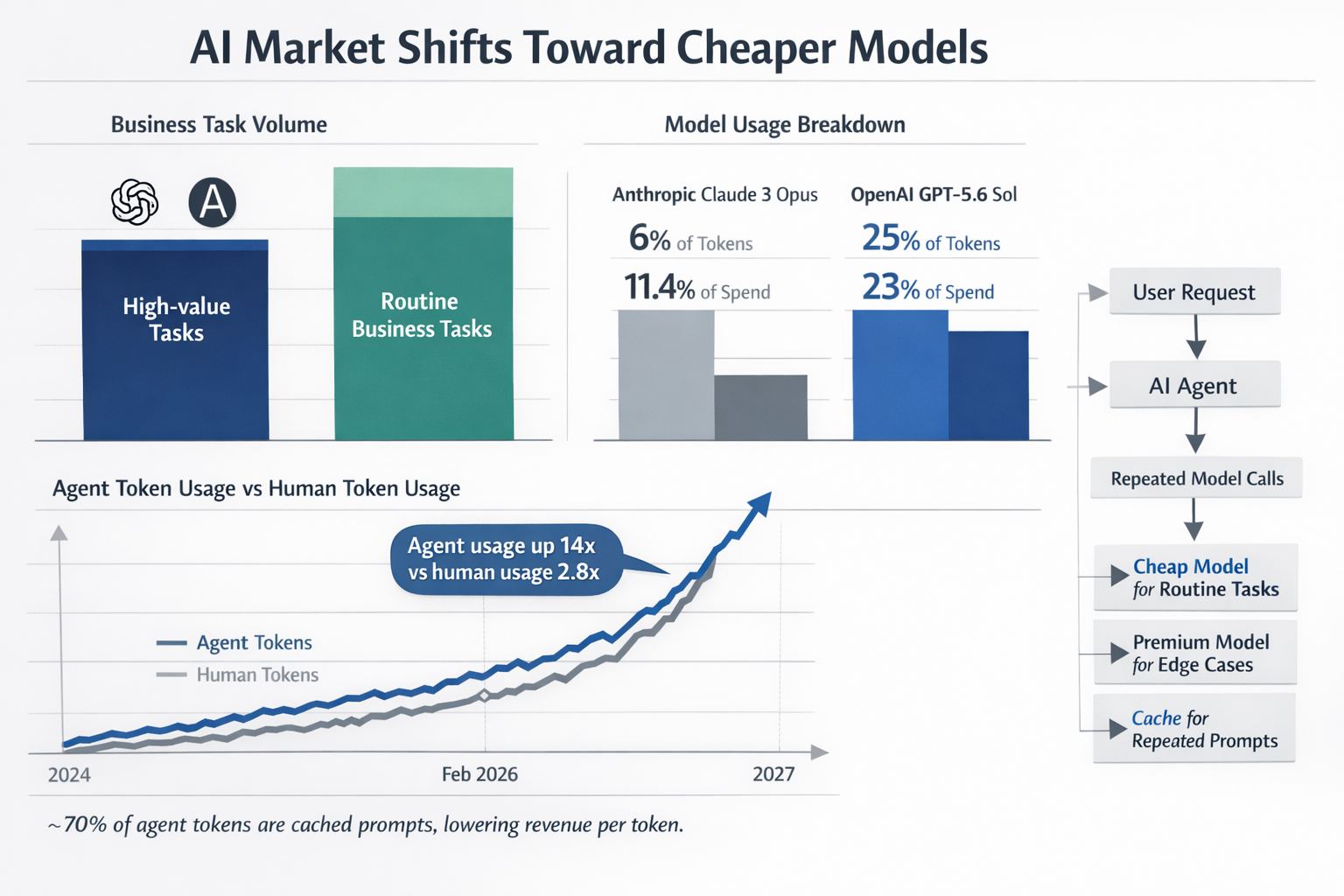
OpenAI’s own research says business message volume has grown eightfold, while reasoning-token consumption through its application programming interfaces has risen 320-fold per organization over the past year. Those figures, if sustained, would suggest that use is not merely spreading to more companies, but becoming more intensive within them.
That distinction matters. Many software tools enjoy a burst of experimentation only to stall before they become essential. OpenAI is trying to show that its products are moving beyond novelty into infrastructure.
A Case Study in Operational Adoption
One of the clearest examples the company has promoted is RingCentral, the communications software provider, which OpenAI says is using ChatGPT Work and Codex across engineering and operations.
The company has described RingCentral’s use as extending beyond technical assistance into cross-tool program management and launch-readiness workflows — the kind of back-office coordination that consumes countless hours in large organizations and often depends on fragmented systems and manual follow-up.
That pitch is central to OpenAI’s current strategy. Rather than selling A.I. merely as a faster interface for individual employees, it is increasingly presenting the technology as a layer that can sit across enterprise systems and help move work from request to execution.
This is also why OpenAI has emphasized “agentic” A.I. — systems that can take on multistep tasks with more autonomy. The promise is not just better answers, but more completed actions.
Finance Joins Engineering and Operations
OpenAI is also pushing the idea that A.I. adoption is no longer confined to software teams.
In a recent account of its own finance operations, Sarah Friar, OpenAI’s chief financial officer, described the company’s efforts to build what she called an “A.I.-native” finance function. The examples included automated forecasting, reporting, variance analysis and tighter controls — areas that executives often view as mission-critical and highly sensitive.
That message serves two purposes. It broadens the addressable market for OpenAI’s workplace tools beyond engineering, where demand for coding assistants is already well established. And it suggests that the company wants to be seen not only as a model provider, but as a maker of enterprise systems that can be trusted with core business processes.
OpenAI has made a similar point elsewhere by presenting itself as a proving ground for its own tools. The company says nearly all of its internal teams use ChatGPT Work and Codex, and outside partners have described OpenAI as “client zero” for an A.I.-native finance model.
For corporate buyers, that framing is meant to reassure: OpenAI is not just selling software for other people’s workflows, it is claiming to run its own business on it.
Why the Timing Matters
The simultaneous push on ads and enterprise deployment comes at a consequential moment for the industry.
Building and operating frontier A.I. systems remains extraordinarily expensive, and pressure to convert usage into dependable revenue has only grown as competition has intensified. Subscriptions have helped, especially among power users and businesses, but they may not be enough to support free-tier demand at internet scale.
Advertising offers one possible answer, though not a simple one. It can subsidize access, but it also imports the incentives and scrutiny that have shaped much of the modern internet.
Enterprise adoption offers another answer, and in some ways a more attractive one: recurring revenue, larger contracts and deeper product integration. But that strategy has its own challenge. Companies often pilot new tools enthusiastically while moving more slowly when it comes to standardizing them across departments, retraining staff and redesigning workflows around them.
OpenAI’s recent messaging appears designed to show that this transition is already underway. Its research argues that frontier firms are pulling ahead because they are using A.I. for execution, not just assistance. The implication is both commercial and competitive: companies that integrate these tools into daily operations may gain an edge, and the vendors that become embedded in those operations may become hard to displace.
The Open Questions
What remains uncertain is how durable either side of the strategy will prove to be.
On advertising, the unanswered question is whether ChatGPT can generate meaningful revenue without undermining the sense that users are receiving neutral help. OpenAI’s safeguards may reduce that risk, but they do not eliminate it.
On enterprise adoption, the company’s evidence points to momentum, yet much of the public record still comes from OpenAI’s own research and selected case studies. It is less clear how easily these gains can be replicated at companies that are less digitally mature, more regulated or less willing to reshape internal processes around one vendor’s tools.
Still, the direction is becoming harder to miss. OpenAI is no longer presenting ChatGPT mainly as a consumer chatbot with a premium tier attached. It is positioning the service as both a mass-market product that may one day carry ads and a workplace platform intended to sit inside the machinery of modern business.
That is a more ambitious role — and a more complicated one — than the company occupied even a year ago.
Sources
Further reading and reporting used to add context:
- https://openai.com/news/ai-adoption/
- https://openai.com/index/how-agents-are-transforming-work/
- https://openai.com/index/introducing-openai-frontier/
- https://openai.com/index/scaling-codex-to-enterprises-worldwide/
- https://help.openai.com/en/articles/20001047-ads-in-chatgpt%25252525252525252525252525252525252525252525252525252525252525252525252525252525252525252525252525252525252525252525252525252525252525252525252525252525252525252525252525252525252525252525252525253F.woff
- https://openai.com/business/guides-and-resources/the-state-of-enterprise-ai-2025-report/
- https://openai.com/signals/research/
- https://openai.com/index/introducing-openai-presence/
- https://openai.com/news/engineering/
- https://openai.com/index/new-ways-to-buy-chatgpt-ads/
- https://openai.com/business/customer-stories/
- https://openai.com/index/1-million-businesses-putting-ai-to-work/
- https://cdn.openai.com/pdf/7ef17d82-96bf-4dd1-9df2-228f7f377a29/the-state-of-enterprise-ai_2025-report.pdf
- https://cdn.openai.com/business-guides-and-resources/building-an-ai-native-engineering-team.pdf
- https://cdn.openai.com/pdf/6a2631dc-783e-479b-b1a4-af0cfbd38630/how-openai-uses-codex.pdf
- https://cdn.openai.com/global-affairs/f319686f-cf21-4b8e-b8bc-84dd9bbfb999/oai-workforce-blueprint-oct-2025.pdf
- https://cdn.openai.com/business-guides-and-resources/a-business-leaders-guide-to-working-with-agents.pdf
- https://cdn.openai.com/business-guides-and-resources/identifying-and-scaling-ai-use-cases.pdf
- https://help.openai.com/en/articles/20001047
- https://help.openai.com/en/articles/6825453-chatgpt-release-notes%2525252525252525252525252525252525252525252525252525252525252525252525252525252525252525252525252525252525253F.webm
- https://help.openai.com/en/articles/6825453-chatgpt-release-notes%2525252525252525252525252525252525252525252525252525252525252525252525252525252523.gz
- https://help.openai.com/en/articles/6825453-chatgpt-release-notes%252520or%25252020260209_ChatGPT%252520Release%252520Notes.pdf
- https://help-lb.openai.com/en/articles/20001047-ads-in-chatgpt
- https://openai.com/index/our-approach-to-advertising-and-expanding-access/?cmid=5cedd7ed-10c0-4f66-b404-5f264342b0f0
- https://help.openai.com/en/articles/20001047-ads-in-chatgpt%25252525252525252525252525252525252525252525252525253F.woff
- https://help.openai.com/en/articles/11989085-what-is-chatgpt-go-1
- https://openai.com/news/?author=martin-abadi
- https://help.openai.com/en/articles/20001047-ads-in-chatgpt%2525252525253F.woff
- https://openai.com/news/?author=emanuel-todorov
- https://openai.com/index/chatgpt-for-your-most-ambitious-work/
- https://openai.com/business/partners/pwc/
- https://openai.com/codex/for-work/
- https://openai.com/business/
- https://openai.com/codex/
- https://openai.com/academy/operations/
- https://help.openai.com/en/articles/20001275-chatgpt-work-and-codex
- https://openai.com/business/guides-and-resources/how-openai-uses-codex/
- https://academy.openai.com/public/clubs/work-users-ynjqu/videos/how-business-operations-teams-use-codex-2026-06-17
- https://cdn.openai.com/pdf/8a9f00cf-d379-4e20-b06f-dd7ba5196a11/OAI_WhitePaper_Codex-maxxing26.pdf
- https://openai.com/news/company-announcements/
- https://openai.com/business/guides-and-resources/identifying-and-scaling-ai-use-cases/
- https://openai.com/business/why-openai/enterprises/
- https://openai.com/chatgpt-work/
- https://openai.com/business/why-openai/small-business/
- https://openai.com/business/partners/
- https://openai.com/business/solutions/sales/
- https://cdn.openai.com/business-guides-and-resources/from-experiments-to-deployments_whitepaper_11-25.pdf
- https://cdn.openai.com/pdf/small-business-jam-report-dec-2025.pdf
- https://cdn.openai.com/business-guides-and-resources/ai-in-the-enterprise.pdf
- https://openai.com/business/solutions/finance/
- https://openai.com/business/guides-and-resources/staying-ahead-in-the-age-of-ai/
- https://openai.com/academy/financial-services/
- https://openai.com/business/guides-and-resources/how-enterprises-are-scaling-ai/
- https://openai.com/index/openai-welcomes-cfo-cpo/
- https://academy.openai.com/en/public/clubs/work-users-ynjqu/resources/use-cases-finance
- https://openai.com/academy/finance/
- https://openai.com/business/learn/
- https://forum.openai.com/public/events/openais-cfo-presents-the-future-of-finance-with-university-of-californias-chief-investment-officer-c9x9nn0lx0
- https://cdn.openai.com/pdf/ae250928-4029-4f26-9e23-afac1fcee14c/staying-ahead-in-the-age-of-ai.pdf?_bhlid=c2894a38d5a20b8122614058a16759b71cb8cfa5
- https://cdn.openai.com/pdf/025ecc00-e528-48dc-95f7-90a96c7be449/frontiers-of-ai-leadership-lessons-guide.pdf
- https://cdn.openai.com/API/docs/deep_research_blog.pdf
- https://cdn.openai.com/policies/global-employee-and-contractor-privacy-policy.pdf
- Ads in ChatGPT | OpenAI Help Center
- Enterprises | OpenAI | OpenAI
- Our approach to advertising and expanding access to ChatGPT | OpenAI
- The state of enterprise AI | OpenAI
- ChatGPT is now a partner for your most ambitious work | OpenAI









Leave a Reply