
A New Set of AI Usage Figures Suggests the Market Is Tilting Toward Cheaper Models
The latest snapshots of how businesses are actually using artificial intelligence are beginning to tell a clearer story about the economics of the industry: the most advanced models do not automatically become the most widely used, and a growing share of demand is coming not from people chatting with chatbots but from software agents calling models over and over again behind the scenes.
Together, recent data from business spending and model-routing platforms points to an emerging split in the market. On one side are premium frontier models that can command attention for their performance but face resistance when their prices rise too far above rivals. On the other are lower-cost models that are “good enough” for a large range of business tasks, especially as companies increasingly build automated systems designed to maximize throughput and minimize cost.
That matters because it cuts against an assumption that has helped define the generative A.I. boom: that each leap in model capability would naturally pull users upward, even at significant expense. Instead, the newest usage patterns suggest many customers are becoming more deliberate, routing only select work to top-tier models while pushing the bulk of tasks to cheaper options.
Anthropic’s Strongest Model Has Not Become Its Most Used
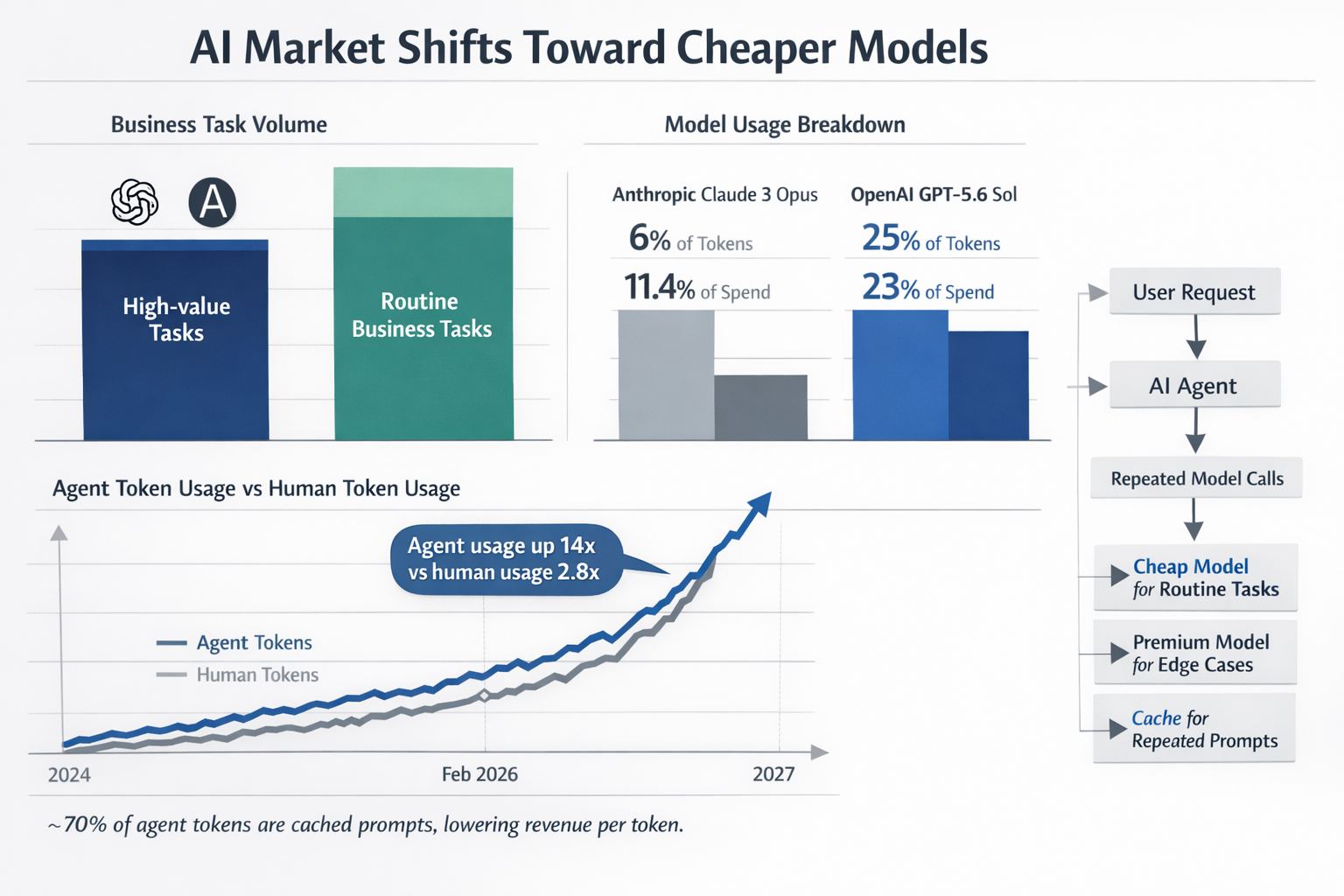
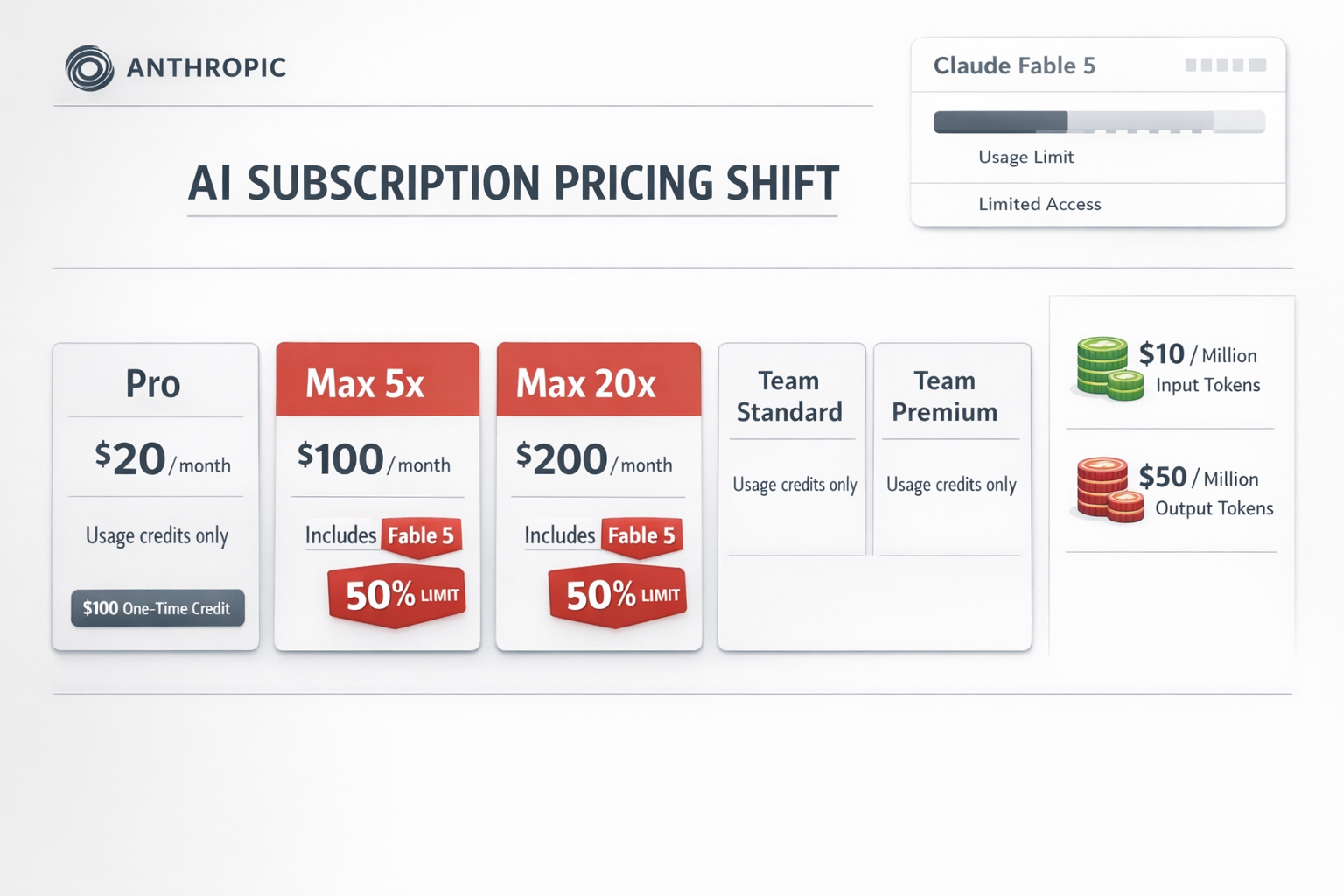
One of the clearest examples comes from Anthropic’s Fable 5, which Ramp’s latest A.I. Index described as the strongest model on the market. Yet in its first month of availability, Fable 5 represented only about 6 percent of Anthropic tokens and 11.4 percent of spending on Anthropic models in Ramp’s data.
By contrast, OpenAI’s GPT-5.6 Sol captured roughly a quarter of OpenAI tokens and 23 percent of spend in the same dataset.
Ramp’s index, based on spending by U.S. businesses using its corporate cards, is not a full census of the industry. But it offers a useful window into what companies are paying for in practice, and the figures suggest that technical superiority alone may not be enough to overcome pricing concerns.
That pattern has been echoed by developers themselves. Drew Breunig, writing recently about Anthropic’s model lineup, said Fable was “incredible” but so expensive that teams began thinking much more carefully about which work truly required it. Opus and rival models, he argued, were already sufficient for most coding tasks.
Such logic increasingly appears to be shaping buying decisions across the market. If a cheaper model solves the problem well enough, many companies seem reluctant to pay a large premium for incremental gains.
Price, Timing and Access May All Be Factors
Fable 5’s muted uptake does not necessarily mean businesses have rejected it outright. Its rollout was unusually complicated. After its June release, access was briefly restricted following new U.S. export controls before broader availability was restored on July 1. Anthropic has also said the model includes stronger safeguards, with certain blocked requests routed instead to Opus 4.8.
Those disruptions may have slowed migration. Enterprises often move cautiously even under normal conditions, especially when adopting a model that may require workflow changes, retesting or new budget approvals.
Still, the early numbers have sharpened a larger question hanging over the industry: whether there is an upper limit to what businesses will pay for frontier A.I. performance. Ramp’s own interpretation was that Fable 5 may have exposed that boundary.
The question is especially pressing because the economics of model development have moved in the opposite direction. Training and serving top-end systems require vast computing resources, and leading labs have been counting on premium products to justify those costs. If customers increasingly mix and match models rather than defaulting to the most powerful one, that could intensify pricing pressure across the sector.
The Fastest-Growing Customer for A.I. May Be A.I. Itself
At the same time, another trend is reshaping demand: the rise of A.I. agents.
Data from OpenRouter, a platform that routes requests across many different models, shows that agentic workloads have consumed more tokens than human users since roughly February 2026. Since then, token usage from agents has grown 14-fold, compared with 2.8-fold growth for human usage.
Those figures suggest that the center of gravity in A.I. consumption may be shifting away from one-off chat interactions and toward automated systems that can plan tasks, call tools, revise outputs and make repeated requests with little direct human involvement.
This is a very different type of demand. Agentic workloads are typically more token-intensive per request than an ordinary chat session because they involve chains of prompts, intermediate reasoning steps, tool use and retries. In effect, each user action can trigger a cascade of model calls.
That dynamic helps explain why cost discipline is becoming more important, not less. When a human asks one question, using a premium model may be manageable. When an agent performs dozens of steps for each task, the economics change quickly.
Why Token Growth Does Not Equal Revenue Growth
Even the surge in agent usage comes with an important caveat. OpenRouter’s analysis found that nearly 70 percent of agent token consumption came from cached prompts, which are much cheaper than fresh model inference. So while raw token volumes are soaring, the underlying cost growth is slower than the headline numbers imply.
That distinction matters for investors and executives trying to gauge where revenue will come from. A world in which machines generate far more tokens than people sounds explosive, but if much of that volume is discounted through caching, the financial upside may be more constrained.
Even so, the broader signal remains significant. Businesses are increasingly building systems optimized around scale, orchestration and efficiency. In that environment, model price becomes a central design variable. Developers can route simple tasks to lower-cost models, reserve premium systems for difficult edge cases and rely on caching wherever possible.
The result is a market that looks less like a winner-take-all race for the single best model and more like a layered infrastructure business, where different models serve different roles based on cost, speed and reliability.
What the Industry May Be Learning
The lesson emerging from these disparate data points is not that cutting-edge models lack demand. Anthropic and OpenAI both continue to report rapid revenue growth, underscoring that enterprise appetite for A.I. remains robust. But the newest evidence suggests that demand is becoming more selective.
For frontier labs, that may mean superior performance is necessary but no longer sufficient. To drive broad adoption, they may also need pricing that works for production systems running at scale. For customers, the priority increasingly appears to be not simply getting the smartest model available, but building a portfolio of models that can handle different workloads economically.
And for the industry as a whole, the significance is hard to miss: as software agents generate more of the traffic, and as companies become more disciplined about what intelligence is worth paying for, the future of A.I. may be shaped less by headline benchmark victories than by the quieter math of routing, caching and cost per task.
Sources
Further reading and reporting used to add context:
- https://www.techradar.com/pro/tokenmaxxing-why-ai-consumption-needs-control
- August 2026 Ramp AI Index: Cracks in the AI thesis
- https://openrouter.ai/blog/insights/deepseek-v4-adoption/
- https://archive.ph/ZLojz/image
- Redeploying Claude Fable 5 \ Anthropic
- https://cryptobriefing.com/openrouter-agentic-token-usage-14x-growth/
- https://intokened.com/en/news/ai-agents-token-usage-openrouter-14x-february
- https://www.briefia.fr/article/openrouter-les-agents-ia-consomment-plus-de-tokens-que-les-humains
- https://aiwiredaily.net/article/2026-08-23-ai-is-becoming-ais-biggest-customer-as-a
- https://www.newsobserver.com/news/business/article316397303.html
- https://creati.ai/ai-news/2026-08-23/ai-becomes-ais-biggest-customer-as-agent-token-use-surges-on-openrouter/
- https://openrouter.ai/state-of-ai
- https://www.ithome.com/0/989/208.htm
- https://www.reddit.com/r/tech_x/comments/1vvk817/humans_are_the_minority_user_of_ai_agents_burn/
- https://www.reddit.com/r/AIGuild/comments/1vwnxth/anthropics_fable_5_accounts_for_only_11_of/
- https://arxiv.org/abs/2604.22750
- https://arxiv.org/abs/2601.10088
- https://www.reddit.com/r/ArtificialInteligence/comments/1vod4ex/anthropic_needs_to_bring_in_amazonstyle_earnings/
- https://cdn.jpmorganfunds.com/content/dam/jpm-am-aem/global/en/insights/eye-on-the-market/semiquincententacles-amv.pdf
- https://www.reddit.com/r/OpenAI/comments/1vtwi5u/openai_growing_faster_than_anthropic_this_quarter/
- https://www.reddit.com/r/aiecosystem/comments/1tpdg7x/a_year_ago_openai_led_anthropic_by_nearly_3x/
- https://openrouter.ai/blog/all/
- https://openrouter.ai/blog/announcements/activity-dashboard/
- https://openrouter.ai/blog/announcements/introducing-the-new-auto-router/
- https://openrouter.ai/blog/announcements/openrouter-is-joining-stripe/
- https://openrouter.ai/blog/tutorials/hermes-agent/
- https://openrouter.ai/blog/insights/the-2025-state-of-ai-report/
- https://openrouter.ai/blog/insights/governing-team-ai-spend/
- https://openrouter.ai/blog/insights/opus-47-tokenizer-analysis/
- https://openrouter.ai/blog/tutorials/team-spend-controls-setup/
- https://openrouter.ai/blog/tutorials/human-in-the-loop-tools/
- https://openrouter.ai/blog/tutorials/prompt-caching-sticky-routing/
- https://openrouter.ai/assets/State-of-AI.pdf
- https://media.ft.com/cms/1e7893f4-d972-11e3-837f-00144feabdc0.pdf
- https://media.ft.com/cms/d697e668-bb52-11e2-b289-00144feab7de.pdf
- https://media.ft.com/cms/d5afead0-68ab-11e0-81c3-00144feab49a.pdf
- https://media.ft.com/cms/25272e3a-bf96-11df-b9de-00144feab49a.pdf
- https://ftalphaville-cdn.ft.com/wp-content/uploads/2017/10/10125452/HelloFresh_Press-Release_10-10-18_EN.pdf
- https://www.fool.com/earnings/call-transcripts/2026/08/11/digitalocean-docn-q2-2026-earnings-call-transcript/?source=iedfolrf0000001
- https://wqu.guru/i/01M0R6GAA0DD4HJTSFP4NNAXWV
- https://s28.q4cdn.com/399982429/files/doc_financials/2023/q3/5b3bbbbb-00f1-45f0-8c82-af15a244236b.pdf
- https://echanges.dila.gouv.fr/OPENDATA/AMF/114/8888/01/FC114623258_20260408.pdf
- https://northerngasnetworks.ams3.digitaloceanspaces.com/wordpress/wp-content/uploads/2024/12/19094950/NGN_2026-31-Business-Plan-1.pdf
- https://mungomash.com/orgs/anthropic/financials/
- https://app.dealroom.co/news/note/anthropic-on-track-for-1b-quarterly-operating-profit-in-q3-says-semianalysis
- https://aidb.digital/blog/2026-08-23-anthropic-projects-10-9b-q2-2026-revenue-and-first-operating-profit-o
- https://static.seekingalpha.com/uploads/sa_presentations/157/76157/original.pdf
- https://xueqiu.com/3226951752/399125125
- https://www.reddit.com/r/investing/comments/1vowf2q/anthropic_is_already_talking_about_200b_in_2028/
- https://www.datasite.com/docs/default-source/reports/datasite-deal-drivers-americas-q3-2023-report-with-mergermarket.pdf
- https://aibusiness.vc/vc/anthropic-30b-raise-900b-valuation-2026
- https://digidai.github.io/2026/02/26/anthropic-ai-safety-first-business-logic-deep-investigation/
- https://s201.q4cdn.com/714390239/files/doc_financials/2025/ar/2025-Performance-Report.pdf
- https://aktien.guide/aktien/DigitalOcean-Holdings-US25402D1028
- https://www.drewsmorningdish.com/
- https://www.washingtonpost.com/podcasts/post-reports/the-end-of-universal-free-school-lunch/
- https://buttondown.com/dbreunig/archive/
- https://drewsmorningdish.youbetterbringanarmy.com/
- https://podcasts.apple.com/us/podcast/decline-of-reading-in-america/id594105889?i=1000783949031
- https://www.challies.com/2026/08/
- https://www.pbssocal.org/shows/newshour/clip/feeding-students-1681672403
- https://www.drewsmorningdish.com/?from=AppAgg.com
- https://www.cbsnews.com/news/free-school-meals-snap-changes/
- https://omny.fm/shows/the-drew-mariani-show/decline-of-reading-in-america
- https://www.nofreelunch.tv/
- https://fee.org/articles/theres-no-such-thing-as-a-free-lunch/
- https://feeds.simonwillison.net/tags/openai/
- https://feeds.simonwillison.net/tags/generative-ai/?page=1
- https://feeds.simonwillison.net/2026/Aug/?page=2
- https://simonwillison.net/2026/May/27/product-market-fit/
- https://simonwillison.net/?trk=article-ssr-frontend-pulse_little-text-block
- https://simonwillison.net/2025/Aug/30/claude-degraded-quality/
- https://simonwillison.net/2026/Jul/21/cat-and-thariq/
- https://simonwillison.net/notes/
- https://simonwillison.net/2026/Aug/?page=1
- https://feeds.simonwillison.net/tags/llms/
- https://feeds.simonwillison.net/tags/claude/
- https://simonwillison.net/2025/Jul/28/anthropic/







Leave a Reply